

The preamble
Similar to the previous post on climate change, without providing an aggregated list of evidences, below links the best books I am aware of that raises the secretive, privately owned, cunning yet corrupt nature of the Central Banking system.
How can a privately owned entity have the power to create money out of nothing, then lend it to governments which in turn is sold as a first tier asset called a bond, and finally to be settled by the unsuspecting tax payer, at an interest rate that they determine and the governments simply submit to?
To make it worse, the Fed dropped the reserve requirements to zero. That’s the float needed to cover withdrawals. So, if a bunch of customers, like you and I, want to withdraw funds, the banks could experience a bank run since there are not enough deposits to cover the demand. This happened to a few US banks in 2023. Some were bailed out and some were bought up. Armstrong blogged extensively on this.
Below, a visual representation of failures on a timeline:
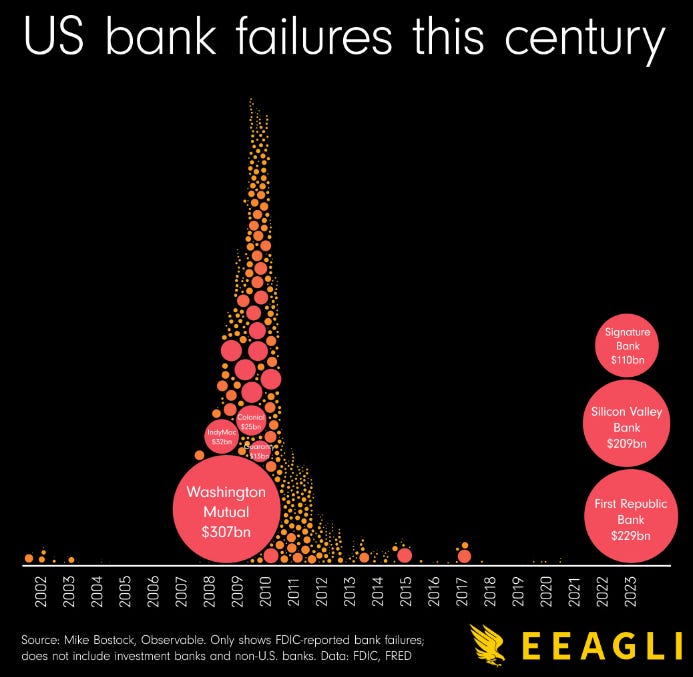
Makes sense why Exodus 22:25-27, Ezekiel 18 and Deut 23:19 frowned upon the practice of charging interest rates. The modern financial system revolves around this entity that's been put in place on Jekyll Island in 1910.
This is nothing new. Fiat currencies have come and gone for millennia. This is the latest edition and it seems we are on the cusp of a transition to a new one in digital form called a Central Bank Digital Currency (CBDC). Feel free to track it here or here and most literature points to implementation gaining momentum in 2025. Nigeria already have one. Go look it up, and the chaos it caused in that country whilst the media remains deathly silent. Also, Zimbabwe is toying with a gold backed one.
No need to ponder the origins of inflation. Each cent the state receives has to be repaid at an interest rate, resulting in an ever deflating currency. They are replaced all the time. The oldest currency in existence today is the pound dating back to 800.
Brazil experienced several resets, even recently. All attributed to the existential threat of hyperinflation, but the underlying cause remains cloaked.
This is a conversation between two grey haired men, that spent their careers in the financial world in the UK and Switzerland, speculating the nature and form that a reset to CBDCs could take.
Those countries that opposed the system, was met with war and fathom. Can’t be, right? Don't take my word on it. Research it yourself. Have a look into Lincoln while you are at it.
Speculation abound that a crises is needed to usher in a currency reset and it happens to coincide with that US’ November 2024 election. There is a reason why the debt ceiling debate was pushed out to January 2025. Expect some turmoil, or rumours of it, in 2024 that Martin Armstrong pointed out several times.
The next two sections summarises books that cover the nature of the Federal Reserve and my customary whydoneit, at the end.
The evidence - book one
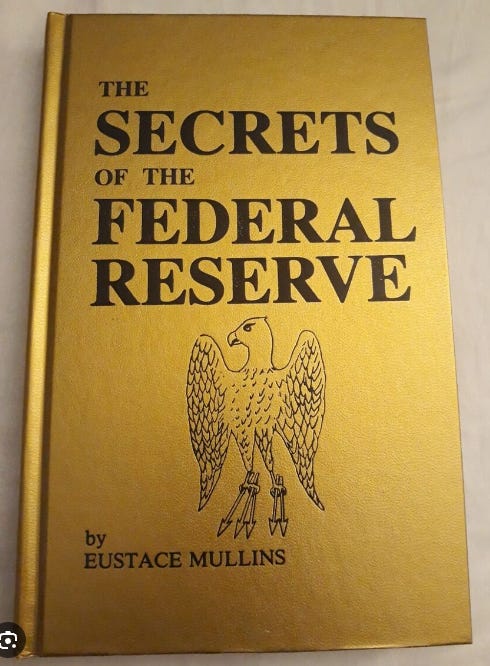
Herewith a summary of Eustace Mullins’ book titled “Secrets of the Federal Reserve“ by copilot:
The London Connection:
The Federal Reserve, despite its name, is not truly federal. It is a private banking cartel.
The controlling interests behind the Federal Reserve are primarily based in London, not the United States.
The Federal Reserve Act of 1913 effectively transferred financial power from the U.S. government to private banking entities.
The London Connection subtly reasserted British influence over American monetary policy.
Jekyll Island Conference:
In 1910, a secret meeting took place on Jekyll Island, where influential figures like Paul Warburg discussed the creation of the Federal Reserve System.
The conference laid the groundwork for the central banking system, which significantly impacted the U.S. economy.
The Federal Reserve’s origins were shrouded in secrecy, and its implementation was carefully orchestrated by powerful interests.
Financial Control and Global Influence:
The Federal Reserve wields immense power over the U.S. economy through its control of interest rates, money supply, and credit.
Its decisions impact not only domestic policies but also global financial stability.
The book argues that the Federal Reserve serves the interests of a small elite, rather than the American people.
Critique of Fractional Reserve Banking:
Mullins criticizes the fractional reserve banking system, where banks create money out of thin air by lending more than they hold in reserves.
This practice contributes to inflation, debt, and economic instability.
The Role of Central Banks in Wars and Crises:
The book explores how central banks, including the Federal Reserve, have played a role in financing wars and economic crises.
Mullins suggests that these institutions benefit from chaos and instability.
And a summary from ChatGPT:
The Federal Reserve is not a government agency: Mullins asserts that the Federal Reserve is not truly a government institution but rather a private banking cartel. He argues that it was created by private bankers and operates for their benefit rather than for the public good.
Control by elite bankers: Mullins contends that a small group of elite bankers, including the Rothschilds and the Rockefellers, have significant control over the Federal Reserve and its policies. He suggests that these bankers manipulate the economy for their own gain.
Origins of central banking: Mullins provides a historical overview of central banking in the United States, tracing its roots back to the Bank of England and the European banking families. He argues that the Federal Reserve was modeled after these European central banks and serves similar interests.
Influence on government policies: According to Mullins, the Federal Reserve has a considerable influence on government policies, particularly monetary and fiscal policies. He suggests that the Federal Reserve works in collusion with government officials to implement policies that benefit the banking elite.
Detrimental effects on society: Mullins posits that the actions of the Federal Reserve have often been detrimental to the interests of the American people. He points to instances of economic instability, inflation, and financial crises as evidence of the negative impact of Federal Reserve policies.
Lack of transparency: Mullins criticizes the lack of transparency surrounding the Federal Reserve's operations and decision-making processes. He argues that the Federal Reserve operates in secrecy, making it difficult for the public to hold it accountable.
Call for reform: Throughout the book, Mullins calls for greater transparency and accountability within the Federal Reserve system. He suggests that the Federal Reserve should be reformed or abolished in order to restore control of the monetary system to the American people.
He wrote several other books including “The-Federal-Reserve-Conspiracy“.
The evidence - book two
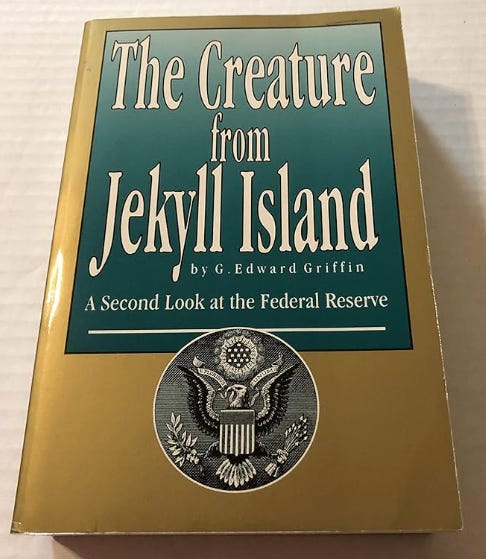
G Edward Griffin wrote a highly respected and top rated book on the topic titled “The Creature From Jekyll Island“.
Herewith the copilot points:
Seven Reasons to Abolish the Federal Reserve:
The Federal Reserve should be abolished because it:
Is incapable of achieving its stated objectives.
Operates for private interests rather than the public good.
Functions as a fiat money system, creating money from nothing.
Generates the most unfair tax: inflation.
Encourages war due to its monetary policies.
The Natural Laws of Money and the Mandrake Mechanism:
Fractional and fiat money systems degenerate into economic chaos.
The Mandrake mechanism describes how government debt is converted into money from nothing, perpetuating instability1.
The Rothschild Formula:
The Federal Reserve has given the most powerful individuals a tool for manipulating geopolitics.
Throughout history, powerful families have played both sides of wars for their own financial gain1.
The Federal Reserve and Global Tyranny:
The Federal Reserve plays a role in a broader agenda of global socialism.
Objective of Global Socialism:
As the world reserve currency, the Mandrake mechanism has international implications.
And a summary from ChatGPT:
Origins of the Federal Reserve: Griffin delves into the secretive meeting that took place on Jekyll Island in 1910, where representatives from powerful banking interests, including J.P. Morgan, Rockefeller, and Rothschild agents, crafted the initial plans for what would become the Federal Reserve System. He argues that this meeting was held in secret to avoid public scrutiny and to consolidate banking power.
Creation of the Federal Reserve: Griffin provides a detailed account of the political and economic climate leading up to the passage of the Federal Reserve Act in 1913. He argues that the legislation was pushed through Congress during a period of crisis and under questionable circumstances, with the true implications of the bill concealed from the public.
Centralization of Banking Power: Griffin contends that the Federal Reserve was designed to centralize banking power in the hands of a few elite bankers, rather than to serve the interests of the American people. He suggests that the Federal Reserve operates as a cartel, with member banks working together to manipulate the economy for their own benefit.
Control of Money Supply: Griffin discusses the Federal Reserve's control over the money supply and its ability to create money out of thin air through the process of fractional reserve banking. He argues that this power allows the Federal Reserve to influence economic conditions and to benefit certain groups at the expense of others.
Debt-based Monetary System: Griffin critiques the debt-based nature of the modern monetary system, in which money is created as debt through the issuance of loans by banks. He argues that this system inevitably leads to cycles of boom and bust, as the economy becomes increasingly dependent on credit and debt.
Inflation and Currency Devaluation: Griffin warns about the dangers of inflation and currency devaluation caused by the Federal Reserve's monetary policies. He suggests that the Federal Reserve's actions erode the value of the dollar over time, leading to a loss of purchasing power for ordinary citizens.
Call for Transparency and Reform: Throughout the book, Griffin calls for greater transparency and accountability within the Federal Reserve system. He argues that the Federal Reserve should be audited and its operations subjected to public scrutiny in order to restore trust and confidence in the monetary system.
The whydoneit
As always: Why is this system in place? Where is this leading? And given the immense level of debt of the US (increasing a trillion dollars every 100 days), what will replace it?
This is complete and utter speculation on my behalf: It seems that the powers to be are struggling to get WWIII going. Perhaps they need to escalate the matter and reveal a Trump card… time will tell.