

Eph 5:11:"…have no fellowship with the unfruitful works of darkness, but rather reprove them.”.
Amos 3:7 “…God will do nothing, but he revealeth his secret unto his servants the prophets.”
Why this post?
To provide evidence of which Bible is accurate and which have been edited.
Introduction
Before I continue with prophecy, I thought to point out that there is some controversy when it comes to which Biblical translation is the most accurate.
Several authors have written volumes on the origins of the Bible, the different versions, its integrity, the content and more. Below is a summary of the main lines of original texts that lead to the number of editions we have today.
Below follow a few evidences that should lead you to also conclude that the King James Version (KJV) is the most accurate and why they burnt Bibles.
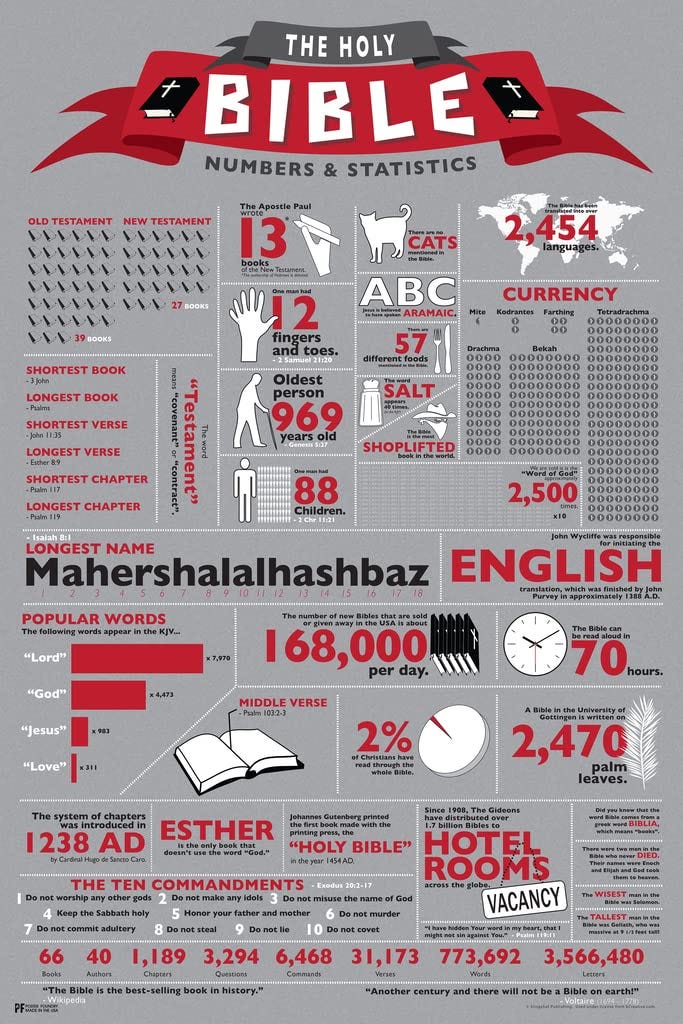
Bible statistics
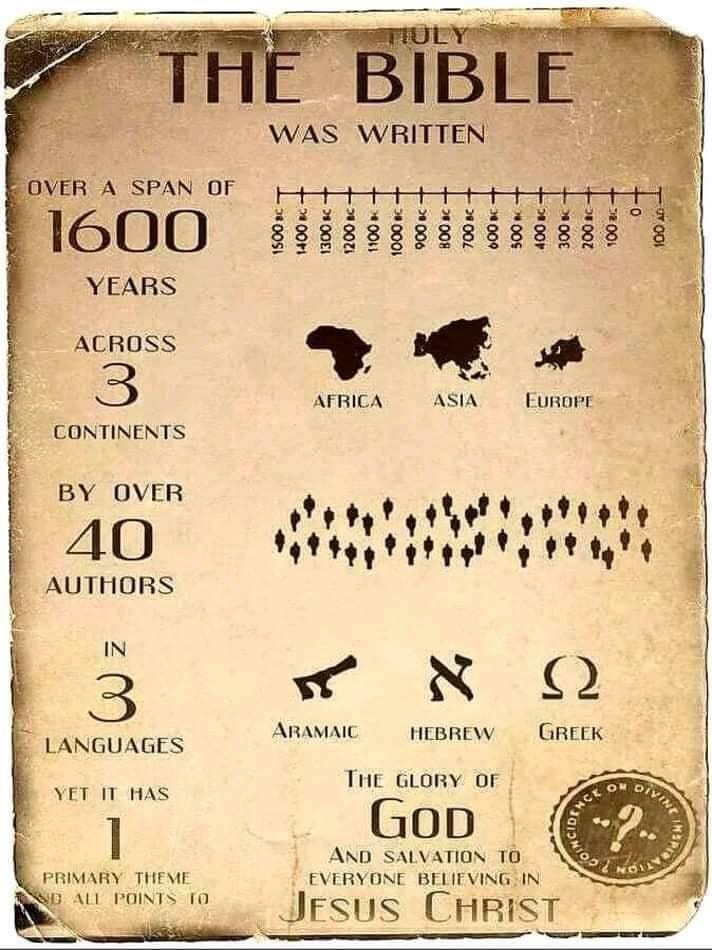
And some fun facts:
Best selling book;
Most stolen book;
185 songs;
Shortest verse: “Jesus wept”;
Kickstarted the printing press.
Consider the insightful comment from a well known scientist bottom right:
The lines
Look at the diagram below carefully. The original New Testament manuscripts — the autograph copies — are lost. They wore out. What survives is copies of copies, in three families.
The central family is what the chart calls the Lost Manuscripts of the Traditional Text — almost identical with originals. Gothic version (4th century). Peshitta Syriac (2nd century). Codex W on Matthew (4th century). Codex A on the Gospels (5th century). And then the vast majority of extant New Testament manuscripts — roughly 1,900 Greek manuscripts, plus thousands more in early translations. They all agree closely with each other. They all feed into the King James Version of 1611. Even the enemies of this text admit that about 19 out of every 20 surviving Greek manuscripts belong to this family.
The left family is the Ancestor of Alexandrian — text an abbreviation of the original. Four manuscripts: Papyrus 75, Papyrus 66, Codex B (Vaticanus), Codex Aleph (Sinaiticus). From these four, Westcott and Hort built their 1881 Greek text. From their text descend the Revised Version 1881, the American Standard Version 1901, the Revised Standard Version 1946, the New English Bible 1961, and most modern translations after that — including the NIV, NASB, NLT, and ESV.
The right family is the Ancestor of Western — text an expansion of the original. Old Latin, the Latin Vulgate (declared infallible by the Vatican), Codex D, Codex D2, Codex E2 — all feeding the Douay (Catholic) Version of 1582.
So when a modern Bible’s preface says it is “based on the most ancient and reliable manuscripts,” the operative word is ancient, not reliable. Modern Bibles descend from a stream of four documents. The KJV descends from a stream of approximately 1,900. Old does not equal good. Numerous does.

The original manuscripts are lost and thus it becomes a matter of which copies reflect the original texts the best, which means we’re back to weighing the evidence.
A very detailed chart of the lineage is available at the bottom from this site. PLEASE NOTE that some key information is not elaborated.
There really is just two lines. Those on the outside lead to spurious versions and the centre does not, but let me provide the evidence.
Codex (plural, Codias) consisted of gatherings, or groups, of pages sewn through the fold along one edge and bound together.
Historical evidence for the left and right lanes
The Sinaitic manuscript was found in a wastepaper basket
The discovery story of the Sinaitic manuscript deserves a slow look. In 1844, Constantin von Tischendorf was visiting St. Catherine’s Monastery on Mt. Sinai when he noticed parchment leaves in a wastepaper basket near the kitchen, ready to be burned for fuel. That was the manuscript. It had been thrown away. By the very monks who possessed it. As scrap.
Why? Because — by the standards of the people who actually used it — it was unreliable. Modern textual analysis confirms what the monks already knew: the document had been rubbed out and rewritten in many places, up to 70 times. Letters and words and sometimes whole sentences had been added, erased, re-written, cancelled, double-written. It was so damaged that the institution which had inherited it deemed it fuel.
That rescued-from-the-fire manuscript is now treated as one of the two foundation stones of every modern English Bible. The next time a translation’s preface says “based on the most ancient and reliable manuscripts,” remember: the people who actually had it threw it in the bin.
I’ve decided not to cover the history in any detail. There are several good sources available and let’s consider the work we have in the hands of the populous today. Before I do that, let me note a few basics:
Around 400BC the Old Testament was complete;
Around 100AD the New Testament was complete;
Only later was the Apocrypha written;
Codex Aleph, also known as the Sinaiticus or Sinai Bible dates back to the 4th Century and only covers the New Testament;
Codex B also known as Codex Vaticanus, now kept at the Vatican, shared the same writing style of, what it seems, two or three scribes and it does not contain all the books;
Both the Sinaiticus and Vaticanus included Apocrypha which does not align at all to the Old and New Testament;
The Vatican declared the Latin Vulgate as infallible;
Wycliffe produced the first true English Bible but it was based on the flawed Vulgate; and
Douay/Rheimes Bible was the first Catholic English Translation.

Many recent Bibles are translated from the Westcott and Hort text riddled with manipulation:

Brief history of the centre lane
This lane’s origin is often referred to as the received text or Textus Receptus which are translations from mostly Greek origins.
Several copies have been found. The sheer volume is significant. These copies are in harmony, many letters quote directly from it.
Politically, the Turks invaded several countries around the Mediterranean causing Greek scholars to flee to Europe. This is when the works fell into western hands.
Erasmus produced a parallel Greek / Latin Bible and may have helped Martin Luther produce the first German NT which lead as the basis of Danish & Swedish translations.
Geographical heartland receipt (place near the existing prose on Erasmus / Luther / Tyndale)
The Textus Receptus did not come from Rome. It came from the Christian heartland.
When the Romans destroyed Jerusalem in AD 70, the Christians fled to Pella in Palestine — taking their scriptures with them. The Syrian Church of Antioch — the original geographical home of the label “Christians” (Acts 11:26) — produced eminent Greek scholarship for centuries. The Italic Church in Northern Italy received its scriptures from the Middle Eastern route, not from Rome — and Northern Italy and Rome quarreled over their differing texts. The Gallic Church in southern France, the Celtic Church in Great Britain before Rome’s later imposition of its rule, the Waldenses in the Piedmont valleys — all of them held to substantially the same text family. So did the Reformation.
The map of where the Textus Receptus survived is the map of where the apostles first preached. The map of where its rival survived is the map of Alexandria and Rome — the two centres of pagan-philosophical syncretism Christianity emerged into conflict with. The geographical receipt has been hidden in plain sight for two thousand years.
Seven times
There were seven waves of attempts to translate the original Greek into English:
William Tyndale, in 1525, published the New Testament. Genesis through 2 Chronicles and Jonah were translated, but published separately, not as a Bible. Tyndale translated as much as possible from the Greek and Hebrew rather than the Latin as Wycliffe did (Wycliffe's translation was not a purification as it was translated solely from the corrupted Latin Vulgate).
He was hunted by the establishment, strangled and burnt at the stake in 1537 - sounds like the apostles.
Myles Coverdale, in 1535, published the first complete English Bible. Coverdale built on Tyndale's work yet translated also from the German and Latin, but not completely from the original languages. Coverdale and Tyndale at times worked on this translation together.
John Rogers, in 1537, (using the pen name of Thomas Matthew) published the Matthew Bible, which combined the best of Tyndale's and Coverdale's work.
Burnt at the stake.
The Great Bible, of 1539, was completed by Myles Coverdale—and called great because of its large size. This Bible used Tyndale's unfinished Old Testament books which were translated from the Latin Vulgate and German translations rather than original the Greek and Hebrew. The Great Bible was also called the Whitchurche Bible after its first English printer, the Cromwell Bible after the one who prepared it for publication, the Cranmer Bible after the preface by Cranmer, or the Chained Bible since it was chained in a convenient place for people to read in the churches.
The Geneva Bible, of 1560, was the first Bible to be translated completely from the original text. William Whittingham, Myles Coverdale, Christopher Goodman, Anthony Gilby, Thomas Sampson, William Cole, John Knox, and John Calvin participated. It was very popular because it was a study Bible with maps and cross references, and was small enough to be used for home study.
Contains hardly flattering comments about the Catholic Church;
If you have one that you want to donate, please contact me.
The Bishops' Bible, of 1568, was translated by Matthew Parker, Archbishop of Canterbury, and his fellow bishops. Because there was no supervisor, the translation practice varies greatly from book to book. They also removed the Calvinistic marginal notes of the Geneva Bible.
The King James Version of 1611, was the seventh purification — God's promise to preserve his pure Word.
Probably dismissed by most as pure chance, but note this verse:
Psalms 12:6-7 King James Version (KJV)
The words of the LORD are pure words: As silver tried in a furnace of earth, purified seven times. Thou shalt keep them, O LORD, Thou shalt preserve them from this generation for ever.
The King James Version
The King James Version (KJV) of the Bible, published in 1611, was translated under the direction of King James I of England.
The translation process took around 7 years and aimed to produce an authoritative and scholarly version in the vernacular English language based on the original Hebrew and Greek texts, while also preserving the familiar ecclesiastical words and style of earlier English translations.
King James appointed a committee of around 50 scholars and linguists who were divided into six groups based at Westminster, Cambridge, and Oxford.
The translators relied primarily on the Masoretic Hebrew text for the Old Testament and the Textus Receptus Greek text for the New Testament.
The translators followed specific rules, including instructions to follow the Bishop's Bible closely and only depart from it when the original Hebrew or Greek permitted it. They were also instructed to retain ecclesiastical words like "church" and to consult Jewish scholars on the translation of Hebrew texts.
The older translations like Tyndale's, Matthew's, Coverdale's, and the Geneva Bible were to be used and followed when they agreed better with the text than the Bishop's Bible.
The proper names of the Hebrew were to be retained as far as possible.
No marginal notes were to be added explaining the text.
Each book went through a rigorous review process involving all six groups. One group would translate a book, and the others would review and cross-check it against the original languages and other translations.
When any company disagreed over the rendering of a word or passage, it was to be noted and referred to a general committee.
After the entire Bible was translated and reviewed by all groups, two members from each group met as a final committee to review and agree upon the unified version to be published.
The KJV included extensive notes, prefaces, and other reference materials aimed at aiding study and understanding of the text.
The T and the Y
Many argue that the text is hard to read but then again details such as the use of T in Thee is singular and Y in Ye is plural.
A word on Luther
Luther was instrumental in breaking away from the spurious versions of the Bible and Christianity. The following stone reflects Luther’s position:

God’s Word and Luther’s writings are poison to the pope and Calvin.
Bible differences
Changes range from removal of words, to sentences to entire verses. Let’s take the example from above (Psalms 12) and compare a few versions:
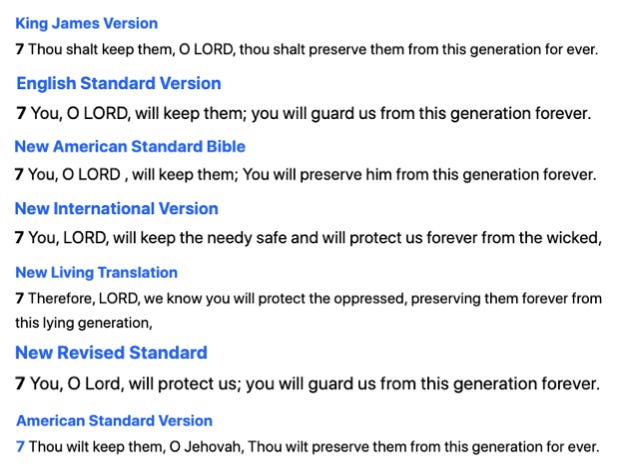
KJV obviously refers to preserving the Word for us. But that’s changed to preserving us, to him (no capital), to the oppressed. How does that convey the same message? The meaning utterly lost in translation. Let’s consider few more from the New Testament:

Some are missing entirely, and witness the attack on Jesus Christ:
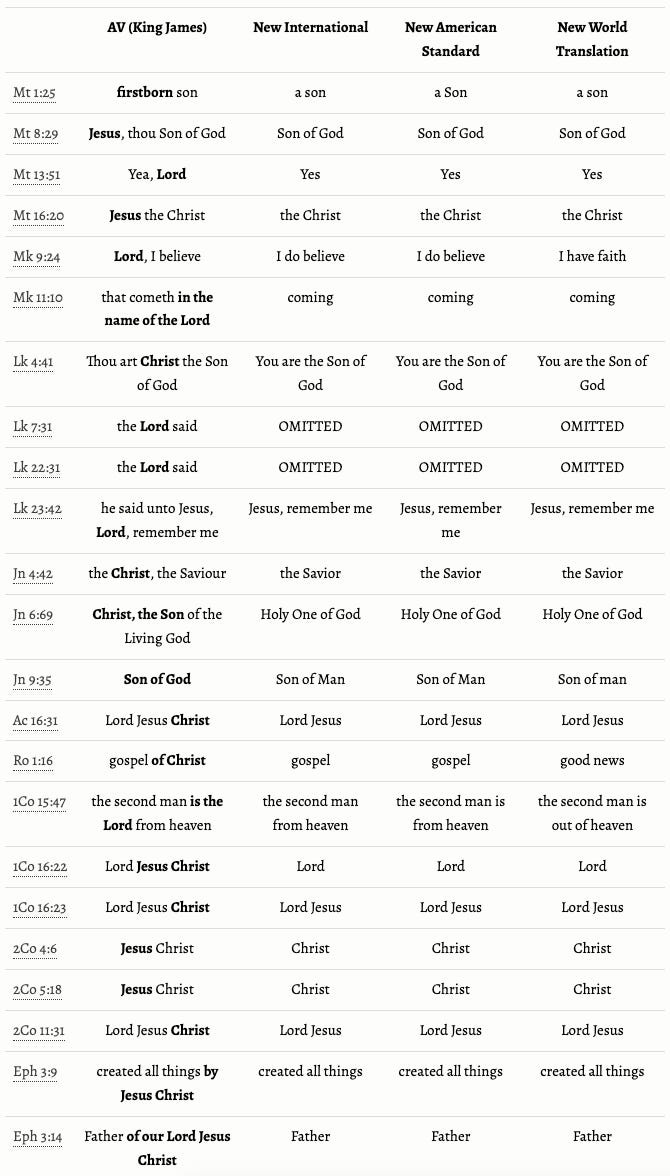
Read the three comparison tables above slowly. Notice that the changes are not random. They cluster.
The Psalm 12:7 cluster is about the preservation of God’s words. The KJV (with the older ASV) preserves the original — the LORD shall keep them, the LORD shall preserve them, where them refers back to the words of the LORD in verse 6. Modern translations — ESV, NASB, NIV, NLT, NRSV — change the antecedent to us, him, the needy, the oppressed. God preserves people in the modern reading. God preserves His words in the original. The promise that there would be a preserved Bible across history was edited out of the very passage that made the promise.
The missing-verses cluster in the second table is about Christ’s mission and authority. Why did Jesus come? To save that which was lost — Matthew 18:11, gone in NIV. To call sinners to repentance — Matthew 9:13, to repentance dropped. Christ our Passover is sacrificed for us — 1 Corinthians 5:7, for us dropped. He that believeth on me hath everlasting life — John 6:47, on me dropped. Joseph and his mother — Luke 2:33, changed to the child’s father and mother, removing the virgin-birth implication.
The Christ-title cluster in the third table is about Christ’s deity. Across 22 passages — Matthew, Mark, Luke, John, Acts, Romans, 1 Corinthians, 2 Corinthians, Ephesians — every “Lord Jesus Christ” attribution shrinks to “Christ” or “the Lord” or simply omits the name; every “Son of God” attribution to Jesus’s identity is softened toward “a Son of God” or “Holy One”; every “by Jesus Christ” creator-clause is removed (“who created all things by Jesus Christ” — Ephesians 3:9 — becomes simply “who created all things” in modern Bibles). The deity of Christ is not denied outright. It is softened. Edit by edit, verse by verse.
Three clusters. Three doctrines under attack. The pattern is not editorial. It is theological.
Here’s a brief video on the matter by Kent Hovind:
And this list goes on.
This is intentional!
Surely it can’t be intentional? Well, consider the quote below:

Dean John William Burgon — Dean of Chichester, one of the 19th century’s most rigorous Greek New Testament textual critics — counted. He counted the omissions, the duplications, the cancelled clauses in the two manuscripts modern Bibles depend on. The numbers are above. In the Gospels alone, Codex B (the Vatican manuscript) leaves out words or whole clauses no less than 1,491 times. Codex Sinaiticus “abounds with errors of the eye and pen to an extent not indeed unparalleled, but happily rather unusual in documents of first-rate importance.” On many occasions 10, 20, 30, or 40 words are dropped through carelessness. Letters and words are written twice over, or begun and immediately cancelled. The gross blunder of accidentally omitting a clause because it ends in the same words as the previous clause occurs 115 times in the New Testament alone.
1,491 omissions in four Gospels. 115 same-ending duplication-skips across the New Testament. And these are the manuscripts modern Bibles call “the most ancient and reliable.” Burgon’s count was published in the 19th century. The numbers have not been disputed since. They have been ignored.
It is a literal attack on the Protestant movement.
What do you think is this little angel doing? It’s tearing apart His Word.


Westcott and Hort — what their own letters say
Now to the men who wrote the Greek text most modern Bibles use. Brooke Foss Westcott (1825-1901) and Fenton John Anthony Hort (1828-1892) — both Cambridge professors, both ordained in the Church of England, both responsible for the 1881 Greek New Testament that displaced the Textus Receptus from English-speaking academia. Their reputations are scholarly and respectable.
Their own letters, however — published after their deaths by their sons in Life and Letters of Brooke Foss Westcott and The Life and Letters of Fenton John Anthony Hort — show something else. Read what they wrote to each other and to their associates over the course of their lives.
Both were Darwinists. Hort to McMillan: “another last word on Darwin — I shall not let the subject drop in a hurry, or to speak more correctly, it will not let me drop.” He wrote that Origin of Species “drove me to the conclusion that some kind of development must be supposed.” Westcott applied the same principle to Genesis — “no one now I suppose holds that the first three chapters of Genesis give a literal history. I could never understand how anyone reading them with open eyes could think they did.” The men revising the Greek New Testament did not believe Genesis 1-3 was historical.
Hort hated the Textus Receptus. Direct quote: “having read so little Greek Testament and dragged on with the villainous Textus Receptus.” He called it vile. The man who wrote the replacement Greek text despised the manuscript family the Reformers preserved.
Both belonged to a Cambridge secret society called The Apostles. Hort, in his published correspondence, says he wrote the oath that “binds the members to a conspiracy of silence.” Documented by Hort’s own son. A conspiracy of silence is the phrase chosen by a man revising the Word of God.
Both founded the Society for the Investigation of Ghosts in the 1880s — which became the Society for Psychical Research. The SPR is now widely acknowledged as the institutional origin of the modern New Age and channeling movements. Edward White Benson, future Archbishop of Canterbury, was a fellow member. The men revising the Greek New Testament were practicing occultists.
Hort believed in purgatory. Letter to Reverend Davies: “the idea of purgation, purgatory, burning your sins off on the other side, of cleansing as by fire, seems to me inseparable from what the Bible teaches us.” Letter to Reverend John Ellerton: “I fully and unwaveringly agree… that the power of repentance is not limited to this life.”
Hort called substitutionary atonement “immoral.” Letter to Westcott: “the popular doctrine of substitution is an immoral and material counterfeit.” The doctrine that Christ died as a substitute for sinners — the heart of the gospel — was, in Hort’s own words, immoral. He wrote that while editing the Greek text from which the modern English Bibles he wanted to displace the KJV come.
Westcott prayed at a Marian shrine. Letter to the Archbishop of Canterbury, after visiting La Salette in France: “had I been alone I would have knelt there for hours.” The man revising the Greek New Testament was kneeling in private at a shrine to Mary. Hort, in a separate letter, wrote: “I have been persuaded for many years that Mary worship and Jesus worship have very much in common in their causes and their results.”
Hort wrote that “human forms are Divine forms.” Letter discussing the divine image: “it is of course true that we can only know God through human forms but then I think the whole Bible echoes the language of Genesis 1:27 and so assures us that human forms are Divine forms.” In plainer English: man is God. This is Masonic and Theosophical doctrine — and it is what Origen taught a millennium and a half earlier, the same teaching that drove Origen to correct manuscripts in line with his philosophy of mystical and allegorical ideas. Hort followed Origen. The Greek text most modern Bibles use was edited by an occultist who believed humanity is divine.
Both believed Protestantism was “parenthetical and temporary.” Hort to Westcott: “protestantism is only parenthetical and temporary.” Faber, an associate of Newman in the Oxford Movement which sought to return the Church of England to Rome, said the same thing in plainer language: “protestantism is perishing… my whole life, God willing, shall be one Crusade against the detestable and diabolical heresy of protestantism.” Westcott and Hort were sympathisers of that Oxford Movement.
And finally, the strategy. Hort’s own letters describe how the new text was to displace the old — gradually. “As to our proposed recension of the New Testament text, our object should be I suppose to prepare a text for common and general use. With such an end in view, would it not be best to introduce only certain emends [only change it a little bit here and a little bit there] into the received text, and to take note in the margin… so that when they read it and they read the margin they’ll see, oh yes, this probably shouldn’t be that, because an early manuscript [a corrupt one] doesn’t have it.” The plan was trifling alterations — small enough to escape notice individually, cumulative enough to alter doctrine. “The difference between a picture say of Raphael and a feeble copy of it is made up of a number of trivial differences.” Hort knew exactly what he was doing.
Now read the modern Bible’s preface again — “based on the most ancient and reliable manuscripts… revised by the leading scholars of the late nineteenth century.” The leading scholars were a Darwinist who hated the Textus Receptus, an occultist who edited the Word of God by a “conspiracy of silence,” a man who called the atonement “immoral,” and a Marian-shrine-kneeler who believed Protestantism was a parenthesis. Their letters are public. Their conclusions are documented. The receipts are above.
Roman Catholic doctrines smuggled into modern Bibles
The pattern of the changes is not random. It is doctrinal. Read the categories below. Each one is a Roman Catholic distinctive that the Reformers rejected — and each one is now recoverable from a modern English Bible by a Catholic apologist who knows where to look.
Purgatory. Hebrews 9:27 — KJV: “after this the judgment.” NIV: “after this to face judgment.” The article change opens space for an intermediate state between death and judgment. Plus Luke 1:72 — KJV: “to perform the mercy promised to our fathers.” NIV: “to show mercy to our fathers.” The dead can apparently still receive mercy in the modern reading.
The confessional. James 5:16 — KJV: “confess your faults one to another.” NIV: “confess your sins to each other.” The Dublin Review, a Catholic publication, celebrated this exact change in July 1881: “The apostles have now power to forgive sins and not simply to remit them.”
A separated priesthood class. Hebrews 10:21 — KJV: “high priest” (one priest, Christ Himself). NIV: “great priest” (implies a class — some great, some less). Plus Acts 15:23 — a comma change merges apostles, elders, and brethren (three groups, the priesthood-of-all-believers reading) into apostles and elders writing to the brethren (two groups, a clergy/laity divide).
Transubstantiation. 1 Corinthians 11:29 — KJV: “For he that eateth and drinketh unworthily, eateth and drinketh damnation to himself, not discerning the Lord's body.” NIV: “For those who eat and drink without discerning the body of Christ eat and drink judgment on themselves.” The KJV’s “unworthily” clause is dropped, opening space for the Roman reading that the bread is the body literally.
Sabbath softened. Acts 13:42 — KJV: “when the Jews were gone out of the synagogue, the Gentiles besought that these words might be preached to them the next sabbath.” NIV: “as Paul and Barnabas were leaving the synagogue, the people invited them to speak further on the next sabbath.” Removing “the Jews” removes the literal-Saturday context — the “sabbath” could now be any day.
Food laws abolished by addition. Mark 7:19 — KJV: “because it entereth not into his heart, but into the belly, and goeth out into the draught.” NIV: ADDS “In saying this, Jesus declared all foods clean.” Those words are not in the Greek. They are an editorial commentary smuggled into the verse itself.
The Trinity verse, gone. 1 John 5:7 — KJV: “For there are three that bear record in heaven, the Father, the Word, and the Holy Ghost: and these three are one.” The single most explicit Trinity prooftext in the New Testament. Removed from the NIV, NASB, ESV, and most modern translations. The remaining trinitarian doctrine has to be deduced from other passages; this one stated it.
The deity of Christ softened. Across the comparisons in the Bible differences section above — every Lord Jesus Christ shrinks to Christ or the Lord, every Son of God attribution to Jesus’s identity is softened, every by Jesus Christ creator-clause is removed.
The verse-count summary: the New American Standard Bible has 909 verses changed from the Textus Receptus. The NIV has 695. The New World Translation (the Jehovah’s Witness Bible) has 767. The Douay — the actual Jesuit Bible of 1582 — has fewer changes than the NASB. Read that twice. The modern Protestant Bible has been edited more aggressively away from the Textus Receptus than the historical Catholic Bible was.
Bible lineage in detail
Here’s a very detailed history of the various versions as they arose from the different source languages:

Museum of the Bible
So the day you visit the Museum of the Bible in Washington, please remember which version to check out. See this reviewers comments here.
If buying old Bibles is your thing. First edition of the KJV for $150,000.
whydoneit?
Why would they change the text? I think their own words said it all.