

Religious 30: Does the law matter?
Eph 5:11: “…have no fellowship with the unfruitful works of darkness, but rather reprove them.”
Amos 3:7: “…God will do nothing, but He revealeth His secret unto His servants the prophets.”
Why this post?
To show, with scripture, that God’s law still stands — and that without it, the cross makes no sense.
Something personal
This is probably the 2nd most important article I shall ever write. And the longest to date. The first would be on why to believe in Jesus, but there is a mountain of books, articles and videos on the topic. No point in aggregating those.
When you’ve spent hours and hours aggregating, researching and understanding, sometimes the gravity of the material humbles you. Below one of those: a labor of love.
It starts with a brief intro and then follows a 2-act structure: Past & Future.
Introduction
Here is the cleanest argument in Christianity, and most pastors avoid it.
If God’s law was abolished at the cross, then Jesus died for nothing.
Follow the chain. No law, no transgression. No transgression, no sin. No sin, no penalty. No penalty, no need for a substitute. The cross either establishes the law, or it empties itself of meaning. There is no third option.
And yet — walk into most Protestant churches on any given Sunday and you will be told, in one way or another, that the law is done. That we are “under grace.” That the Ten Commandments belonged to Moses and the Jews. That to speak of keeping the commandments is legalism. That God has moved on.
It’s not true. It was never true. And the moment we follow the evidence, the whole sanctuary doctrine falls into place, Article 12 on the judgement becomes unavoidable, and the prophetic outline of end-time events — the mark, the beast, the remnant — starts to make sense in a way that is, frankly, terrifying.
This post is the missing pillar. I’ve written about Rome, about the beast, about the timelines, about the mark, about the judgement. None of that matters if the law doesn’t. So let’s settle this one.
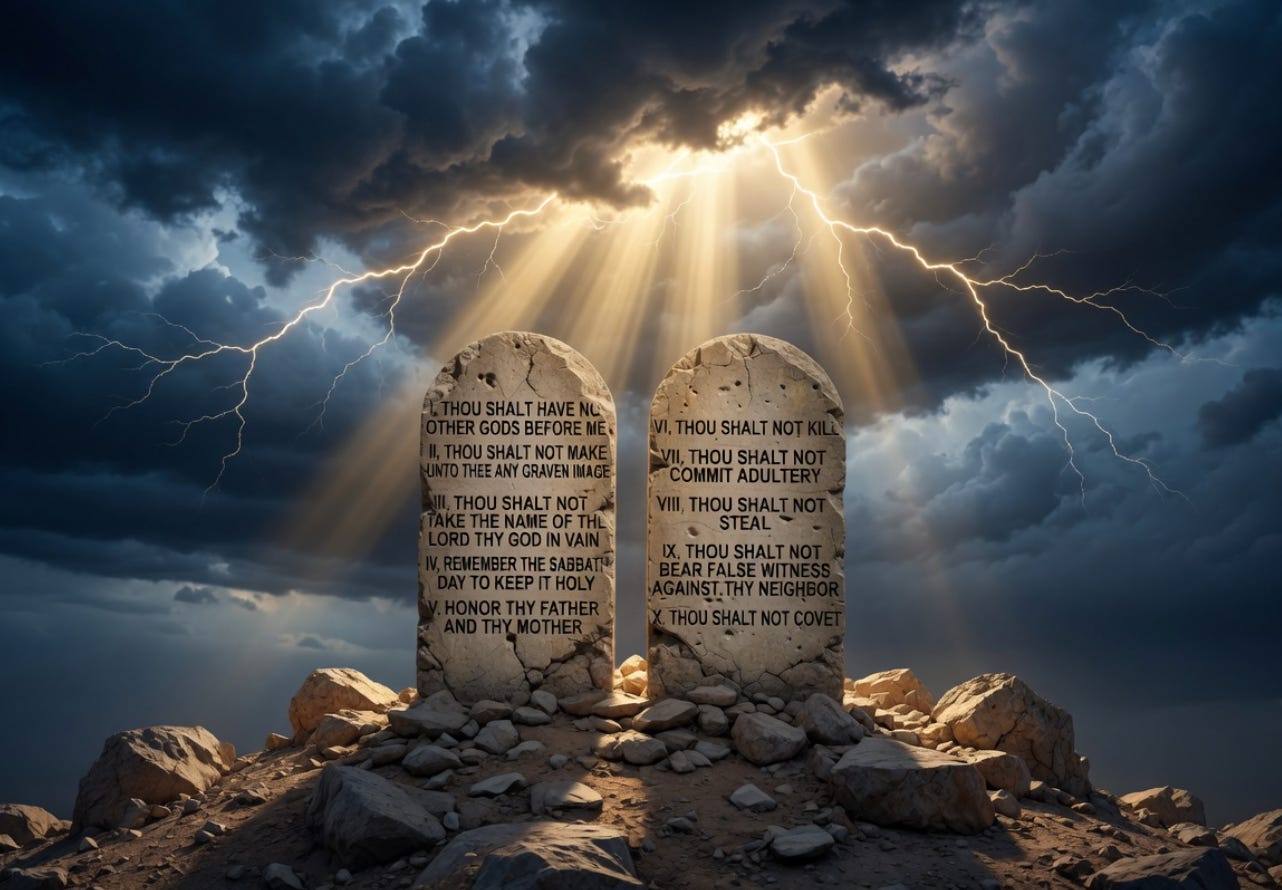
The whole thing in one paragraph
Before the deep dive, here’s the story in simple terms. God gave a law that defines right and wrong. We broke it. The penalty is death. God, being just, cannot wave that away without ceasing to be God. He is 100% just and 100% mercy. So God became man, lived sinless under that same law, and took the penalty in our place. The sacrificial system of the Old Testament pointed to Him before He came. The sanctuary doctrine explains what He’s doing right now. The law still stands — His death proves it. Our part is to accept the gift, confess where we fall, and let Him write the law on our hearts. That’s it. Everything below is just evidence.
If you stop reading here you’ve got the core. If you keep going, I’ll prove it.
ACT 1 - The past
The first law, the first lie - tree of knowledge
Before Sinai. Before Abraham. Before Cain and Abel. Before there was even a second human being to sin against.
There was a tree. And there was a command.
Genesis 2:16-17 — “And the LORD God commanded the man, saying, Of every tree of the garden thou mayest freely eat: But of the tree of the knowledge of good and evil, thou shalt not eat of it: for in the day that thou eatest thereof thou shalt surely die.”
Stop and read what this verse actually does.
It is the first explicit law in the Bible. Given by God himself. Spoken directly to humanity. With a stated penalty for violation. In a world where no sin had yet entered. And everything we argue below across this whole post — everything — is already operating in that one sentence.
Law existed before sin. The command is given in a perfect, unfallen world. Which destroys the common assumption that law is only a thing for fallen people, that grace somehow makes law irrelevant. Law was there before grace ever needed to exist. God’s first recorded interaction with humanity, after giving them a garden and a wife, was giving them a law.
Law existed before Moses. By roughly 2,500 years, depending on your chronology. The idea that the law was “given at Sinai” is only half true. What was given at Sinai was the written, codified, publicly proclaimed version of a law that had been in force since the morning of creation. Sinai was the public declaration. A reminder. Eden was the original.
Transgression requires a pre-existing law. Eve could not have done wrong if there had been no command. The whole episode only makes moral sense because the command existed before the violation. Paul’s logic in Romans 4:15 — “where no law is, there is no transgression” — is already operating in Genesis 3. The Bible’s very first sin is proof that the Bible’s own definition of sin (1 John 3:4 — “sin is the transgression of the law”) was in force before the fall.
The penalty for breaking the law is death. “Thou shalt surely die.” The same penalty attached at Eden is the same penalty Paul names in Rom 6:23 — “the wages of sin is death.” Not a new rule. Not a Sinai innovation. The original terms, unchanged.
God does not change. The penalty in Genesis 2 is the penalty Jesus pays on Calvary. Which means the law hasn’t changed either. If the penalty had been adjusted, or if the law had been withdrawn, Jesus’ death would have been unnecessary. The continuity of the penalty proves the continuity of the law.
Free will was engineered in from the start. The tree existed. The fruit was reachable. Adam and Eve could pick it up at any moment. God didn’t put a fence around it. He didn’t place an angel with a sword to prevent access. He gave a command and left the choice open. This is the same God we meet in John 12:32 and Revelation 22:17 — He draws, He invites, He warns, but He never coerces. The tree of knowledge is the first proof that God values human freedom enough to permit the possibility of its misuse.
One command. Six doctrines. Before the earth had seen a single sin.
The serpent’s three moves on Eve
Now — and this is the part every modern reader needs to see — look at what Satan does in Genesis 3:1-5. Because his three opening moves are the exact three moves still being made today to talk Christians out of the law.
Move 1. Question whether God really said it.
Genesis 3:1 — “Yea, hath God said, Ye shall not eat of every tree of the garden?”
Notice he doesn’t deny the command outright. He doesn’t say “there’s no law.” He just questions whether it really means what it plainly says. Maybe you’ve misunderstood. Maybe God meant something else. Maybe the command is more ambiguous than you thought.
The modern equivalent is every single one of the counter-verse arguments we dismantle below in the section on abused verses. “Hath God really said the law still applies? Paul says we’re under grace. Hebrews says the covenant is old. Jesus says He came to fulfil it — so maybe ‘fulfil’ means ‘end.’” Every hermeneutical trick that softens a clear command is a direct descendant of the serpent’s opening question. The words change. The move doesn’t.
Move 2. Deny the penalty.
Genesis 3:4 — “Ye shall not surely die.”
The first recorded lie in scripture. God said “in the day you eat it, you shall surely die.” Satan said “you shall not surely die.” That’s it. That’s the whole lie. No penalty means no consequence. No consequence means the law is effectively toothless. A law with no enforcement is no law at all.
The modern equivalent: “we’re under grace, so the law doesn’t apply to us anymore.” Same move. Different century. The claim is that God’s justice has been suspended, that the penalty no longer reaches us, that we can break the command without facing the consequence. It is the direct echo of Eden, in Christian vocabulary. And it is just as false.
Notice too what Satan’s lie accidentally affirmed. He didn’t say “there is no command.” He said “you shall not surely die.” Even in the act of denying the penalty, he conceded the law existed. You cannot deny a penalty that attaches to nothing. He knew the law was real. He was just betting Eve could be talked past it.
Move 3. Offer autonomy in place of obedience.
Genesis 3:5 — “For God doth know that in the day ye eat thereof, then your eyes shall be opened, and ye shall be as gods, knowing good and evil.”
Ye shall be as gods. This is the heart of it. The offer isn’t really about fruit. The offer is that you get to decide what is good and what is evil. You don’t need an external standard. You don’t need a God telling you what is right. You can be your own authority. You can define morality for yourself.
The modern equivalent is everywhere. “My faith is personal.” “I don’t need rules to have a relationship with Jesus.” “God knows my heart.” “Who are you to tell me what’s sin?” In every case the underlying claim is the same — that I, the individual, am the final arbiter of what is acceptable behaviour. The Ten Commandments become suggestions. The law becomes advisory. Each person sits on their own throne, deciding.
It is not a new doctrine. It is the oldest doctrine in the book, going back to chapter three.
Six thousand years, same script
Satan has not updated his playbook because he has not needed to. The three moves that worked on Eve — question the command, deny the penalty, offer autonomy — are the three moves that work on modern Christians. Every sermon that tells you “the law is done” is running some combination of these three. Every pastor who preaches grace as a replacement for law rather than as the solution to law-breaking is, whether they know it or not, repeating the serpent’s lines to a new audience.
And the Bible bookends itself to make the point. It opens with a tree and a command broken. It closes with a tree and a command kept:
Revelation 22:14 — “Blessed are they that do His commandments, that they may have right to the tree of life, and may enter in through the gates into the city.”
(One day I hope to know what it in this fruit allows us to live forever.)
One tree in Eden, forbidden because of sin. One tree in the new earth, welcomed because sin is finally done with. The frame of scripture is a commandment frame. The story begins with a law and ends with a law-keeping people restored to the garden. Anyone who tells you the middle of the story involves the law being cancelled is not reading the same book.
The second Adam in the wilderness
Four thousand years later, give or take, the same adversary met the same species in the same kind of encounter — and this time, the species won.
Jesus had just been baptised. The Spirit had descended like a dove. The voice from heaven had said “This is my beloved Son, in whom I am well pleased” (Matt 3:17). And then — immediately — the Spirit drove Him into the wilderness to be tempted of the devil.
Think about the setup. Forty days. No food. The weakest physical condition a human body can survive. Alone in the desert. And the same entity that had once walked into the garden to find an unfallen Eve now walked into a wilderness to find a hungry, exhausted Jesus. Paul explicitly frames this moment:
1 Corinthians 15:45 — “And so it is written, The first man Adam was made a living soul; the last Adam was made a quickening spirit.”
Jesus is the second Adam. The first one fell in a garden with every advantage — full belly, perfect climate, a companion, an unmarred relationship with his Creator. The second one stood in a wilderness with every disadvantage — starving, drained, alone, in our fallen nature. The contrast is deliberate. If Eve could have been spared temptation by better conditions, God would have engineered better conditions. The issue was never the conditions. The issue was the choice.
And the serpent’s playbook, in forty centuries, had not changed a single word.
Move 1 — Question the command
Matthew 4:3 — “And when the tempter came to him, he said, If thou be the Son of God, command that these stones be made bread.”
Read it carefully. This is not just “do a miracle.” This is a direct attack on the declaration God had just made at the Jordan — “This is my beloved Son.” Satan starts with “If thou be the Son of God” — planting exactly the doubt he planted in Eden. “Hath God really said?” becomes “If thou really art the Son.” Question whether God meant what He said.
And then comes the bait. Use your power to meet your own physical need. Step outside the Father’s provision. You are hungry; surely God wouldn’t want you hungry; surely the rule doesn’t apply here.
Jesus’ answer is a direct quotation — not a philosophical reply, not a debate, not a clever counter. Scripture:
Matthew 4:4 — “But He answered and said, It is written, Man shall not live by bread alone, but by every word that proceedeth out of the mouth of God.”
That’s Deuteronomy 8:3. The law. And notice specifically “every word that proceedeth out of the mouth of God” — not some words, not the ones we like, not the ones that are convenient when we’re hungry. Every word. The same God who gave the command at the Jordan is the God whose word we live by, even when that word means going hungry in a wilderness.
Where Eve second-guessed the command, Jesus quoted it. Where Eve reasoned with the serpent, Jesus refused to negotiate. The fruit was on the tree. The stones were at His feet. The lesson was the same in both cases — God’s word is not adjusted by our circumstances.
Move 2 — Test the penalty
Matthew 4:5-6 — “Then the devil taketh Him up into the holy city, and setteth Him on a pinnacle of the temple, And saith unto him, If thou be the Son of God, cast thyself down: for it is written, He shall give His angels charge concerning thee: and in their hands they shall bear thee up, lest at any time thou dash thy foot against a stone.”
Notice what Satan does here. He quotes scripture himself. Psalm 91:11-12. And he quotes it accurately — well, almost. He leaves out the phrase “to keep thee in all thy ways,” which in context means the ways of obedience, not the ways of presumption. He takes a real verse, strips its context, and weaponises it.
This is important. Satan has no problem with scripture. He has no problem with Bible verses. What he cannot survive is scripture rightly understood and obeyed. The devil himself can quote chapter and verse. Every heresy in church history has had scripture behind it. The question is never is this a Bible verse? The question is always is this the right use of a Bible verse, in its proper context, in harmony with all the rest?
And notice too what the temptation actually is. It is the second move from Eden in a new costume. “Ye shall not surely die” becomes “cast thyself down — the angels will catch you.” The underlying claim is the same: the penalty won’t really reach you. You can presume on God’s mercy. You can do the dangerous thing because the consequence will be averted.
Jesus’ answer — again, Deuteronomy:
Matthew 4:7 — “It is written again, Thou shalt not tempt the Lord thy God.”
Deut 6:16. The law. Quoted against a misused scripture. This is precisely how the rest of our post handles the misuse of Paul’s writings by modern pastors — answer the abuse of one verse with the plain sense of another. Jesus did it first. He didn’t argue with the serpent’s reading of Psalm 91. He reached for another verse that cut through the misuse.
Where Eve believed the penalty was negotiable, Jesus refused to put it to the test. Where Eve let the serpent redefine what God really meant, Jesus let the law speak for itself.
Move 3 — Offer autonomy
Matthew 4:8-9 — “Again, the devil taketh Him up into an exceeding high mountain, and sheweth Him all the kingdoms of the world, and the glory of them; And saith unto him, All these things will I give thee, if thou wilt fall down and worship me.”
The third move, finally unmasked. This is the real offer. This has always been the real offer. In Eden it came as “ye shall be as gods” — you get to decide what is good and evil, no divine authority needed. In the wilderness it comes as “fall down and worship me” — abandon the Father, take a shortcut, and I’ll give you what’s yours anyway, without the cross.
Read what Satan is claiming. He is offering the kingdoms of the world as though he owned them. And — disturbingly — Jesus doesn’t contest the claim. Because in the temporal sense, through the fall, Satan did have a kind of authority over the world system (hence John calls him “the prince of this world,” John 12:31). But what Satan is really offering is a crown without a cross. A victory without the law being satisfied. A kingdom without the penalty being paid.
And this is the deepest version of the third move. “Ye shall be as gods” was the offer to Eve. “Fall down and worship me” is the offer to Jesus. In both cases, the substance is the same — replace the true authority with a false one. Eve was offered self-authority. Jesus was offered Satan’s authority. Either way, the Father is displaced.
Jesus’ answer is the most direct of the three:
Matthew 4:10 — “Then saith Jesus unto him, Get thee hence, Satan: for it is written, Thou shalt worship the Lord thy God, and Him only shalt thou serve.”
Deuteronomy 6:13. The first commandment, in effect — Him only shalt thou serve. The law, again. Third time, Jesus goes to the law. Third time, the law wins.
And then Matthew 4:11 — “Then the devil leaveth him, and angels came and ministered unto him.”
The angels that Satan had invoked hypothetically in Move 2 actually arrived — but only after Jesus refused the shortcut. The provision Jesus wouldn’t grasp for became the provision the Father supplied freely. That’s the pattern. Obedience first, provision second. Not provision as the bait for disobedience.
What the wilderness proves
Lay the two scenes side by side and the point of the whole post lands with force.
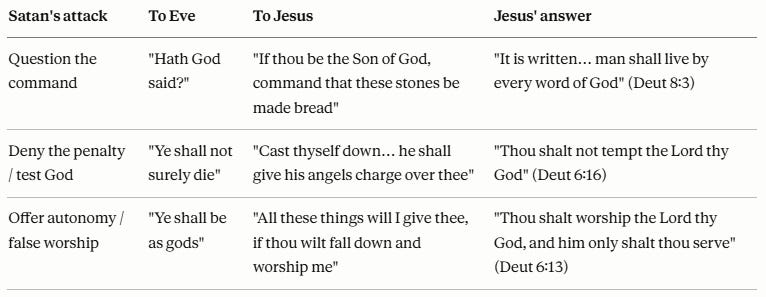
Three attacks. Two responses. One universe watching.
And note the weapon of choice. In every single round, Jesus answered with scripture — and not scripture from the Psalms, not from the prophets, not from some later revelation. The law. Every answer was a quotation from the same Deuteronomy that modern preachers will tell you is obsolete. Jesus, under direct assault by the devil, weakened by forty days without food, with the fate of the human race in the balance, reached for the law of Moses and defeated the accuser with it.
If the law had been abolished, or was about to be abolished, Jesus picked the strangest possible weapon. If the law had no enduring authority, His response to Satan was theologically incoherent — quoting a defunct code at the devil and expecting it to hold. But of course the law wasn’t defunct. The law was — and is — the very character of God in written form. Satan knew it. Jesus knew it. The only people who don’t know it are modern Christians who’ve been told, by pastors who mean well, that the law is gone.
It isn’t gone. It defeated the devil in the wilderness. It is still defeating him today, every time a believer answers temptation with “it is written.” The weapon is the word. The word contains the law. Use it.
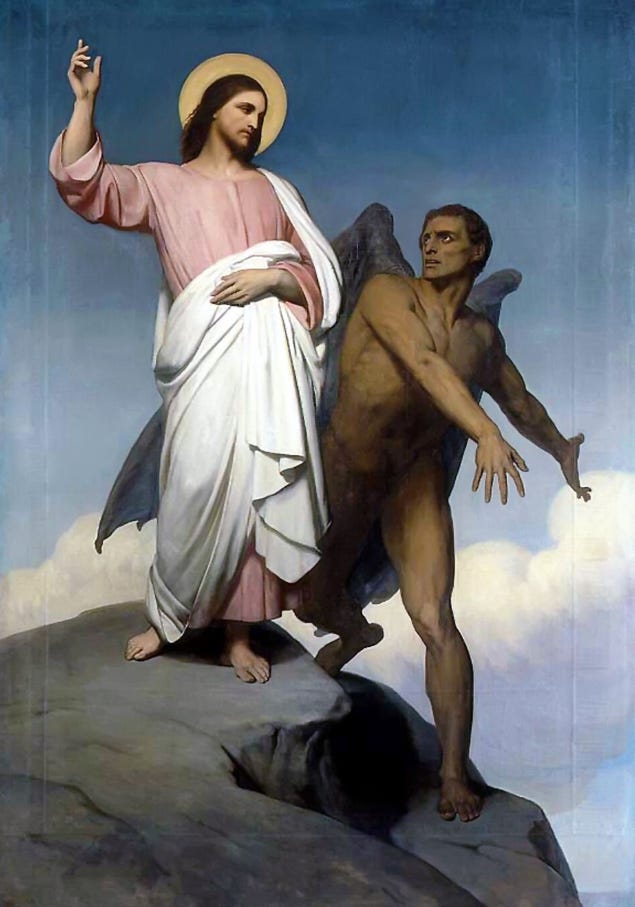
(Jesus and the Devil depicted in The Temptation of Christ, by Ary Scheffer, 1854)
When Israel broke the law — and what God did about it
If God does not change, and if His law does not change, then the consequences of breaking it don’t change either. That’s not me asserting it. That’s the inescapable logic of Malachi 3:6 and Hebrews 13:8.
So look at what happened when His own covenant people broke His law. Because the same God who responded then is the God we stand before today.
The flood
We start before Israel even exists, because the pattern is older than the nation.
Genesis 6:5 — “And God saw that the wickedness of man was great in the earth, and that every imagination of the thoughts of his heart was only evil continually.”
Pre-Sinai. Pre-Moses. No written law had been given. And yet God held humanity accountable for breaking a law He hadn’t yet written down — because, as we saw in the Eden section, the law was in force from the beginning. God gave humanity 120 years of warning through Noah (Gen 6:3). A 120-year sermon, with an ark being built right there as the visual aid. They laughed. They kept laughing. Until the rain came.
Every human being outside that ark drowned. The Bible does not soften this. It reports it. The reason was consistent with the reason for every other judgement that followed — humanity had rejected God’s authority and His standard of right and wrong.
And yet — notice what God did even here. He saved Noah. He saved the family. He saved the animals. He preserved a remnant precisely so the human race could continue. The flood is not just judgement. It is judgement with mercy, because God is both. Always both.
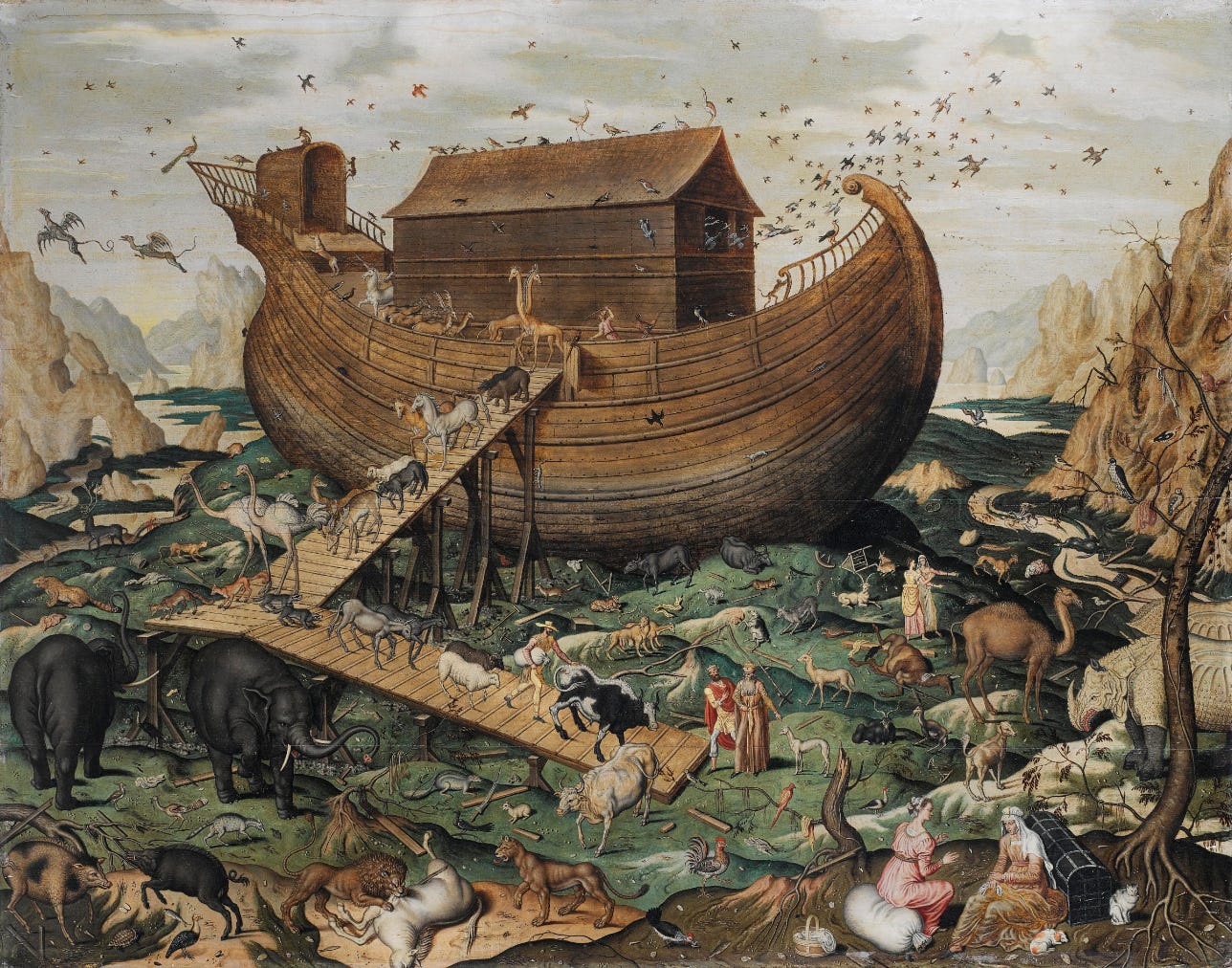
(‘NOAH’S ARK' on Mount Ararat’ (1570) by Flemish painter Simon de Myle.)
The golden calf
Forty days. That’s how long it took.
Moses went up the mountain and came back down with tablets of stone written by the finger of God. In the intervening six weeks, the people who had just heard God’s voice thundering the Ten Commandments in their own ears had already talked Aaron into melting their jewelry into an idol:
Exodus 32:4 — “…he fashioned it with a graving tool, after he had made it a molten calf: and they said, These be thy gods, O Israel, which brought thee up out of the land of Egypt.”
The second commandment, violated before the stone it was written on had even been delivered. Moses smashed the tablets. Three thousand people died that day (Ex 32:28). And God’s response cuts to the heart of the problem:
Exodus 32:33 — “…Whosoever hath sinned against me, him will I blot out of my book.”
Sinned. Transgression of the law. Blotted out of the book. The same book we’re judged by now, as Revelation 20 will later confirm. The mechanism in Exodus 32 is the same mechanism operating today.
But look what else happens. Moses intercedes. He pleads for the people. He goes back up the mountain. And God writes the law again — the second set of tablets, identical to the first. The nation isn’t destroyed. The covenant isn’t abandoned. God, having disciplined, immediately offers restoration. That’s the pattern emerging. Sin. Consequence. Mercy to those who turn. Again and again and again.
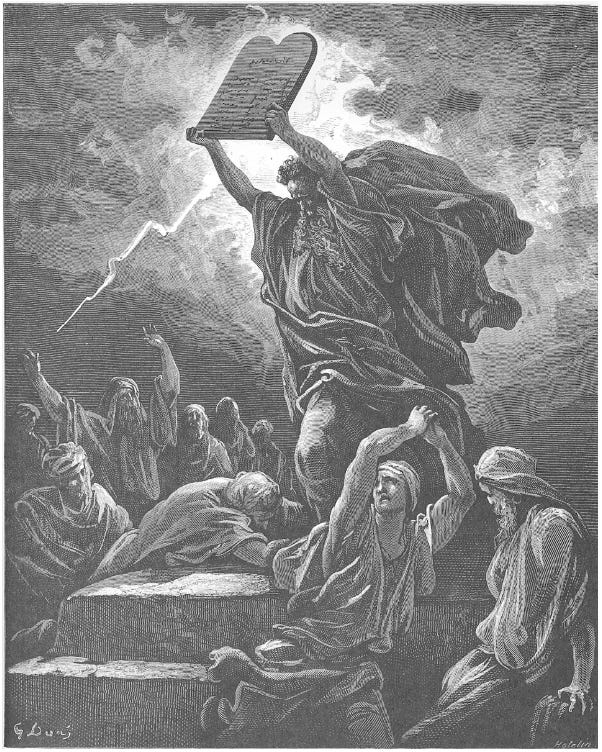
(Moses Breaks the Tables of the Law - Ex. 32:19)
The wilderness generation
The next cycle came fast. The spies returned from Canaan with a report, ten of them afraid, two of them faithful. The people chose to believe the ten. They refused to enter the promised land. They talked about stoning Moses and Caleb and Joshua. They said, out loud, that they’d rather go back to Egypt.
Numbers 14:29 — “Your carcases shall fall in this wilderness; and all that were numbered of you, according to your whole number, from twenty years old and upward, which have murmured against me.”
Forty years of wandering. An entire adult generation dying in the desert, one burial at a time. Six hundred thousand men, plus women and older children. A generation erased — not by invading armies, but by God’s own judgement against unbelief and disobedience.
And Paul does not let us skate past this one:
1 Corinthians 10:11 — “Now all these things happened unto them for ensamples: and they are written for our admonition, upon whom the ends of the world are come.”
For our admonition. Written so we would read them and learn. The wilderness generation was not just ancient history. Paul is saying: look at this. Study it. The pattern applies to you, now, in the last days. God did not preserve a disobedient generation then, and His character has not shifted since.
But watch the mercy thread. The children of that generation did enter the land. Joshua and Caleb — the two faithful spies — survived to lead them in. God disciplined a generation without abandoning the promise. That is who He is.
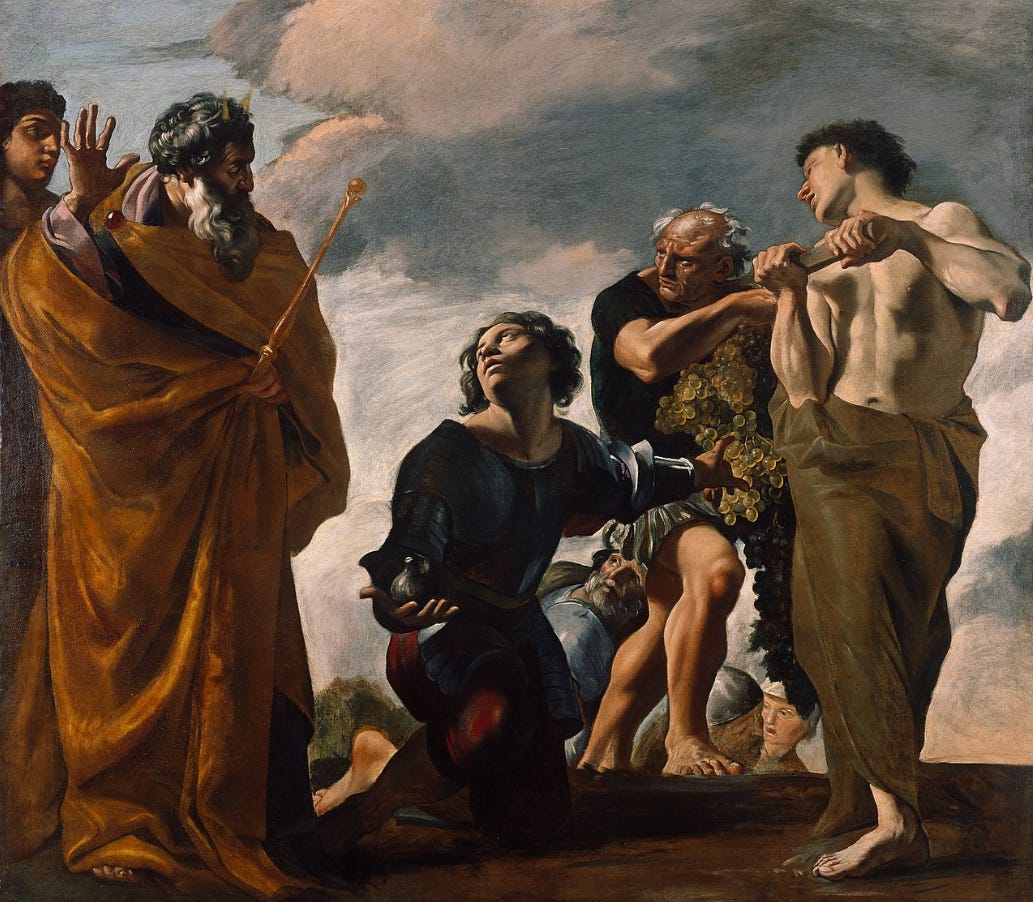
(Giovanni Lanfranco - Moses and the Messengers from Canaan)
Judges — the cycle written seven times
The book of Judges is arguably the most disturbing book in the Old Testament because it shows the same mistake repeating. The template is laid out at the start:
Judges 2:11-16 — “And the children of Israel did evil in the sight of the LORD, and served Baalim: And they forsook the LORD God of their fathers… And the anger of the LORD was hot against Israel, and He delivered them into the hands of spoilers… Nevertheless the LORD raised up judges, which delivered them out of the hand of those that spoiled them.”
Read the cycle. Sin. Oppression. Cry out to God. Deliverance. Peace. Sin again.
Seven times in the book of Judges. Seven. Mesopotamia, Moab, Canaan, Midian, Ammon, Philistia, and again Philistia. Each oppression lasted years — sometimes decades. Each deliverance came after Israel repented. The message is brutal in its clarity: God will not leave His people in comfort while they are in apostasy. He will send the consequences they earned, not as vengeance, but as the fastest way to get them to turn around.
And He always, always, always accepted the turning. Seven times. Not once did Israel cry out in repentance and find God unresponsive. Not once.
The exile
Eventually the cycles stopped working. The southern kingdom of Judah had been warned by Isaiah, by Jeremiah, by Ezekiel, by Micah, by Habakkuk. Prophet after prophet. Decade after decade. The northern kingdom of Israel got Hosea, Amos, Jonah — and was carried off by Assyria in 722 BC and scattered.
The reason is stated plainly:
2 Kings 17:15-18 — “And they rejected His statutes, and His covenant that He made with their fathers, and His testimonies which He testified against them; and they followed vanity, and became vain… Therefore the LORD was very angry with Israel, and removed them out of His sight…”
The northern ten tribes were never restored as a political entity. They vanished into history.
The southern kingdom held out longer but the end came in 586 BC. Nebuchadnezzar sacked Jerusalem. The temple — Solomon’s temple, the glory of the nation — was torn down. The sacred vessels were carried off. The population was marched into Babylon in chains. Jeremiah, who had warned them for decades, sat in the rubble and wrote Lamentations.
Read the reason given:
2 Chronicles 36:15-17 — “And the LORD God of their fathers sent to them by His messengers, rising up betimes, and sending; because He had compassion on His people, and on His dwelling place: But they mocked the messengers of God, and despised His words, and misused His prophets, until the wrath of the LORD arose against His people, till there was no remedy.”
Till there was no remedy. That phrase should terrify any nation that claims to be under God’s favour while breaking His law. There comes a point where the warnings have been sent, the prophets have been mocked, the patience has been exhausted, and the consequences arrive. God does not stay His hand indefinitely.
And yet — even here. Seventy years later, Cyrus of Persia issued the decree. The exiles returned. The temple was rebuilt. The walls went up under Nehemiah. The people stood in the square as Ezra read the law aloud (Neh 8), and when they heard it, they wept — because they finally understood what they had lost and how far they had wandered.
God disciplined a nation to the brink of annihilation, and then restored it. Because He does not change. His standards are constant. So is His willingness to receive the penitent.
The four hundred years of silence
And then something happened that may be the most sobering consequence of all. After Malachi — the last Old Testament prophet, around 430 BC — God went silent.
No prophet for 400 years. Nothing. Malachi to Matthew is a gap longer than the entire history of the United States. A nation that had been guided by prophetic voices for a thousand years suddenly heard nothing from heaven. The warnings stopped. The correction stopped. The explicit revelation stopped.
The Bible does not explain this silence directly. But Amos had already warned it could happen:
Amos 8:11-12 — “Behold, the days come, saith the Lord GOD, that I will send a famine in the land, not a famine of bread, nor a thirst for water, but of hearing the words of the LORD: And they shall wander from sea to sea, and from north even to the east, they shall run to and fro to seek the word of the LORD, and shall not find it.”
A famine of the word. The worst famine there is.
And yet — after four hundred years — a voice crying in the wilderness. John the Baptist. And then Jesus himself. God’s silence was never abandonment. It was restraint. He was waiting for the fullness of time (Gal 4:4), and when it came, He sent His Son.
Even here, He did not forsake them. He sent His most precious.
Jerusalem, AD 70
One more. The most painful. Because this one involves Jesus himself.
Luke records the moment Jesus stood above Jerusalem and wept:
Luke 19:41-44 — “And when He was come near, He beheld the city, and wept over it, Saying, If thou hadst known, even thou, at least in this thy day, the things which belong unto thy peace! but now they are hid from thine eyes. For the days shall come upon thee, that thine enemies shall cast a trench about thee, and compass thee round, and keep thee in on every side… because thou knewest not the time of thy visitation.”
He predicted it specifically. Within one generation. By the Romans. With siege works. Stone upon stone torn down. Matthew 24 spells out the details.
In AD 70, Titus and the Roman legions did exactly what Jesus said they would do. The Jewish historian Josephus — who was there — records that over a million died in the siege, many by starvation, many by crucifixion on the walls of the city. The temple was burned to the ground. The stones were torn apart so thoroughly that, as archaeologists have confirmed, the only substantial remains left standing were the retaining walls of the Temple Mount itself.
And Jesus had told them why. “Thou knewest not the time of thy visitation.” They had been given the Messiah in person. They had seen the miracles. They had heard the teaching. And the leadership, clinging to their ceremonial system and their political hopes, rejected Him and condemned Him. The consequence came forty years later, exactly as prophesied.
But — and here we have to slow down — Jesus wept. He didn’t stand above the city announcing their doom with satisfaction. He wept.
Matt 23:37 - “O Jerusalem, Jerusalem, thou that killest the prophets, and stonest them which are sent unto thee, how often would I have gathered thy children together, even as a hen gathereth her chickens under her wings, and ye would not!”.
That is who God is, even when the judgement is about to fall. He does not delight in it. He grieves it. He would rather gather them under His wings. But He will not override their choice. And when a people — a nation, a church, a generation — refuses His protection long enough, His protection eventually lifts. And what comes after is not God’s wrath arriving. It is God’s wrath being no longer restrained.
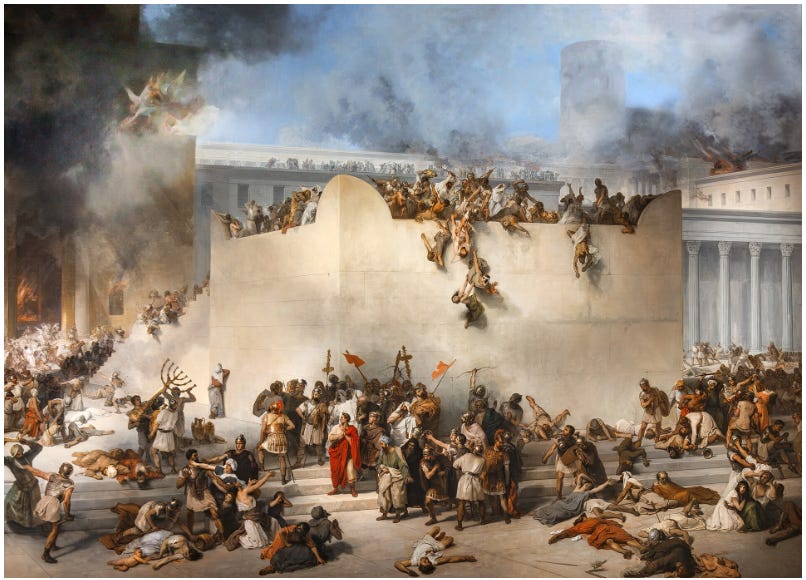
(Francesco Hayez: The destruction of the temple of Jerusalem - 70AD)
The individual examples
The nation-level cycles are the most visible, but the Bible records individuals too. Briefly, because the point is made:
Saul — first king of Israel. Partial obedience, twice. God gave him instructions, he decided which parts to keep. “To obey is better than sacrifice, and to hearken than the fat of rams” (1 Sam 15:22). The kingdom was taken from him. He died on the battlefield.
David — adultery with Bathsheba, murder of Uriah to cover it. Nathan the prophet confronted him. David confessed: “I have sinned against the LORD” (2 Sam 12:13). God forgave. But the consequences still unfolded — the child died, and the sword never left David’s house. Forgiveness does not erase consequence. It restores the relationship while the earthly consequence still plays out.
Uzzah — touched the ark to steady it when the oxen stumbled (2 Sam 6:6-7). Struck dead instantly. God had given specific instructions about how the ark was to be carried, and those instructions were being ignored. The law mattered. The method mattered. Even for an act that looked helpful in the moment.
Ananias and Sapphira — the pattern did not stop at the cross. In Acts 5, a couple in the early church lied about the money they had given. Both dropped dead on the spot. Luke records that “great fear came upon all the church, and upon as many as heard these things” (Acts 5:11). The post-Pentecost church, under the new covenant, with the Spirit poured out — and God still took sin seriously enough to make an immediate example of it.
The pattern, and the God behind it
Look at what is consistent across every one of these accounts.
God gives the law. People break it. God sends warnings — prophets, messengers, conscience, sometimes circumstances. The warnings are ignored, for a while, sometimes for centuries. Consequences come, scaled to the stubbornness. Some repent. Some don’t.
And here is the thread that carries through all of it. Every single time, across every century, without exception, when any person or nation genuinely turned back to God, he received them. The cycles in Judges. Manasseh, who was the worst king Judah ever had and who repented in a Babylonian prison and was restored (2 Chron 33:10-13). Nineveh, under Jonah’s preaching — an entire pagan city repenting in sackcloth and God relenting. David, after Nathan. The returning exiles under Ezra and Nehemiah. The thief on the cross, with hours to live.
Not one person who came to him in genuine repentance was turned away. Not one.
That is who God is. Truthful — the law was real, the consequences were real, the body counts were real. Just — the penalty was proportionate to the covenant they had broken, the warnings they had ignored, the light they had rejected. And merciful, beyond what any of them deserved — always ready, always patient, always willing to receive the broken-hearted.
Psalm 103:8-10 — “The LORD is merciful and gracious, slow to anger, and plenteous in mercy. He will not always chide: neither will He keep His anger for ever. He hath not dealt with us after our sins; nor rewarded us according to our iniquities.”
2 Peter 3:9 — “The Lord is not slack concerning His promise, as some men count it slackness; but is longsuffering to us-ward, not willing that any should perish, but that all should come to repentance.”
That’s the full picture. Not a God of only wrath. Not a God of only mercy. A God who is exactly who He says He is — holy, just, and more patient with rebellious humanity than any of us would ever be with each other.
And the application
If God disciplined His covenant people — the line of Abraham, the nation He chose, the people who had the law in writing, the temple, the prophets, the priesthood — for walking away from His law, on what basis does modern Christianity expect to be exempt?
Paul saw this coming. He wrote directly to Gentile believers in Rome:
Romans 11:20-22 — “Because of unbelief they were broken off, and thou standest by faith. Be not highminded, but fear: For if God spared not the natural branches, take heed lest he also not spare thee. Behold therefore the goodness and severity of God…”
Broken off. The natural branches. Take heed lest He also not spare thee. Paul is warning the early church — and by extension, us — that Gentile Christians do not have a special exemption from the pattern He had just spent the Old Testament establishing. Same tree. Same gardener. Same law. Same God.
The goodness and severity of God. Paul uses both words. Goodness to those who receive the gospel and walk in it. Severity to those who presume on it. The modern church, comfortable in Sunday worship, quietly editing commandments, preaching away the law — on what basis does it expect to avoid the pattern?
The answer, honestly, is that it doesn’t. It just hasn’t faced the consequences yet. The warnings are being sent right now. The prophets (the modern equivalents — faithful voices, old and new) have been sounding for decades. Some are listening. Most are not. And when a people stops listening long enough, the cycle arrives at its final stage. It has before. It will again.
That’s the point of prophecy in the awkward method by which I try to point it out with these writings.
But — and this is the whole point — while there is time, there is mercy. Seek ye the LORD while He may be found, call ye upon Him while He is near (Isa 55:6). That invitation is older than Israel and newer than this morning. The same God who wept over Jerusalem is the God who stands at the door and knocks (Rev 3:20). Every person who opens, He receives. Every nation that turns, He heals (2 Chron 7:14).
He has not changed. He will not change. The law still stands, the consequences still apply, and the mercy is still on the table.
But only for those willing to come back.
Intermission: That was then. What about now?
Step back a moment.
Everything we’ve covered so far is history. Eden was four thousand years ago. The wilderness was three. Israel’s cycles, the exile, the silence, Jerusalem — ancient by any measure. And a reader could, at this point, nod along with every argument and still quietly think: fair enough, but that was then. Jesus rose and nullified all of that.
Which is exactly where the devil wants the conversation to stop and deception to start.
Because if the law applied to Adam but not to me, or to Israel but not to the church, or to Jerusalem but not to London or New York or Pretoria — then everything we’ve argued is interesting but academic. Historical. Inapplicable. A museum piece. Yawn.
The whole logic of this post rests on a single thread, and we’ve already pulled on it more than once: God does not change. If He is the same yesterday, today, and forever, then what He required then, He still requires. What grieved Him then, still grieves him. What He disciplined then, He still disciplines. What He forgave then, He still forgives. There is no version of biblical Christianity in which the God of Sinai and the God we stand before are different Gods with different standards.
So let’s stop arguing the historical case and start applying it. The rest of this post is about right now. About the commandments in the New Testament, in your life. About the versions of the law that have been quietly edited or buried by institutions with motives. About the mark of conscience that every person alive still has to make. About what the remnant looks like in a world that has, overwhelmingly, been talked into believing the law is gone.
Same God. Same law. Same stakes. Different century. That’s the point.
Keep reading.
ACT 2 - The future
Where the law came from, and how old it actually is
Most people think the Ten Commandments start with Moses. They don’t.
The law is older than Sinai. Older than Moses. Older than Abraham. Older, I’d argue, than the earth itself — because it is the codified character of God, and God is eternal. What happened at Sinai was a public declaration of what had always been true.
Consider the evidence.
God told Abraham centuries before Sinai:
Genesis 26:5 — “Because that Abraham obeyed my voice, and kept my charge, my commandments, my statutes, and my laws.”
Abraham kept the commandments. What commandments? There were no commandments at Sinai yet. The only answer that makes any sense is that the law already existed and Abraham knew it.
Go further back. Cain murdered Abel in Genesis 4. God holds him accountable. But Paul says:
Romans 4:15 — “…for where no law is, there is no transgression.”
If there was no law, Cain could not have transgressed. And yet he was held guilty. The law was already in force.
Further still. Adam and Eve. The command not to eat of the tree is a specific, explicit law. Break it and you die. Genesis 2:16-17. Before the fall. Before sin entered the world. The law was already there.
And Lucifer lied about it. The lie of all lies. The father of lies.
Romans 2:14-15 — “For when the Gentiles, which have not the law, do by nature the things contained in the law, these, having not the law, are a law unto themselves: which shew the work of the law written in their hearts, their conscience also bearing witness...”
Written on Gentile hearts and witnessed by conscience — so the law was never “Jewish-only.”
And Paul is explicit that this applies across the board:
Romans 5:13 — “For until the law sin was in the world: but sin is not imputed when there is no law.”
Sin was in the world. Before Sinai. Which means the law was in the world. Before Sinai.
So where did it come from?
It came from God, and it reflects who God is. When Moses went up the mount, God wrote it in stone, with His own finger:
Exodus 31:18 — “And He gave unto Moses, when He had made an end of communing with him upon mount Sinai, two tables of testimony, tables of stone, written with the finger of God.”
And then, after Moses broke the first set in anger, God wrote it again:
Deuteronomy 10:2 — “And I will write on the tables the words that were in the first tables which thou brakest, and thou shalt put them in the ark.”
God wrote His law twice. In stone. With His own finger. Think about that. In the entire Bible, only three events involve God writing directly: the tablets at Sinai (twice), Jesus writing in the sand before the accusers of the adulterous woman, and the finger that wrote the sentence on Belshazzar’s wall. That’s it. And two of those three are the same moment — the law, given twice, in stone, by the finger of God.
Stone is forever. Permanent. His finger is personal. The law is both.
And it was placed inside the ark:
1 Kings 8:9 — “There was nothing in the ark save the two tables of stone, which Moses put there at Horeb, when the LORD made a covenant with the children of Israel.”
Nothing else inside. Just the law. And the ark itself was the centerpiece of the sanctuary, which — we’ll get to this — is a scale model of a sanctuary in heaven:
Hebrews 8:5 — “Who serve unto the example and shadow of heavenly things, as Moses was admonished of God when he was about to make the tabernacle: for, see, saith he, that thou make all things according to the pattern shewed to thee in the mount.”
So the law didn’t start with Moses. It sits in heaven. The earthly ark is a copy. The heavenly one is the original.
And John saw it there:
Revelation 11:19 — “And the temple of God was opened in heaven, and there was seen in His temple the ark of His testament…”
The ark, in heaven, in the temple. Which means the law, in heaven, in the temple. Not abolished. Not retired. Still there.
Law by Moses, grace and truth by Jesus
John 1:17 is one of the most-abused verses in modern Christianity.
John 1:17 — “For the law was given by Moses, but grace and truth came by Jesus Christ.”
People read this and hear: law is out, grace is in. As if the two are opposites. As if they cancel each other.
But that’s not what it says. Read it again. It says law was given by Moses. It does not say law was cancelled by Jesus. What Jesus brought was grace and truth — not a new law, not the absence of law, but the means by which we can stand before the law without being destroyed by it. Jesus is the solution.
The distinction matters because the Bible actually describes two different laws, and most of the modern confusion collapses once you see the difference.
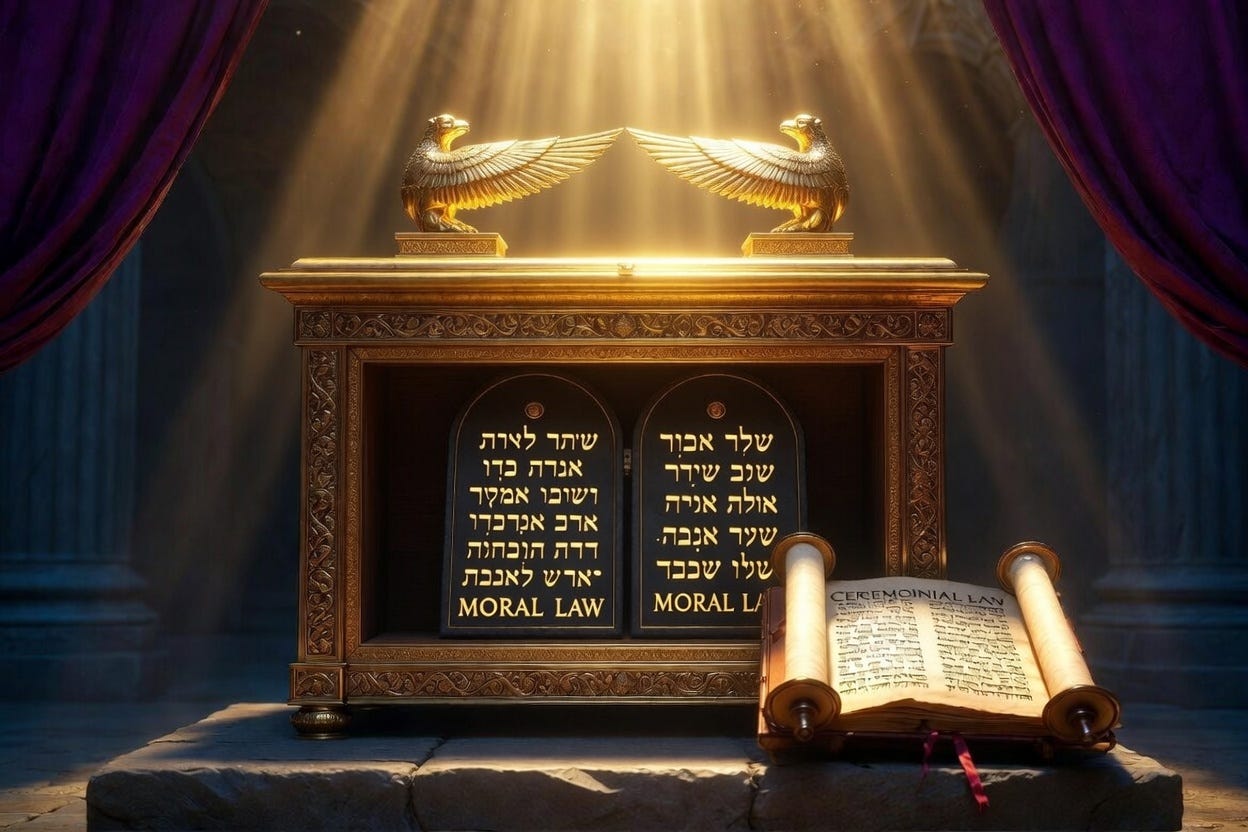
The moral law — the Ten Commandments — was written in stone, by God’s finger, placed inside the ark, and reflects the eternal character of God. This law tells us what is right and what is wrong.
The ceremonial law — the sacrifices, feasts, dietary ordinances, ritual regulations, neighborly treatment — was written by Moses in a book, and placed beside the ark, not inside.
Deuteronomy 31:26 — “Take this book of the law, and put it in the side of the ark of the covenant of the LORD your God, that it may be there for a witness against thee.”
Beside, not inside. Moses’ hand, not God’s finger. And this second law existed for one purpose — to point forward to Jesus.
Paul explains it exactly:
Galatians 3:19 — “Wherefore then serveth the law? It was added because of transgressions, till the seed should come to whom the promise was made…”
Read that slowly. The ceremonial law was added because of transgressions. Which means there was already a law being transgressed. There has to be. You cannot transgress nothing. The ceremonial law was added as the response — the lamb, the blood, the priest — to the breaking of the moral law that already existed.
So when Jesus came and died, the ceremonial law met its antitype and ended. The lamb was no longer needed because the Lamb had arrived. John the Baptist nailed it:
John 1:29 — “Behold the Lamb of God, which taketh away the sin of the world.”
The sacrificial system was the shadow. Jesus is the body. Hebrews says this in so many words:
Hebrews 10:1 — “For the law having a shadow of good things to come, and not the very image of the things, can never with those sacrifices which they offered year by year continually make the comers thereunto perfect.”
The shadow is not the thing. When the thing arrives, the shadow is no longer needed.
But — and this is the whole point — only the shadow ended. The law that defined what sin was, the law that made the sacrifice necessary in the first place, is still standing. It must be. Otherwise Jesus died for nothing.
What the new covenant actually is
Many read Hebrews 8 and conclude that “the first covenant is old and ready to vanish,” and they think that means the law has vanished. It hasn’t. Read it carefully:
Hebrews 8:10 — “For this is the covenant that I will make with the house of Israel after those days, saith the Lord; I will put my laws into their mind, and write them in their hearts: and I will be to them a God, and they shall be to me a people.”
The new covenant does not delete the law. The new covenant internalises the law. Old covenant: law on stone. New covenant: law on the heart. Same law. Different location.
Jeremiah said the same thing six hundred years earlier:
Jeremiah 31:33 — “But this shall be the covenant that I will make with the house of Israel; After those days, saith the LORD, I will put my law in their inward parts, and write it in their hearts…”
The law, inside us. Not erased — written. Not removed — relocated. Both Testaments confirming.
What ended was the old covenant’s mechanism — the repeated animal sacrifices, the yearly Day of Atonement with earthly blood, the priests who had to die and be replaced. That ended because Jesus became the eternal priest (Heb 7) with better blood (Heb 9) in a better sanctuary (Heb 8). But the law itself, the measuring stick, the definition of right and wrong — that went nowhere. It went into us.
Hebrews even says it explicitly, right after the passage about sins being remembered no more:
Hebrews 10:17-20 — “And their sins and iniquities will I remember no more. Now where remission of these is, there is no more offering for sin. Having therefore, brethren, boldness to enter into the holiest by the blood of Jesus, By a new and living way…”
No more offering for sin. That’s the ceremonial system ending. But boldness to enter into the holiest — that’s us entering the sanctuary, the one where the ark still sits, with the law still inside.
The new covenant is not the old covenant minus the law. The new covenant is the old covenant with the law moved from stone to the heart, and with the animal sacrifices replaced by Christ.
That’s it.
The syllogism — no law, no cross
Let the dictionary define a word.
Webster:
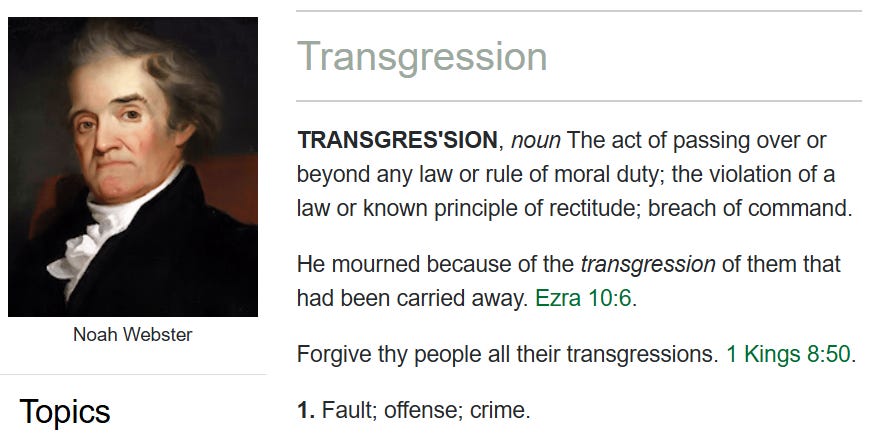
Merriam-webster:

Cambridge:
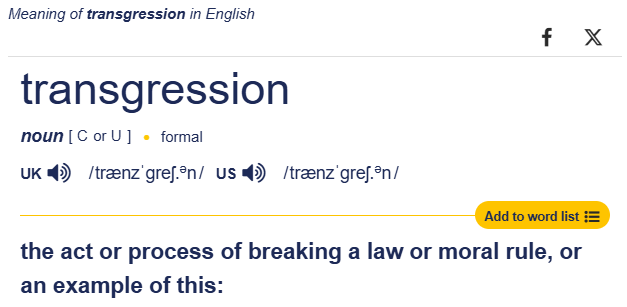
Hold that definition in your head, and read these verses:
1 John 3:4 — “Whosoever committeth sin transgresseth also the law: for sin is the transgression of the law.”
Sin is. Present tense. Not “was.” Not “used to be.” Is.
Romans 4:15 — “…for where no law is, there is no transgression.”
And now the logical chain. Take it step by step. This is the most important paragraph in the post.
Step 1. Sin is the transgression of the law (1 John 3:4).
Step 2. Where there is no law, there is no transgression (Rom 4:15).
Step 3. Therefore, if the law is abolished, there is no transgression. And if there is no transgression, there is no sin.
Step 4. But the wages of sin is death (Rom 6:23). And only the wages of sin is death. If there is no sin, there is no penalty.
Step 5. Jesus died to pay a penalty on our behalf:
Isaiah 53:5 — “But He was wounded for our transgressions, He was bruised for our iniquities…”
Hebrews 9:28 — “So Christ was once offered to bear the sins of many…”
Step 6. If there is no transgression, there is nothing for Jesus to bear. If there is no penalty, there is nothing for Him to pay. His death becomes the most horrifying, pointless act in history.
Step 7. Therefore — the law stands. It must. The cross is the proof.
Jesus died because of my sins. That’s the phrasing that matters. His death is the direct consequence of my breaking a law that still applies. If the law had been abolished, nothing would have been broken. If nothing had been broken, nothing would have needed paying for. The cross is not the end of the law. The cross is the ultimate confirmation of it.
And God, being God, cannot change this. He said so Himself:
Malachi 3:6 — “For I am the LORD, I change not…”
Hebrews 13:8 — “Jesus Christ the same yesterday, and to day, and for ever.”
Numbers 23:19 — “God is not a man, that he should lie; neither the son of man, that he should repent: hath he said, and shall he not do it?”
If God said “you shall surely die” in Eden, and God does not change, then the penalty does not change, and the law does not change, and the only way out is for someone to pay the penalty on our behalf. That someone had to be sinless. That someone had to be willing and able. That someone was Jesus.
The law is as old as God’s character. The cross is as permanent as His justice. Both stand together, or neither does.
Can we keep it? And does that save us?
Now — before we go further — we have to handle a real danger.
If I’m not careful, the above argument sounds like: “Keep the law and you’ll get to heaven.” That is not what I’m saying. That is the opposite of what I’m saying. And I want to be extremely clear, because this is where a lot of sincere Christians have been badly burned by legalism.
You cannot keep the law perfectly. I cannot keep the law perfectly. Nobody can. Paul is absolutely clear on this:
Romans 3:23 — “For all have sinned, and come short of the glory of God.”
Romans 3:20 — “Therefore by the deeds of the law there shall no flesh be justified in His sight: for by the law is the knowledge of sin.”
Romans 3:28 — “Therefore we conclude that a man is justified by faith without the deeds of the law.”
A man is justified — made right before God — by faith, without the deeds of the law. The law saves nobody. The law never could save anybody. The law was never supposed to save anybody. The law is a mirror. The angels keep it. A few did not and was cast out. It shows you the dirt on your face. It does not wash it off.
And Paul nails down the mechanism:
Ephesians 2:8-9 — “For by grace are ye saved through faith; and that not of yourselves: it is the gift of God: Not of works, lest any man should boast.”
Titus 3:5 — “Not by works of righteousness which we have done, but according to His mercy He saved us…”
Galatians 2:16 — “Knowing that a man is not justified by the works of the law, but by the faith of Jesus Christ…”
Romans 11:6 — “And if by grace, then is it no more of works: otherwise grace is no more grace.”
Romans 4:5 — “But to him that worketh not, but believeth on him that justifieth the ungodly, his faith is counted for righteousness.”
Six verses. Five different books. Grace saves. Not works. Not law-keeping. Not good behavior. Grace.
So what is the law for?
The law is the standard. It tells you what God’s character is. It shows you where you fall short. It drives you, in despair, to Jesus — because once you see the gap between what you are and what the law requires, you realise you need a Saviour. Paul calls the law a schoolmaster that brings us to Christ (Gal 3:24).
And once you’re in Christ? The law doesn’t go away. It gets written on your heart. Obedience becomes the evidence of salvation, not the cause. Here’s the order, and it matters:
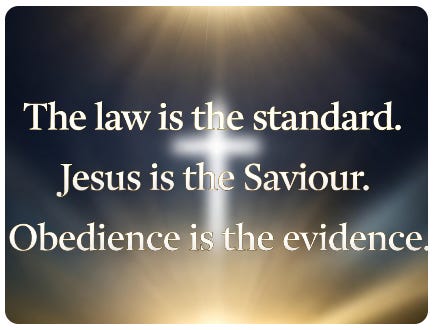
Never reverse the second and third. Never imagine that keeping the commandments is how you earn salvation. That’s the Pharisee in Luke 18 beating his chest about his tithes. It doesn’t work. It never worked.
But — and this is the point — once you’re saved, James is also clear:
James 2:17 — “Even so faith, if it hath not works, is dead, being alone.”
James 2:26 — “For as the body without the spirit is dead, so faith without works is dead also.”
Luther called James “the epistle of straw” because he couldn’t reconcile it with Paul. Later he figured it out. Paul is talking about what saves you (faith, not works). James is talking about what proves you’re saved (works, as the fruit of faith). Two different questions. Two different answers. No contradiction.
Romans 8:3-4 — “For what the law could not do, in that it was weak through the flesh, God sending His own Son in the likeness of sinful flesh, and for sin, condemned sin in the flesh: that the righteousness of the law might be fulfilled in us, who walk not after the flesh, but after the Spirit.”
Paul gives the mechanism: the Spirit actually fulfills the righteous requirement of the law in us. It is the clearest answer to “but we can’t keep it.” It also directly answers the charge of legalism with Paul’s own words.
The summary line, to carry through the rest of this post: The law is the standard. Jesus is the Saviour (solution). Obedience is the evidence.
Never the cause.
The sanctuary — architecture of the whole argument
I walked through the sanctuary in Article 12, but it’s so central to this that I have to revisit it here.
Moses built an earthly sanctuary on God’s exact instructions:
Exodus 25:8-9 — “And let them make me a sanctuary; that I may dwell among them. According to all that I shew thee, after the pattern of the tabernacle… even so shall ye make it.”
It wasn’t arbitrary. Every object, every dimension, every ritual was a shadow of something real in heaven. Hebrews spells this out:
Hebrews 8:5 — “Who serve unto the example and shadow of heavenly things…”
Hebrews 9:24 — “For Christ is not entered into the holy places made with hands, which are the figures of the true; but into heaven itself, now to appear in the presence of God for us.”
So the earthly is a copy. The heavenly is the real thing. Jesus is in the real one. Right now.
The earthly layout:
Outer court: altar of burnt offering, laver
Holy place: table of showbread, lampstand, altar of incense
Most Holy Place: the ark, containing the law
Each piece points to something in the plan of salvation. The altar points to Christ’s sacrifice. The laver to baptism. The bread to Christ as the bread of life. The lampstand to the Holy Spirit. The incense to the prayers of the saints. And the ark — the ark contains the law.
That’s the pinnacle of the whole thing: The law.
Now here’s the key question. When Jesus ascended after the resurrection, where did He go? Paul answers this across Hebrews — He entered heaven itself, the true sanctuary, as our high priest (Heb 8:1-2, 9:24). And Daniel shows us that at the end of 2300 days — which lapsed in 1844AD — something specific happened:
Daniel 8:14 — “Unto two thousand and three hundred days; then shall the sanctuary be cleansed.”
Daniel 7:13 — “I saw in the night visions, and, behold, one like the Son of man came with the clouds of heaven, and came to the Ancient of days, and they brought him near before Him.”
The Son of man comes before the Ancient of Days. This is not the second coming — at the second coming, Jesus is the one descending to earth, not being brought before the Father. This is the investigative judgement beginning in 1844, when Jesus moved from the Holy Place into the Most Holy Place, and the cleansing of the heavenly sanctuary began. I worked through the timelines in detail in Article 11.
Now put the pieces together. Jesus is in the Most Holy Place of heaven’s sanctuary, right now, as our high priest. The Most Holy Place contains the ark. The ark contains the law.
If the law has been abolished, what exactly is Jesus ministering over?
Take a minute with that. The whole sanctuary doctrine — the whole judgement — is built on the assumption that the law is the measuring stick by which our cases are being reviewed. If the law is gone, the ark is empty. If the ark is empty, the sanctuary is pointless. If the sanctuary is pointless, then Jesus’ ministry right now is pointless. And if that’s pointless, the whole apparatus of Christian hope collapses.
It doesn’t collapse. Because the law is still there. The ark still holds it. Jesus still ministers over it.
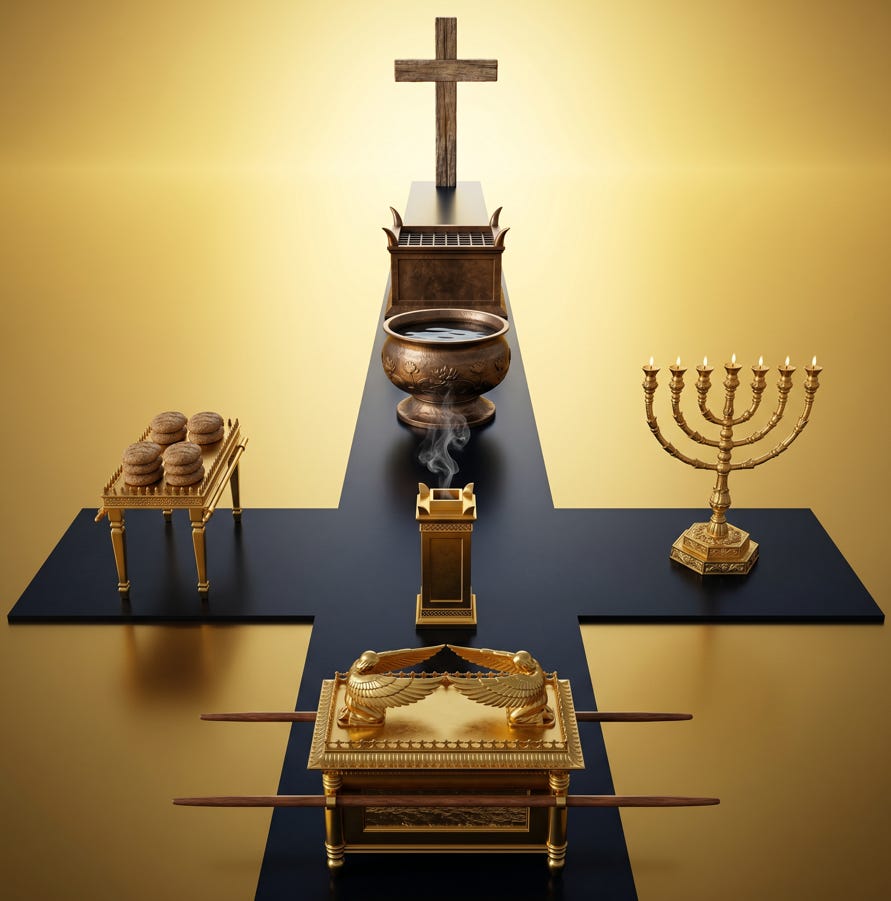
(The layout of the items was in the form of a cross)
A video describing the sanctuary:
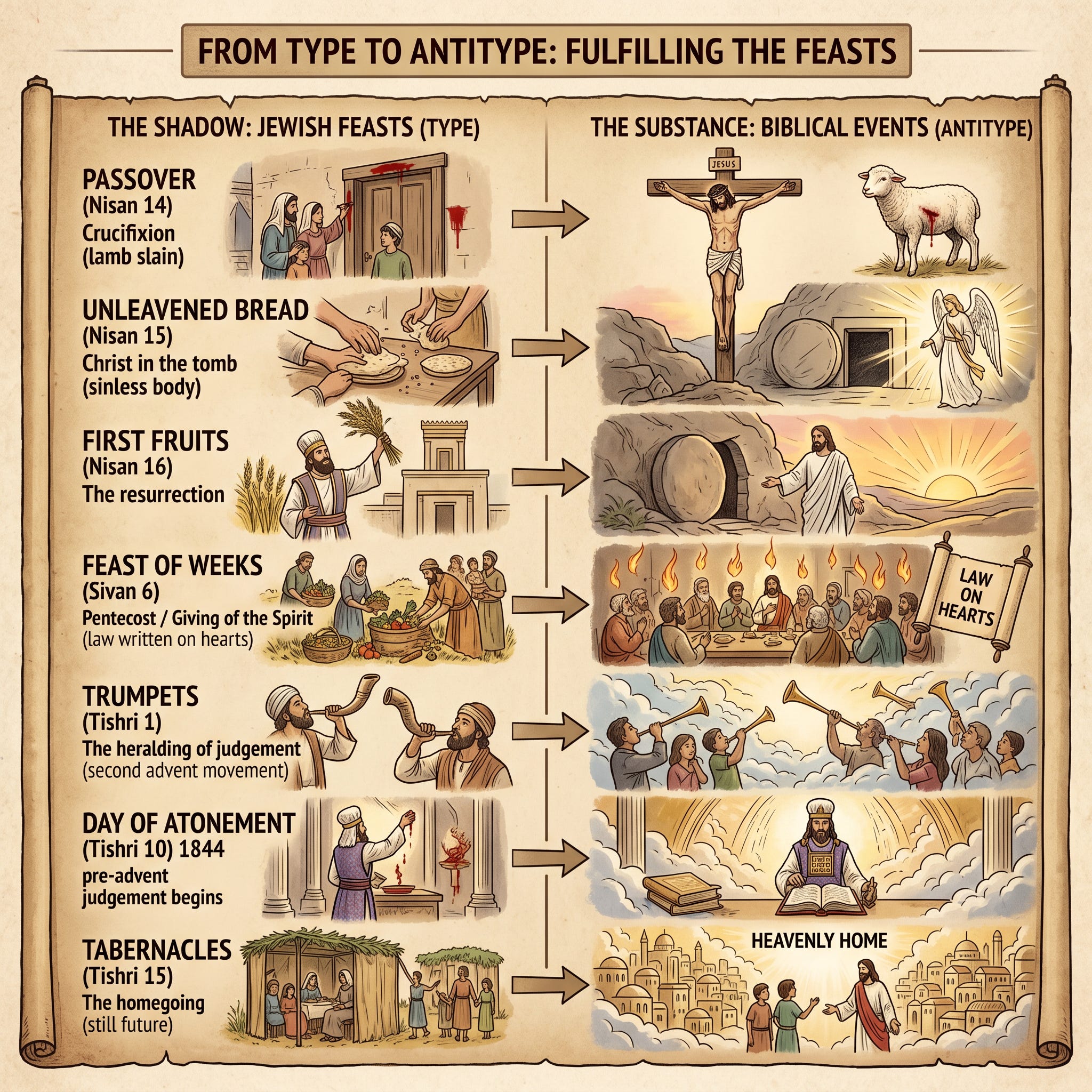
The feasts — the whole Christian story in one calendar
Before we move on, a quick detour I already introduced in Article 11, because it slots in here.
The Jewish ceremonial year had seven annual feasts. Each was a type pointing to an antitype — a shadow pointing to a substance. Laid out side by side:
Passover (Nisan 14) → Crucifixion (lamb slain)
Unleavened Bread (Nisan 15) → Christ in the tomb (sinless body)
First Fruits (Nisan 16) → The resurrection
Feast of weeks (Sivan 6) → Pentecost / Giving of the Spirit (law written on hearts)
Trumpets (Tishri 1) → The heralding of judgement (second advent movement)
Day of Atonement (Tishri 10) 1844 → pre-advent judgement begins
Tabernacles (Tishri 15) → The homegoing (still future)
The first four were fulfilled at Christ’s first coming. Trumpets points to the Advent movement. Atonement points to what is happening in heaven right now. Tabernacles is still ahead.
A year of feasts in type points to the antitype human earthly cycle until we go home.
These feasts were the ceremonial law. They ended when their antitype arrived. That’s why Paul says in Colossians 2 that no one should judge you regarding a feast day or new moon — those were the ceremonial shadows, and they pointed to Christ who is now here.
But notice — the weekly Sabbath is not in this list. The weekly Sabbath was a creation ordinance (Gen 2:2-3), given before sin, before Israel, before there was any ceremonial system. It’s in the Ten Commandments, on stone, inside the ark. It has nothing to do with the feasts.
This distinction collapses about half of the standard arguments against the law. People read Colossians 2:16 — “let no man therefore judge you… in respect of… the sabbath days” — and think Paul is cancelling the weekly Sabbath. He isn’t. He’s talking about the ceremonial sabbaths (the feast-day sabbaths) that fell on various dates and pointed forward to Jesus. We’ll come back to this in the counter-verses section.
It all played out in a year which has its antitype in the human earthly cycle until we go home.
Isaiah 66:22-23 — “For as the new heavens and the new earth, which I will make, shall remain before me, saith the LORD, so shall your seed and your name remain. And it shall come to pass, that from one new moon to another, and from one sabbath to another, shall all flesh come to worship before me, saith the LORD.”
This verse shows the weekly Sabbath still functioning in the new earth. It is the only commandment explicitly pictured as continuing after the second coming. It turns “Remember” into “it will still be remembered forever.”
One last feast in antitype still to come:
No collective atonement — every single person paid
One of the most overlooked features of the Old Testament sacrificial system is how personal it was.
Every Israelite, rich and poor, had to bring a ransom for themselves. Exodus 30 lays it out:
Exodus 30:13-15 — “This they shall give, every one that passeth among them that are numbered, half a shekel… The rich shall not give more, and the poor shall not give less than half a shekel, when they give an offering unto the LORD, to make an atonement for your souls.”
Half a shekel. Every single person. Not one coin from the tribe as a whole. Not a family plan. Every individual.
And for individual sin — not national sin, not church sin, individual sin — each person brought their own offering:
Leviticus 4:27-31 — “And if any one of the common people sin through ignorance… he shall bring his offering, a kid of the goats, a female without blemish, for his sin which he hath sinned. And he shall lay his hand upon the head of the sin offering… and the priest shall make an atonement for him…”
Notice: He shall bring, He shall lay His hand, an atonement for him. Singular. Personal. Nobody else could stand in for you. Nobody else’s lamb could cover your sin.
Why does this matter? Because it tells us something critical about the judgement and about Jesus.
You cannot get a free ride. The Bible never teaches collective atonement, never teaches group salvation, never teaches “our nation is saved” or “our church is saved.” Judgement is always individual:
Ezekiel 18:20 — “The soul that sinneth, it shall die… the righteousness of the righteous shall be upon him, and the wickedness of the wicked shall be upon him.”
Romans 14:12 — “So then every one of us shall give account of himself to God.”
2 Corinthians 5:10 — “For we must all appear before the judgment seat of Christ; that every one may receive the things done in His body…”
Ecclesiastes 12:13-14 — “Fear God, and keep His commandments: for this is the whole duty of man. For God shall bring every work into judgment, with every secret thing…”
One person. One account. No escape through association. This has massive implications for the whole “group liberty of conscience” argument later in this post, because it means no government, no church, no authority can stand before God on your behalf.
So, in the very near future, when you hear: “It’s for the common good”… RUN.
And it also points directly to why Jesus had to be sinless.
Think about it. In the Old Testament system, the lamb had to be “without blemish” (Lev 4:32). Why? Because a lamb with its own blemish could not cover someone else’s. If the lamb itself was already disqualified, it could not serve as a substitute.
The antitype is exact. Jesus had to be sinless, because only a sinless substitute could pay for another’s sin:
Hebrews 4:15 — “For we have not an high priest which cannot be touched with the feeling of our infirmities; but was in all points tempted like as we are, yet without sin.”
1 Peter 2:22 — “Who did no sin, neither was guile found in His mouth.”
John 8:46 — “Which of you convinceth me of sin?”
He kept the law perfectly. He passed every test. He remained spotless. And because of that, He could take our place.
No law, no blemish. No blemish, no disqualification. No disqualification, no reason He had to be sinless. No reason to be sinless, no point in the sinless life. The whole substitutionary atonement falls apart without the law it is substituting under.
The priest, the bells, and the weight of unconfessed sin
I mentioned the earthly priesthood in Article 12 but didn’t dwell on one detail that needs its own moment.
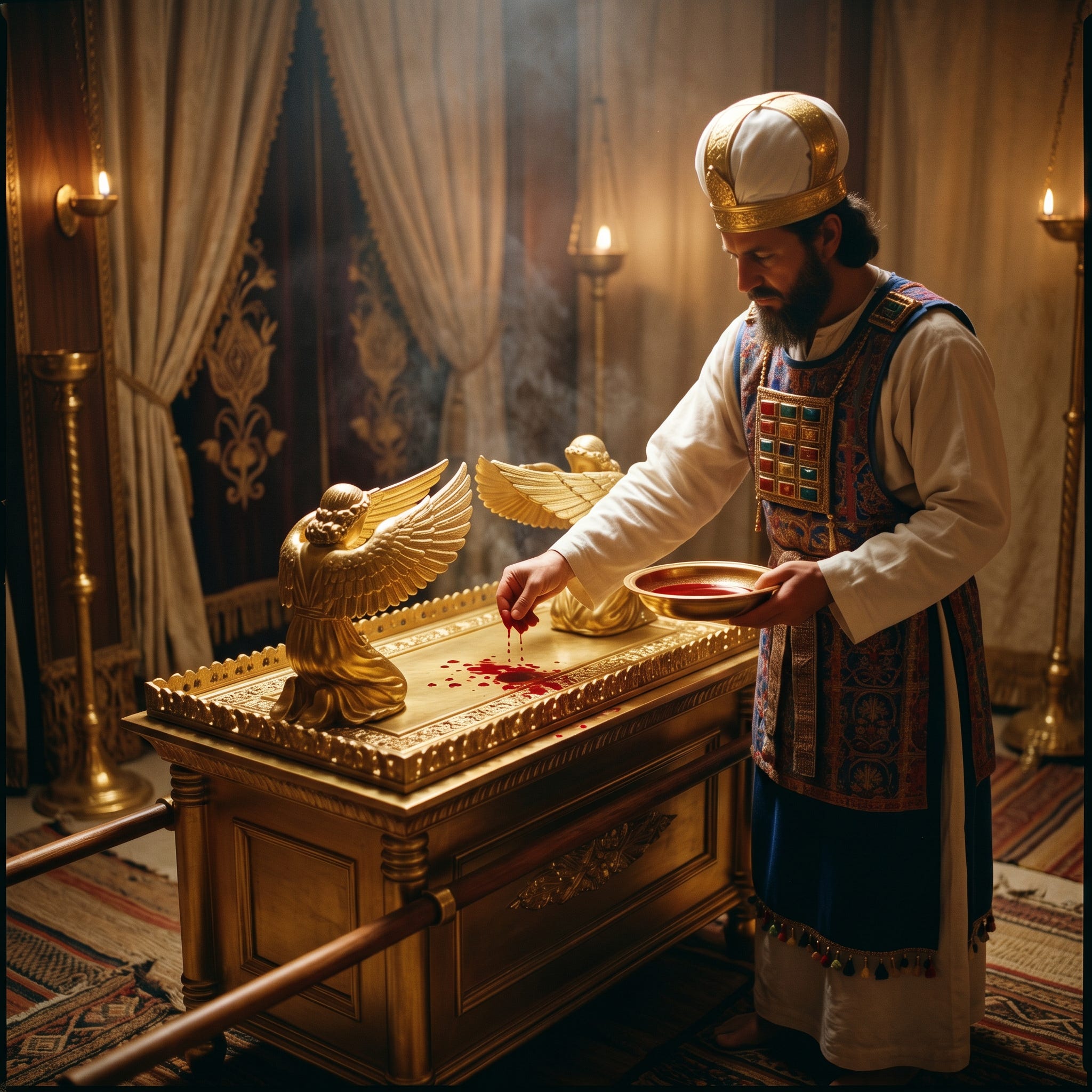
When the high priest entered the Most Holy Place on the Day of Atonement, he did so under very specific conditions. His robe had bells sewn along the hem:
Exodus 28:33-35 — “And beneath upon the hem of it thou shalt make pomegranates of blue, and of purple, and of scarlet… and bells of gold between them round about… And it shall be upon Aaron to minister: and his sound shall be heard when he goeth in unto the holy place before the LORD, and when he cometh out, that he die not.”
That he die not. Read that again. The priest could die in there. Entering the presence of God carrying unconfessed sin was fatal.
Jewish tradition — and I want to be honest here, it’s not in the Bible, it’s in later rabbinic sources — adds the detail that the priest had a rope tied around his ankle, so that if he died inside, the other priests could pull the body out without entering themselves. Whether or not the rope is historical, the principle absolutely is. The bells are scripture. The warning is real.
Why did priests die in there? Because they entered unworthy. Because they hadn’t confessed. Because they carried sin into a place where sin cannot exist.
Habakkuk 1:13 — “Thou art of purer eyes than to behold evil, and canst not look on iniquity…”
Isaiah 59:2 — “But your iniquities have separated between you and your God, and your sins have hid His face from you, that He will not hear.”
Revelation 21:27 — “And there shall in no wise enter into it any thing that defileth…”
Sin and God cannot coexist. Not in heaven. Not in the Most Holy. Not in the new earth. This is why the sanctuary has to be cleansed. This is why sin has to be paid for. This is why the law has to apply — because the law is the definition of what can and cannot stand before Him.
And that brings us directly to you and me.
If we’re going to stand before God at the judgement — and we are, every single one of us — then every sin has to be addressed. Confessed. Covered by the blood of the Lamb. Transferred off us and onto Him.
1 John 1:9 — “If we confess our sins, He is faithful and just to forgive us our sins, and to cleanse us from all unrighteousness.”
Proverbs 28:13 — “He that covereth his sins shall not prosper: but whoso confesseth and forsaketh them shall have mercy.”
Acts 3:19 — “Repent ye therefore, and be converted, that your sins may be blotted out…”
Confession is not optional. It is the mechanism by which sin leaves us and goes onto Him. Without it, we are the priest walking into the Most Holy with dirty hands — and the bells will go silent.
The challenge here is simple and personal. Are we bringing our sins to Him daily? Are we naming them honestly, or are we hiding them, minimising them, covering them up with religious activity? There is no bell loud enough to warn the person who refuses to confess. The only warning is the Holy Spirit speaking to your conscience.
The Great Controversy — Lamb vs Scapegoat
Here’s a cosmic-level view, because the law has to be understood inside the bigger story.
Before there was sin on earth, there was rebellion in heaven. Lucifer — originally a covering cherub, among the most exalted beings God had made — decided he would not submit to God’s law. Two passages describe his fall:
Isaiah 14:12-14 — “How art thou fallen from heaven, O Lucifer, son of the morning!… I will ascend into heaven, I will exalt my throne above the stars of God… I will be like the most High.”
Ezekiel 28:15-17 — “Thou wast perfect in thy ways from the day that thou wast created, till iniquity was found in thee… Thine heart was lifted up because of thy beauty, thou hast corrupted thy wisdom by reason of thy brightness…”
His argument was essentially this: God’s law is unfair. God’s law cannot be kept. God is asking for something His creatures cannot give. Therefore God is unjust.
It’s the same lie he sold to Eve. “Hath God said?” — question the law. “Ye shall not surely die” — deny the penalty. “Ye shall be as gods” — set yourself up as your own authority.
And he continued the argument. Job chapters 1 and 2 show him standing before God, accusing. Zechariah 3 shows him standing beside the high priest Joshua, accusing. Revelation 12:10 calls him — plainly — “the accuser of our brethren… which accused them before our God day and night.”
That is his role. Accuser.
Now — here is the thread that most people miss. If there is no law, the accuser has no grounds to accuse. You cannot accuse someone of breaking nothing. The whole trial collapses. Which means the devil has an incentive against people admitting the law exists. If he can get Christians to dismiss the law, he removes the basis of his own accusations — but he also removes the basis of their need for a Saviour. Both at once. It’s elegant, in the worst way.
So how does God settle this once and for all?
He sends Jesus to keep the law perfectly. To prove, in human flesh, that the law is keepable. To demonstrate in public, before the entire watching universe, that Lucifer’s accusation is a lie.
John 15:10 — “If ye keep my commandments, ye shall abide in my love; even as I have kept my Father’s commandments, and abide in His love.”
Jesus says it plainly. I have kept my Father’s commandments. Not “the commandments no longer matter.” Not “I’m above them.” He kept them. Perfectly. In our nature. And that sinless life is what qualifies Him to die as our substitute.
On the annual Day of Atonement (Lev 16), two goats were brought. Lots were cast. One goat was slain as the sin offering — its blood taken into the Most Holy Place to cleanse the sanctuary. The other goat — the scapegoat, called Azazel — was led into the wilderness, carrying the unconfessed sins of the people, and was never killed as a sacrifice.
Leviticus 16:8-10 — “And Aaron shall cast lots upon the two goats; one lot for the LORD, and the other lot for the scapegoat… But the goat, on which the lot fell to be the scapegoat, shall be presented alive before the LORD, to make an atonement with Him, and to let him go for a scapegoat into the wilderness.”
Leviticus 16:30 — “For on that day shall the priest make an atonement for you, to cleanse you, that ye may be clean from all your sins before the LORD.”
The Lord’s goat is Jesus. His blood cleanses the sanctuary. He pays for every confessed sin.
The scapegoat — Azazel, a name associated in extra-biblical Jewish literature with a fallen angel — is Lucifer. And at the end of the judgement, after every confessed sin has been covered by the blood, the remaining burden of sin is placed on the originator of sin — the accuser — and he is sent away. Not as a substitute for the righteous. Never as a substitute. But as the one who ultimately bears the consequence of every sin he instigated.
The cosmic trial goes like this:
Lucifer claims the law can’t be kept.
Jesus keeps it perfectly in human flesh. Lucifer did try to deceive him.
Jesus dies for every sinner who confesses.
Judgement decides each case based on whether sins were confessed and covered.
At the end, the accuser himself bears the leftover weight of his own rebellion and is destroyed.
Without the law, none of this makes sense. With the law, every piece lines up.
And one more detail, because it’s too important to skip. Daniel looked forward and saw a power that would attempt — in prophetic code — to do what Lucifer has always wanted to do:
Daniel 7:25 — “And he shall speak great words against the most High, and shall wear out the saints of the most High, and think to change times and laws…”
Think to change times and laws. Think. Not succeed. Because you cannot actually change God’s law — you can only try, and then deceive people into following your version instead of his. Notice how specifically Daniel predicted it.
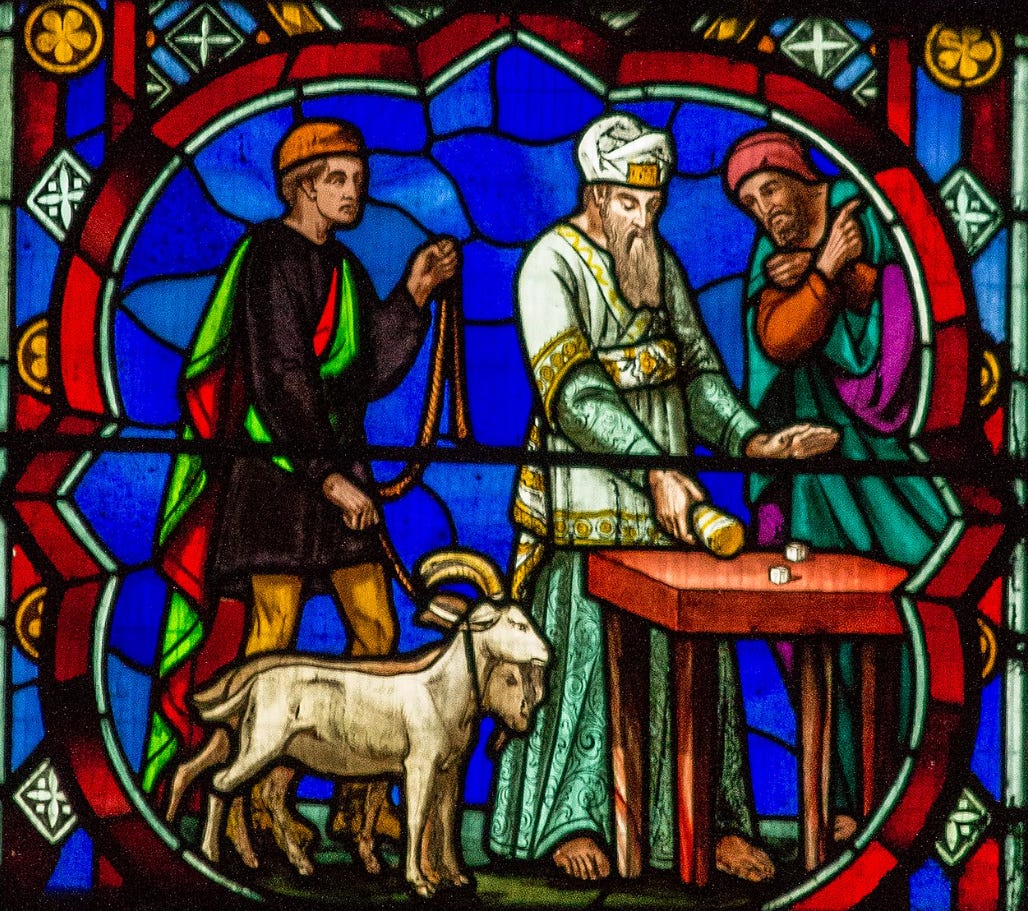
(Scapegoat ceremony depicted at Lincoln Cathedral in stained glass: "[Aaron] is to take the two goats and present them before the Lord at the entrance to the tent of meeting. He is to cast lots for the two goats—one lot for the Lord and the other for the scapegoat. Aaron shall bring the goat whose lot falls to the Lord and sacrifice it for a sin offering. But the goat chosen by lot as the scapegoat shall be presented alive before the Lord to be sent into the wilderness as a scapegoat." (Leviticus 16:7–10))
Described in video:
The verses many abuse
Now we get to the hard part. The counter-arguments.
I want to do this one verse at a time, because if I just wave at them in general, no one is converted. Let me take the ten most-abused verses and handle them specifically.
1. Colossians 2:14 — “Blotting out the handwriting of ordinances that was against us…”
The common read: the law was blotted out at the cross.
What it actually says: the handwriting of ordinances — Greek cheirographon, literally a handwritten document. God didn’t write the Ten Commandments with a hand. He wrote them with His finger, in stone. The handwriting refers to Moses’ book of the ceremonial law — the same one Deuteronomy 31:26 says was placed beside the ark as “a witness against thee.” Colossians 2:14 is talking about the ceremonial system being nailed to the cross. Not the moral law.
Read the next verse — Col 2:16 mentions “meat, drink, holyday, new moon, sabbath days.” Every one of those is ceremonial. Every one of those pointed forward to Christ. Every one of those ended when He came. The weekly seventh-day Sabbath of the fourth commandment was instituted at creation (Gen 2), not at Sinai as part of the ceremonial system.
2. Galatians 3:24-25 — “Wherefore the law was our schoolmaster to bring us unto Christ… But after that faith is come, we are no longer under a schoolmaster.”
The common read: once we have faith, the law is gone.
What it actually says: the law, as an externally imposed schoolmaster that accuses and condemns us, is no longer our relationship to the law once we’re in Christ. We’re not “under” the law in the sense of being condemned by it — we’re “in” Christ, who kept the law, whose righteousness is imputed to us. The law itself doesn’t vanish. Our relationship to it changes. We go from law-breakers to law-lovers.
3. Romans 6:14-15 — “For sin shall not have dominion over you: for ye are not under the law, but under grace. What then? shall we sin, because we are not under the law, but under grace? God forbid.”
The common read: we’re under grace, not law, so the law doesn’t apply.
What it actually says: read verse 15. Paul anticipates exactly that misreading and slaps it down. “Shall we sin?” “God forbid.” Being under grace is being freed from the condemnation of the law, not from the applicability of the law. And remember — Paul defines sin as transgression of the law (Rom 4:15, 1 John 3:4). If the law didn’t apply, there’d be nothing to call sin, and the phrase “shall we sin” would be nonsensical. Paul clearly thinks the law still defines sin even while we’re under grace.
4. Romans 10:4 — “For Christ is the end of the law for righteousness to every one that believeth.”
The common read: Christ is the end of the law — it’s over.
What it actually says: the Greek word translated “end” is telos, which means goal, aim, purpose, destination. Not “termination.” When you say “the end of a journey,” you can mean where it stops — but you can also mean the destination it was aiming at. Paul is saying Christ is the goal the law was pointing toward. He is what the law was always designed to lead us to. The law’s purpose is fulfilled when it brings us to Christ. It doesn’t get deleted at that point. It delivered us to the person who can save us.
5. Ephesians 2:15 — “Having abolished in His flesh the enmity, even the law of commandments contained in ordinances…”
The common read: the law was abolished in His flesh.
What it actually says: the law of commandments contained in ordinances — again, the ceremonial system. The specific ordinances that divided Jew from Gentile (circumcision, dietary laws, feast days) were what created the wall of partition Paul is discussing. Christ broke that wall. The moral law never divided Jew from Gentile — murder was wrong in both camps — so it can’t be what’s being abolished here.
6. Hebrews 8:13 — “In that He saith, A new covenant, He hath made the first old. Now that which decayeth and waxeth old is ready to vanish away.”
The common read: the old covenant (including the law) is vanishing.
What it actually says: the old covenant — the Sinai system of animal sacrifices and earthly priesthood — is passing. That’s exactly what Hebrews 8 has been arguing. But read back to verse 10, in the same chapter: “I will put my laws into their mind, and write them in their hearts.” The new covenant contains the law — just in a new location. It’s not the law that vanishes. It’s the Sinai administration of the law through animal sacrifices and Levitical priests.
7. Hebrews 7:12 — “For the priesthood being changed, there is made of necessity a change also of the law.”
The common read: the law was changed, so it’s no longer binding.
What it actually says: the chapter is about the change from the Levitical priesthood (Aaron’s line) to the Melchizedek priesthood (Jesus). When the priesthood changes, the regulations governing the priesthood have to change — who serves, what their qualifications are, what their tribe is. That’s the “change of the law” being discussed. The Ten Commandments are not mentioned. The moral law doesn’t enter the conversation. Hebrews 7 is strictly about priestly logistics.
8. Matthew 5:17 — “Think not that I am come to destroy the law, or the prophets: I am not come to destroy, but to fulfil.”
Often misread to mean: Jesus fulfilled the law, so it’s done.
What it actually says — and verse 18 removes any ambiguity:
Matthew 5:18 — “For verily I say unto you, Till heaven and earth pass, one jot or one tittle shall in no wise pass from the law, till all be fulfilled.”
Till heaven and earth pass. That’s the condition. Last time I checked, heaven and earth are still here. Not one jot or tittle — the smallest stroke of the smallest letter — passes from the law. Jesus couldn’t have been clearer if he’d tried.
(“…till all be fulfilled” is a topic I do not cover here - but I can if you want to. The close of probation.)
He also said in Luke:
Luke 16:17 — “And it is easier for heaven and earth to pass, than one tittle of the law to fail.”
Easier for the universe to collapse than for one stroke of the pen in the law to fail. That’s how eternal the law is.
9. Romans 14:5-6 — “One man esteemeth one day above another: another esteemeth every day alike… He that regardeth the day, regardeth it unto the Lord…”
The common read: every day is the same, including the Sabbath.
What it actually says: read the whole chapter. Paul is discussing doubtful things in the early church — specifically food offered to idols (verses 2-3, 14-15, 20-23) and fasting days (verses 5-6). These are ceremonial / cultural disputes, not moral-law disputes. Paul never once mentions the Ten Commandments in Romans 14. He certainly doesn’t call the fourth commandment “doubtful.” The days being discussed are fasting days and similar disputed practices, not the weekly Sabbath.
10. 2 Corinthians 3:7-11 — “the ministration of death, written and engraven in stones… was glorious… But the ministration of the spirit… is rather glorious…”
The common read: Paul calls the Ten Commandments “the ministration of death” — they’re gone.
What it actually says: Paul says the ministration — the administration, the system of delivery — is being replaced. Not the law itself. The contrast is between a law written externally on stones that could condemn but not empower, versus a law written internally on hearts by the Spirit that both guides and empowers. Same law. New delivery mechanism. Exactly what Jeremiah and Hebrews 8 said would happen.
Notice the pattern. In every single one of these passages, what is actually being discussed is one of three things:
The ceremonial law (sacrifices, feasts, dietary rules) that pointed to Christ and ended at the cross.
The relationship of the believer to the law (not condemned, but under grace).
The mechanism of delivery (stone versus heart).
What is never discussed is the abolition of the moral law — the Ten Commandments. Paul refuses to say it. Jesus refuses to say it. Hebrews refuses to say it. James refuses to say it. John refuses to say it. The whole New Testament, read carefully, affirms the moral law.
And Paul himself closes the door on every misreading with one sentence:
Romans 3:31 — “Do we then make void the law through faith? God forbid: yea, we establish the law.”
We establish the law. Faith doesn’t destroy it. Faith establishes it. Keep that verse in your back pocket.
Every commandment, confirmed in the New Testament
If the law was abolished — if the Ten Commandments belonged only to Israel — then you would not expect to find every single commandment individually re-asserted in the New Testament. You would expect them to fade away, or at least be replaced by different rules.
But they don’t fade. Every single one is there. Named. Re-affirmed. Taught.
No other gods before me → Matt 4:10, Rev 19:10
No graven images / idols → 1 John 5:21, Acts 17:29
Not take God’s name in vain → 1 Tim 6:1, James 5:12
Remember the Sabbath → Mark 2:27-28, Heb 4:4, 4:9
Honour father and mother → Matt 19:19, Eph 6:1-3
Thou shalt not kill → Matt 19:18, Rom 13:9, James 2:11
Thou shalt not commit adultery → Matt 19:18, Rom 13:9
Thou shalt not steal → Rom 13:9, Eph 4:28
Thou shalt not bear false witness → Rom 13:9, Col 3:9
Thou shalt not covet → Rom 7:7, Eph 5:3
Ten for ten. Every commandment — every single one — re-stated in the New Testament. By Jesus, by Paul, by James, by John. The “Jewish” commandments, apparently, are also the Christian commandments. The moral law didn’t expire. It got re-delivered.
1 Corinthians 7:19 — “Circumcision is nothing, and uncircumcision is nothing, but the keeping of the commandments of God.”
This is Paul, post-cross, in a context where he has just spent chapters dismantling the ceremonial system (circumcision, etc.). He explicitly says the commandments (plural, moral law) still matter while the ceremonial does not.
And this exposes the sleight of hand at the heart of modern preaching. Ask any pastor who says the law is done: can I murder? No. Can I steal? No. Can I commit adultery? No. Can I covet my neighbour’s wife? No.
So six of the commandments obviously still apply. Nobody actually disputes that. Ask them about the horizontal commandments (the last six, governing human relationships) and they agree — those stand. Which is fine. They do.
But then ask about the vertical commandments (the first four, governing our relationship with God) — no other gods, no idols, name in vain, Sabbath — and suddenly the law doesn’t apply.
By what rule? By what principle? God didn’t split the tablets. Humans did. God gave one law. We decided half of it was optional. That’s not theology. That’s preference. And it’s exactly what Daniel predicted — a power that would think to change times and laws.
And remember the individual atonement point. You cannot pick and choose which commandments you’re judged by:
James 2:10-12 — “For whosoever shall keep the whole law, and yet offend in one point, he is guilty of all. For he that said, Do not commit adultery, said also, Do not kill… So speak ye, and so do, as they that shall be judged by the law of liberty.”
One point. Break one, you’ve broken all. Judged by the law of liberty. James calls it the law of liberty — the same law, the moral law, is now on your heart and is the thing setting you free rather than the thing condemning you.
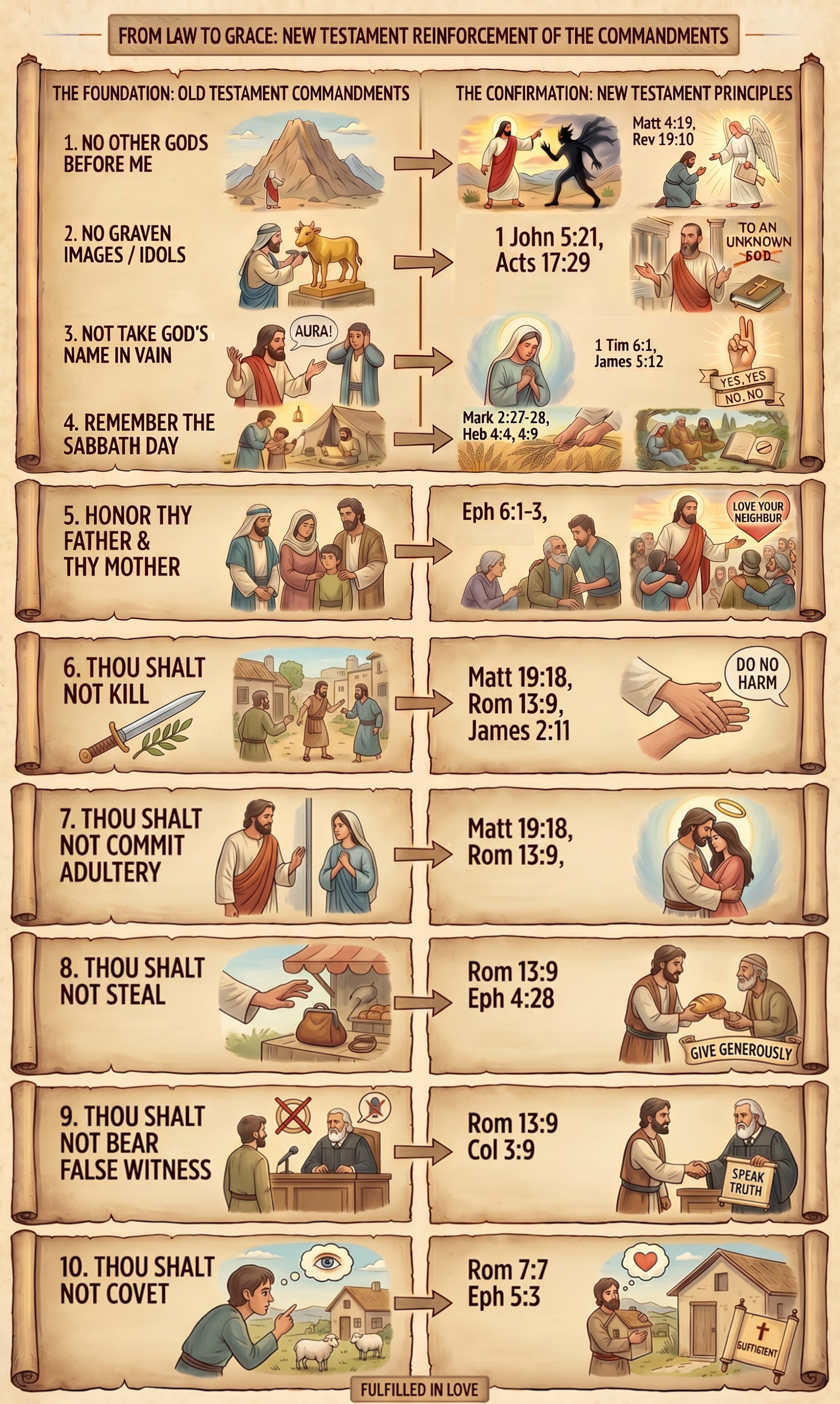
(Neither Nano banana nor Grok always behave.)
The commandment that gets buried
There is a second way the law gets changed, and it deserves its own moment because it sits directly under the table you just read.
Pick up any Catholic catechism card, look at a plaque on a parish wall, or read a confirmation-class summary of the Ten Commandments. Count them. You will get to ten. But read carefully. The second commandment — “Thou shalt not make unto thee any graven image, or any likeness of any thing that is in heaven above, or that is in the earth beneath, or that is in the water under the earth: Thou shalt not bow down thyself to them, nor serve them…” (Ex 20:4-5) — isn’t there.
Not deleted. Strictly speaking. The full text is in the Catechism of the Catholic Church at paragraphs 2084 onwards, and the full Exodus 20 passage is quoted. Rome’s argument is that this is a matter of numbering tradition, not content. Here’s how they put it themselves:
“The division and numbering of the Commandments have varied in the course of history. The present catechism follows the division of the Commandments established by St. Augustine, which has become traditional in the Catholic Church.” — CCC 2066
The Augustinian division folds “no other gods” and “no graven images” together into a single first commandment, then splits “thou shalt not covet” into two (coveting thy neighbor’s wife and coveting thy neighbor’s goods) to get back to ten. It’s a numbering choice. And if we’re being academically fair, the original Hebrew had no section numbers at all. The division into ten came later.
So far, so defensible.
But then go and look at the short versions. The ones actually taught. The ones on the cards, the posters, the memorisation rhymes, the parish walls. Here is what appears:
I am the Lord your God; you shall have no other gods before me
You shall not take the name of the Lord your God in vain
Remember the Sabbath day and keep it holy
Honour your father and mother ...
You don’t get more official than this:
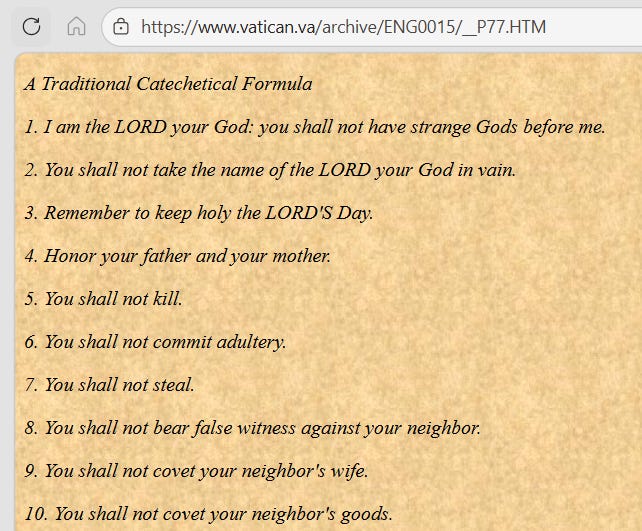
No mention of graven images. No mention of bowing down. No mention of the warning — “for I the LORD thy God am a jealous God” — that follows it in scripture. The entire section on idols simply vanishes from the summary form.
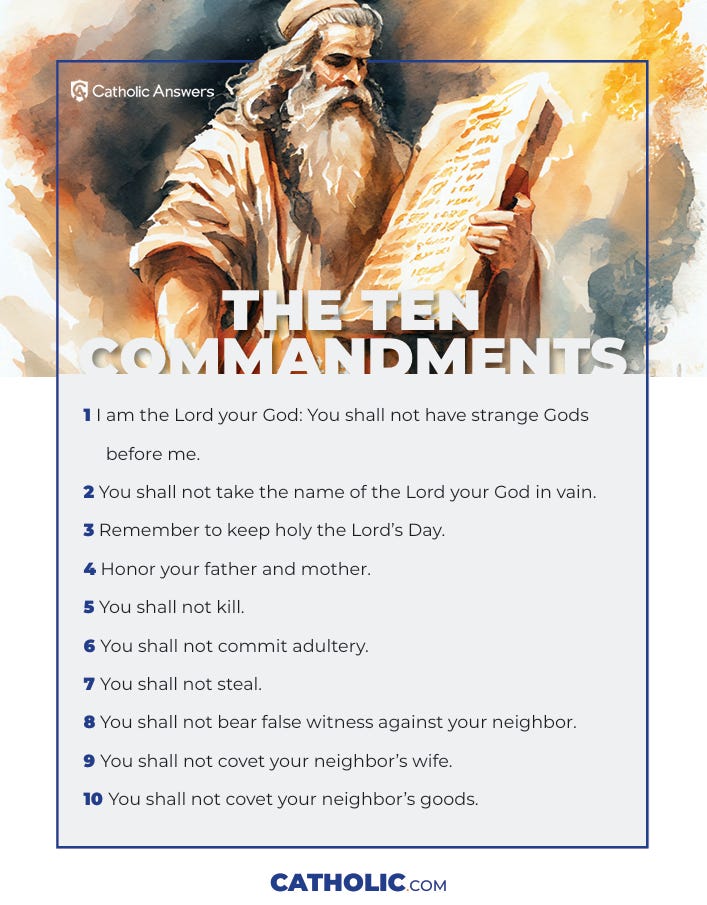
If the argument were really about numbering, the content would still be shown. Combined under the first commandment, perhaps, but still taught, still recited, still memorised. Instead it disappears from every abbreviated presentation that ordinary Catholics will ever encounter. You would have to open the full Catechism and read paragraph 2129 onwards to even know it was there.
And then comes the other tell.
The Catechism spends real space — paragraphs 2129 through 2141 — arguing that the veneration of sacred images is not a violation of what they now call the first commandment:
“The Christian veneration of images is not contrary to the first commandment which proscribes idols.” — CCC 2132
Notice what they just did there. They called it the first commandment. Which means they know it’s about idols. They know that’s what the commandment actually says. They just renumbered it, and then spent paragraphs defending why bowing before statues isn’t what the commandment is talking about.
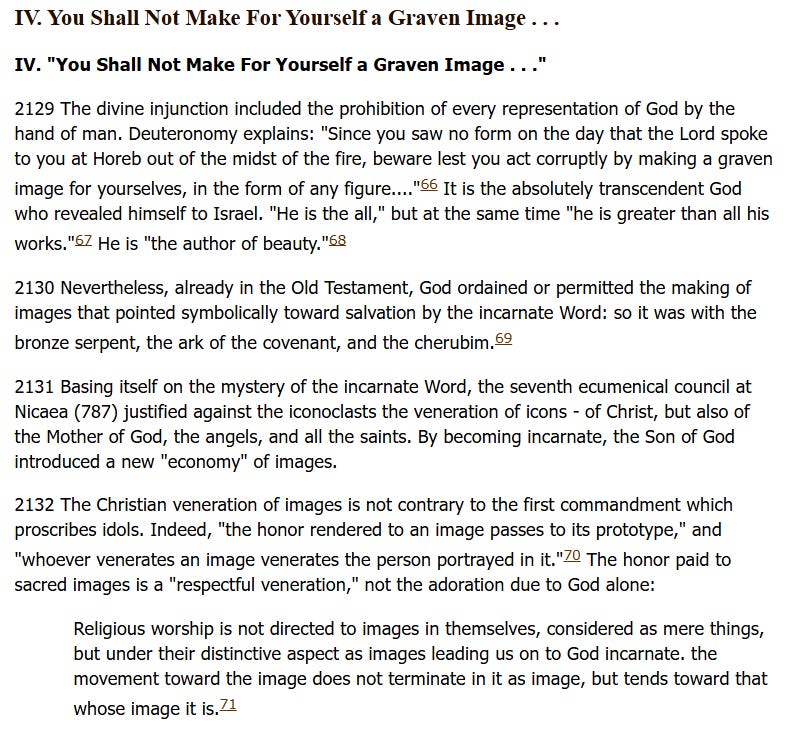
See for yourself.
They distinguish latria (worship, due to God alone) from dulia (veneration, given to saints) and hyperdulia (special veneration, given to Mary). The Catechism argues the honour “passes to its prototype” — that bowing to the statue of Mary isn’t really bowing to the statue, it’s bowing to the person it represents. The incarnation of Christ, they say, “introduced a new ‘economy’ of images” (CCC 2131), which made religious imagery acceptable in a way it wasn’t before.
Read that argument carefully. Read it twice. Because here is the uncomfortable observation. The amount of explanatory effort required to defend a practice is roughly proportional to how directly that practice contradicts the commandment that would otherwise forbid it.
You don’t need a doctrine of latria vs dulia if you’re not bowing to images. You don’t need a whole “economy of images” argument if no one’s venerating icons. Protestants don’t have these distinctions in their catechisms, not because Protestants are more spiritual, but because Protestants aren’t doing the thing that would require the defense.
I want to be careful here. Most Catholics I know are sincere, prayerful people who would be genuinely upset at the suggestion that they worship anything other than God. That’s not the charge. The charge is institutional, not personal. The system buries a commandment in its summary form and then spends pages justifying a practice that the commandment, read plainly, forbids. Individual Catholics are living inside a framework that was built, over centuries, to keep that particular commandment out of view.
Which circles back to Daniel’s prophecy. The power would “think to change times and laws.” The times change — Sabbath to Sunday. The laws change — the second commandment, in all practical summary form, erased. Both changes originated in the same institution. Both changes are defended today. Both changes require the faithful not to look too closely at the source text.
The full text is still in Exodus 20. Read it yourself. Count the words. See what’s missing from the card someone handed you.
Then to my point: they spend so much effort in defending this that they indirectly imply the continued application of the Law.
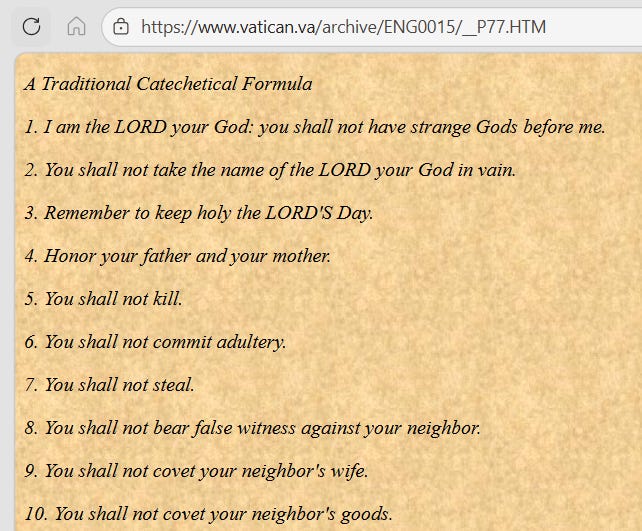
Liberty of conscience — why coerced worship fails on God’s own terms
Now to the prophetic application.
If the law is individual — if each person is judged personally, if each person must confess personally, if no group can save or condemn you — then something very specific follows: no human power has the right to enforce God’s law on another person’s conscience.
This is not a modern liberal idea. It’s a direct consequence of how God Himself operates.
God draws. He never coerces.
John 12:32 — “And I, if I be lifted up from the earth, will draw all men unto me.”
Revelation 22:17 — “…whosoever will, let him take the water of life freely.”
Joshua 24:15 — “…choose you this day whom ye will serve…”
2 Corinthians 3:17 — “…where the Spirit of the Lord is, there is liberty.”
Every single time God deals with human worship in scripture, He invites. He woos. He pleads. He never forces. Even when He gave the law, He said “choose.” Even when He faced off with Lucifer, He has permitted the rebellion to play out so that every mind can decide for itself, based on evidence.
He allows it to this day. If He removed Lucifer from the scene, then the universe would not have experienced the gravity of the ramifications.
The same God who refuses to coerce worship also refuses to let any earthly power step into the place He alone occupies between the first four commandments and the individual conscience. Jesus warned that this final deception would be so powerful that, if it were possible, it would deceive even the very elect (Matthew 24:24; Mark 13:22).
So when any earthly power — whether Rome, or Protestant America, or a secular state, or a theocratic movement — decides to legislate the first four commandments through civil law, they are doing something God Himself refuses to do.
This is what Sunday laws will be. This is what Noahide laws would be if activated (I wrote about this in the context of the Iran war and prophetic alignment). This is what any blasphemy statute ultimately is. A human authority attempting to enforce worship — which God Himself has left to individual conscience.
And the point is not just that it’s wrong. The point is that it’s blasphemous. It replaces the character of God with the character of Babel — the forced worship of Nebuchadnezzar’s image, the forced worship of the papacy through the Inquisition, the forced worship that the beast of Revelation 13 demands on pain of death.
Every time God’s people face forced worship in scripture, they refuse it. Daniel’s three friends in the furnace. Daniel in the lion’s den. Peter and John before the Sanhedrin — “we ought to obey God rather than men” (Acts 5:29). The apostles under Rome. The Waldenses. The Reformers. The remnant.
When Pharaoh prevented the Israelites to keep the Sabbath, God retaliated. Go and read what the original word for ‘rest’ is as used in those sentences.
It’s going to happen again. The framework is already in place. And when it does, the remnant will refuse, because the first four commandments — the vertical ones — are between each person and God, and no human power has the authority to step into that space.
Voices across the centuries
I want to pause here and point out something that bears weight: this is not a fringe teaching that belongs to one modern denomination.
The position that God’s moral law still stands — that the Ten Commandments are binding on all Christians — was the mainstream view of the Reformation. John Wesley, the founder of Methodism, wrote:
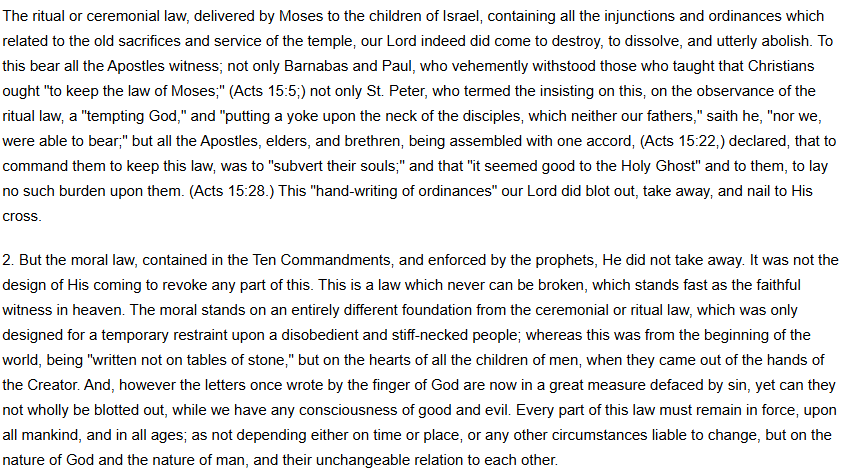
Wesley’s point was clear. Ceremonial law, abolished. Moral law, untouched. Every Christian, in all ages, bound to the Decalogue.
The Waldenses, centuries before the Reformation, kept the Sabbath and the moral law under violent papal persecution — precisely because they refused to accept that the law had been “changed.” John Wycliffe, the Morning Star of the Reformation, upheld the binding nature of the commandments.
Charles Spurgeon — the most celebrated Baptist preacher of the 19th century — preached the continuing authority of the Ten Commandments more than once, calling anyone who denied them “an Antinomian of the worst description.”
John Bunyan, in Pilgrim’s Progress and elsewhere, taught exactly the same thing. Here is a summary from Grok:
These are Methodists, Baptists, Presbyterians, Lollards, Waldensians. The unanimous testimony of Protestantism, across centuries, until the modern antinomian drift took hold in the last hundred years or so.
If you want a deeper academic treatment, Samuele Bacchiocchi’s From Sabbath to Sunday — a study that earned him the highest academic honours at the Pontifical Gregorian University in Rome, of all places — documents how the shift from Sabbath to Sunday took place historically, and it was not through any Biblical authority. It was a political and cultural process in the early church, accelerated by Rome, finalised by councils.
The law standing is the historic Christian position. The law being abolished is the novelty. Don’t let anyone tell you otherwise.
Ellen G. White — what she saw clearly
Ellen White wrote extensively on the law and grace. All her writings are available at egwwritings.org and can be searched directly. A few quotes that anchor everything I’ve written above.
On the impossibility of changing the law without undoing the cross:
“Could the law of God have been changed or abolished, Christ need not have died for death was not necessary in order to abolish the law. The fact that God spared not His own sinless beloved Son from the penalty He pledged Himself to bear as a sinner’s substitute is the most telling argument that could be produced to show that the claims of His law will not be released even in the slightest degree…” — Signs of the Times, August 25, 1887
That single quote is the clearest statement of the syllogism I’ve ever seen. The cross itself proves the law cannot be set aside.
On law and grace being inseparable:
“It is the sophistry of Satan that the death of Christ brought in grace to take the place of the law. The death of Jesus did not change or annul or lessen in the slightest degree the law of the Ten Commandments. That precious grace offered to men through a Saviour’s blood establishes the law of God. Since the fall of man God’s moral government and His grace are inseparable.” — Faith I Live By, p. 79
Inseparable. Not in tension. Not substitutes for each other. The grace establishes the law. Read Galatians differently after you’ve read this.
On the impossibility of claiming holiness while breaking commandments:
“Let none deceive themselves with the belief that they can become holy while wilfully violating one of God’s requirements. The commission of a known sin silences the witnessing voice of the Spirit and separates the soul from God.” — The Great Controversy, p. 472
Willful sin separates. Not inadvertent sin that drives us to repent — willful, eyes-open, “I know this is wrong but I’ll do it anyway” sin. That breaks fellowship. That is a door the Spirit cannot walk through.
On the law being kept only by grace:
“Only by accepting the virtue and grace of Christ can the law be kept.” — Review and Herald, July 15, 1902
This is the antidote to legalism. You don’t keep the law to earn salvation. You keep the law because you’ve been saved, and the Spirit within you is enabling what flesh never could. The distinction matters.
On the remnant and their identifying marks:
“The seal of the living God will be placed upon those only who bear a likeness to Christ in character… Those who were marked by that seal must stand firm for the truth, both in judgment and practice, that they may be kept from the plagues.” — Testimonies for the Church, Vol. 5, p. 212
The remnant — defined in Revelation 14:12 as those who “keep the commandments of God, and the faith of Jesus” — is precisely the group that has refused to accept the lie that the law is gone. They have faith in Jesus, and they keep His commandments. Both. Not one. Not the other. Both.
And what Ellen White saw of the end-time conflict is worth quoting in full, because it ties the law directly to the coming crisis:
“The law of God, through the agency of Satan, is to be made void. In our land of boasted freedom, religious liberty will come to an end. The contest will be decided over the Sabbath question, which will agitate the whole world.” — Maranatha, p. 179
That the final battle will be fought over the law — specifically the fourth commandment — is not a footnote to prophecy. It is the prophecy. Rev 12:17 and 14:12 both identify the remnant by this exact mark.
Faith without works is dead
We’re at the end. Let me land it.
Through this whole post I’ve argued that the law stands, that Jesus’ death proves it, that the sanctuary requires it, that the judgement measures by it, that every counter-verse collapses on examination, that the new covenant internalises it rather than deleting it, and that the end-time crisis will be fought over it.
And through all of it, I’ve kept saying: we are not saved by keeping the law. Grace alone. Faith alone. Through Jesus alone. It’s evidence.
But here is what James closes with, and what I want to close with:
James 2:17-18 — “Even so faith, if it hath not works, is dead, being alone. Yea, a man may say, Thou hast faith, and I have works: shew me thy faith without thy works, and I will shew thee my faith by my works.”
James 2:26 — “For as the body without the spirit is dead, so faith without works is dead also.”
If you say you have faith in Jesus but you’re happy to continue breaking the commandments you know to be His — that faith is dead. It’s not real faith. Real faith produces a changed life. Real faith says, like Jesus said to the woman caught in adultery:
John 8:11 — “…Neither do I condemn thee: go, and sin no more.”
Both halves. “Neither do I condemn thee” — that’s the grace. “Go and sin no more” — that’s the call to obedience. You cannot take one and leave the other. He said both.
And for anyone still wondering whether obedience matters to Jesus after the cross:
John 14:15 — “If ye love me, keep my commandments.”
John 15:10 — “If ye keep my commandments, ye shall abide in my love; even as I have kept my Father’s commandments…”
1 John 5:3 — “For this is the love of God, that we keep His commandments: and His commandments are not grievous.”
1 John 3:21-22 — “Beloved, if our heart condemn us not, then have we confidence toward God. And whatsoever we ask, we receive of Him, because we keep His commandments, and do those things that are pleasing in His sight.”
Love and obedience are not separate categories for Jesus. They are the same category. The person who loves Him keeps His commandments. The person who doesn’t, doesn’t. He said it. More than once. He meant it.
I’d be upset if my child keeps telling me he loves me but keeps breaking my rules. The only interpretation of his disobedience would be that he lied. Which in itself breaks the law.
And the last and most direct:
1 John 2:1-2 — “My little children, these things write I unto you, that ye sin not. And if any man sin, we have an advocate with the Father, Jesus Christ the righteous: and He is the propitiation for our sins…”
John’s pastoral order is perfect. Don’t sin. But if you do, there’s an advocate. The first part is not cancelled by the second. The second is the safety net for the first.
And the final verse of scripture I want to leave you with is the one that defines the end-time people:
Revelation 14:12 — “Here is the patience of the saints: here are they that keep the commandments of God, and the faith of Jesus.”
Commandments and faith. Both.
That’s the remnant. That’s the group God is gathering right now. That’s who He is preparing to take home.
Revelation
The last book in the Bible refers to the remnant as those that keep the commandments THREE time. Twice of those the Spirit through John adds Jesus to it. How many times does He have to point it out?
Revelation 12:17 - “And the dragon was wroth with the woman, and went to make war with the remnant of her seed, which keep the commandments of God, and have the testimony of Jesus Christ.”
Revelation 14:12 - “Here is the patience of the saints: here are they that keep the commandments of God, and the faith of Jesus.”
Revelation 22:14 - “Blessed are they that do his commandments, that they may have right to the tree of life, and may enter in through the gates into the city.”
whydoneit?
Look — the evidence is overwhelming. The law stands. The cross proves it. The sanctuary confirms it. The judgement measures by it. Every counter-verse falls apart when read in context. Every commandment is re-stated in the New Testament. The new covenant moves the law from stone to heart — not from binding to abolished.
So why is the opposite preached everywhere?
Because the one person in the universe with the most to lose from the law standing is the one who has been whispering against it since Eden. “Hath God said?” was his opening line in the garden, and it has been his opening line in every pulpit since. If he can get the church to believe the law is gone, he accomplishes two things at once. He removes the basis on which he himself is accused. And he removes the basis on which people feel any need for a Saviour. Both at once. The deception is ancient, and it is elegant, and it is working.
Across thousands of pulpits, well-meaning pastors will tell their congregations that we’re “under grace” and the law is done. All of them, I believe, genuinely love Jesus. But the doctrine they are repeating did not come from Jesus. It came from the accuser, through centuries of careful distortion — a Sabbath quietly shifted, a commandment quietly buried, a word like telos quietly mistranslated — until the church that was supposed to be the pillar and ground of the truth found itself preaching precisely what the devil needed them to preach.
The cost of being wrong on this one is deathly, because it is precisely this confusion — the belief that the law doesn’t matter — that the end-time deception is built on. When the mark of the beast comes, it will come as a religious mandate from a professing Christian authority, and the churches that have already surrendered the law will fold without a fight. Not because they are wicked, but because they have been deceived. The armour was the law. They were talked into putting it down.
The remnant will be the ones who kept it. Not to earn salvation. Never that. But because they love the one who gave it, and they trust that what He wrote in stone He still means. Evidence of obedience.
Jesus died because of my sins. Not for no reason. Because the law I had broken demanded it. His death wrote the law into permanence, not into deletion. And because He rose, and because He is right now ministering in the Most Holy over the ark that still holds the law, I can stand — confessed, covered, clothed in his righteousness — and be judged by the law of liberty.
The law stands. It will stand forever. Those that love Him will keep it. That’s all.
PS1: If you want to go down the rabbit hole, study the concept: “The close of Probation”.
PS2: I’ve spent more than a decade attempting my hand at screenplays and crafting stories. Nothing remotely resembles the scale of the narrative of the Bible, the foreshadowing of Jesus, how antitype meets type and the prophetic runway.
Here is a video that covers most of the above: