

Religious 26: Programmable Money = Buy & Sell
Eph 5:11: “…have no fellowship with the unfruitful works of darkness, but rather reprove them.”
Amos 3:7 “…God will do nothing, but he revealeth his secret unto his servants the prophets.”
Why this post?
To show that the mechanism to enforce buying and selling at scale — the one described 2,000 years ago — now exists. In law. In code. In the global financial plumbing.
Introduction
If you’ve been following this series, you’ll know I’ve spent a lot of time identifying what the mark of the beast is. In Post 16 we walked through the evidence — from Scripture, from Catholic admissions, from AI analysis — and arrived at the Sabbath. In Post 18 we mapped out the end-time sequence. And in both posts, we asked the same question:
How would they actually prevent buying and selling?
Revelation 13:17 “And that no man might buy or sell, save he that had the mark, or the name of the beast, or the number of his name.”
We mentioned the Canadian truckers who had their bank accounts frozen. We mentioned Nigel Farage. We mentioned CBDCs — Central Bank Digital Currencies — and noted that the BIS had confirmed they’d be programmable. We even floated the idea that Bitcoin’s mysterious creator might be controlled opposition.
That was all theory. Directional thinking. A sketch of where things might go.
This post is the update. And honestly it’s a bit unsettling how fast it moved.
Because the mechanism isn’t coming. It’s here. Already legislated, already operational, already being deployed against entire nations. And the people building it are telling you exactly what it does — if you’re paying attention.
For readers new to this series: I’ve spent the previous 25 posts walking through Biblical prophecy systematically — Daniel’s timelines, the beasts of Revelation, the mark, the judgment, the seven churches. We’ve identified the first beast (the papacy), the second beast (the United States), and the mark of the beast (Sunday worship enforced as a counterfeit Sabbath). If that sounds wild and you haven’t read those posts, start with Post 6: Define Prophecy and work forward. What follows here will make a lot more sense with that foundation.
For those who’ve been following: this post picks up exactly where Post 16 and Post 18 left off. We asked how they’d enforce buying and selling. Now I’m going to show you the infrastructure that’s been built — in law, in technology, and in global coordination — to do exactly that. This is a secular deep dive with prophetic implications throughout.
Let me be clear before we go any further: stablecoins are not the mark. The mark is about worship and compliance — we established that. Programmable money is the enforcement tool. It’s the mechanism that makes Rev 13:17 possible at scale. You can’t prevent 8 billion people from buying and selling with paper cash. But with programmable digital money that can be frozen, burned, or restricted with the click of a button? Now you can.
And the beauty of it — from their perspective — is that most people will adopt it voluntarily. Because it’s convenient. Because it’s fast. Because it’s “the future.” The chains don’t feel like chains when they come wrapped in a sleek app and a 2-second transaction time.
Let’s trace how we got here.
The Blueprint — 1997
In June 1996, the United States National Security Agency published a paper called “How to Make a Mint: The Cryptography of Anonymous Electronic Cash.”
Three NSA employees — Laurie Law, Susan Sabett, and Jerry Solinas — from the NSA’s Office of Information Security Research and Technology wrote it. It was later published in the American University Law Review in 1997.
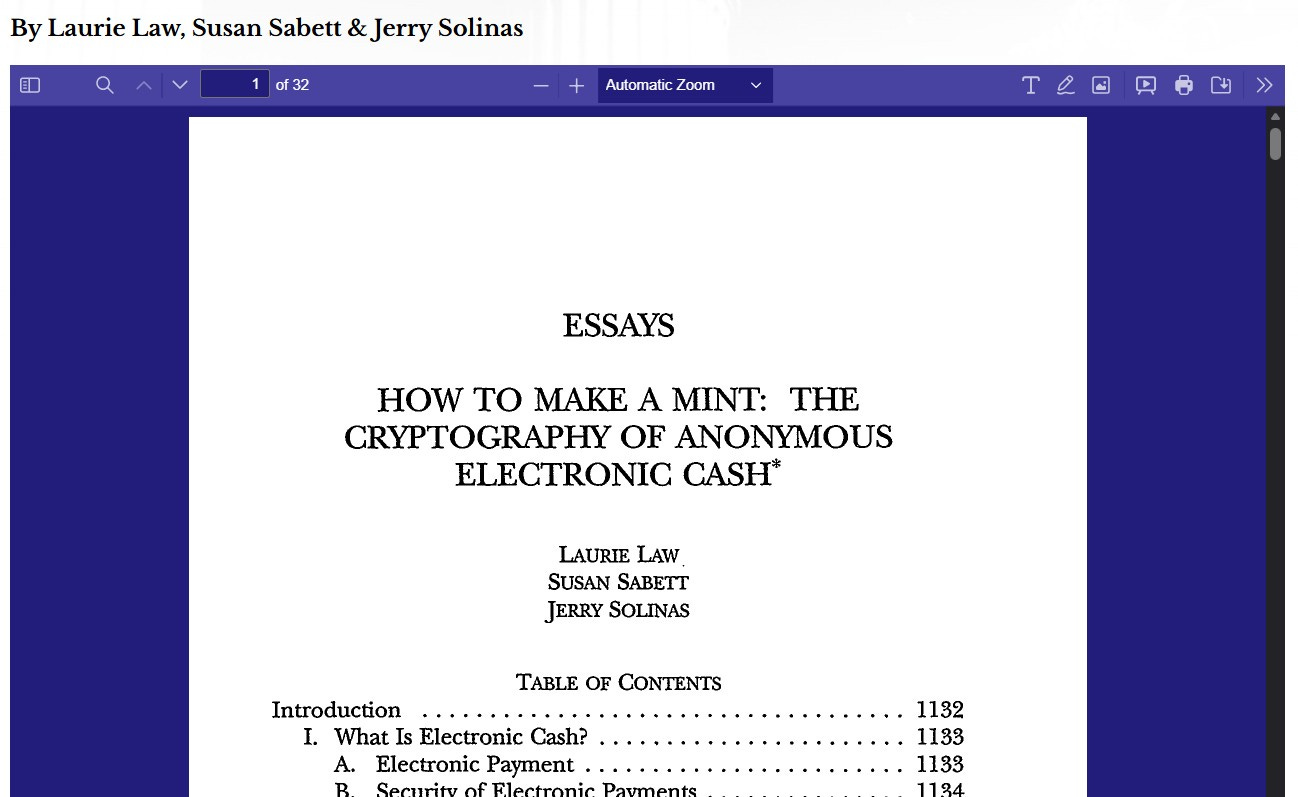
The paper laid out the entire cryptographic framework for digital cash. Blind signatures. Double-spend prevention. Anonymity protocols. Privacy-preserving payment systems. It referenced pioneers like David Chaum and — interestingly — a researcher named Tatsuaki Okamoto. Make of that surname what you will.
The paper also warned about the downsides. It noted that anonymous electronic cash would make money laundering “far more serious than with paper cash” and would increase vulnerability to what they called “Information Warfare attacks.” So they knew. They knew the risks. They knew the potential. And they published the blueprint anyway.
Thirteen years later, in 2009, a mysterious figure called Satoshi Nakamoto — whose identity has never been confirmed — launched Bitcoin. Using cryptographic techniques that the NSA had documented over a decade earlier.
The paper even noted — and this is the part that doesn’t get enough attention — that the “widespread use of electronic cash would increase the vulnerability of the national financial system to Information Warfare attacks.” They weren’t naive about what they were describing. They understood that whoever controls digital money controls the financial battlefield.
And yet they published the blueprint openly. In an academic law review. As if placing a marker for the future.
Coincidence? I don’t know. But the intelligence community had the recipe before anyone else. Whether they baked the cake is a question worth sitting with. At minimum, they were thinking about programmable electronic money at a time when most people were still figuring out email.
The Quiet Part Out Loud
Before we get into the specifics of what’s been built, you need to hear what the architects themselves are saying. Because they’re not hiding it.
Agustín Carstens, General Manager of the Bank for International Settlements — the central bank of central banks — said this at an IMF seminar on CBDCs:
“We don’t know who’s using a $100 bill today and we don’t know who’s using a 1,000 peso bill today. The key difference with the CBDC is the central bank will have absolute control on the rules and regulations that will determine the use of that expression of central bank liability, and also we will have the technology to enforce that.”

Read that again. Absolute control. And the technology to enforce it.
Then there’s Bo Li, Deputy Managing Director of the IMF and former deputy governor of the People’s Bank of China. At a CBDC roundtable in Washington DC in October 2022, he said:
“By programming CBDC, money can be precisely targeted for what kind of people can own and what kind of use this money can be utilized.”
What kind of people can own it. What kind of use it can be put to. That’s not a conspiracy theory. That’s the deputy managing director of the International Monetary Fund describing programmable restrictions on who can buy and who can sell.
And the BIS published a paper in 2023 that asked — I’m not making this up:
“What type of CBDC designs could be launched without programmability but would leave open the capability to introduce it at a future date, if needed, without requiring a major redesign?”
In other words: how do we build the backdoor now and activate it later?
They’re describing the same thing. The only difference is the language.
Stablecoins → The Quiet Takeover
Here’s where it gets practical. While everyone was arguing about Bitcoin’s price and whether Dogecoin was a joke, stablecoins quietly became the most significant financial development in decades.
A stablecoin is a digital token pegged 1:1 to a real currency — usually the US dollar. Think of it as a digital dollar that lives on a blockchain. Unlike Bitcoin, it doesn’t swing 20% in a week. One USDT or one USDC equals one dollar. Always. That’s the point.
The numbers are staggering:
Total stablecoin market cap exceeded $300 billion by late 2025
Stablecoins processed $33 trillion in transaction volume in 2025 — more than Visa and Mastercard combined
99% of all stablecoins are pegged to the US dollar
Tether (USDT) dominates at ~$187 billion market cap, followed by Circle’s USDC at ~$75 billion
USDC grew 73% in 2025 alone
Tether holds approximately $135 billion in US Treasury bills — ranking it around 17th globally as a holder of US debt. Ahead of South Korea. Ahead of Saudi Arabia.
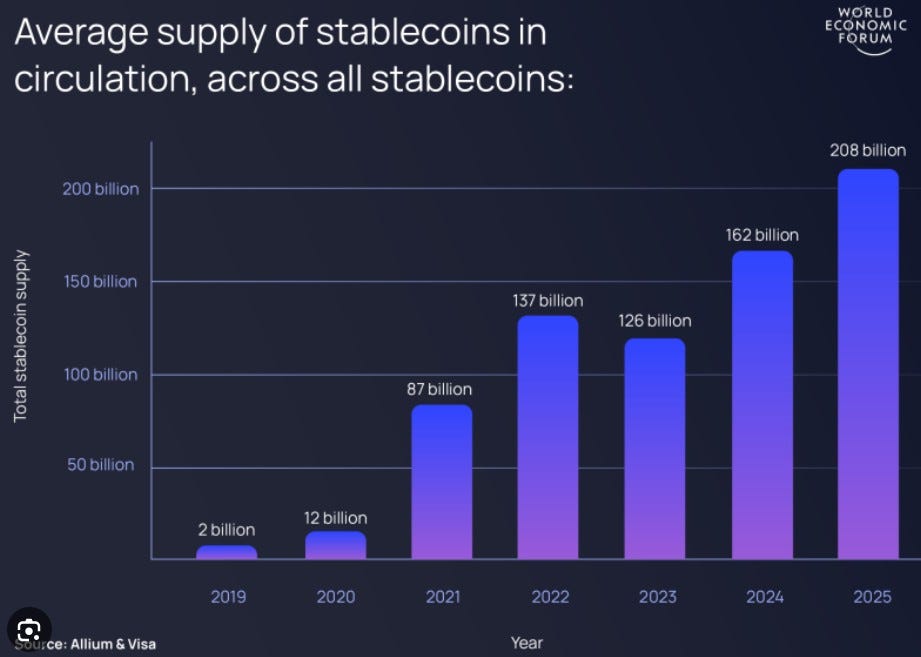
This isn’t speculation. This isn’t the crypto casino. This is financial infrastructure. And it’s denominated in dollars by design — extending US monetary influence into every corner of the digital world.
Standard Chartered projects the stablecoin market could reach $2 trillion by 2028. Citi’s estimate is even higher — between $1.9 trillion and $4 trillion by 2030. Treasury Secretary Bessent has floated $3.7 trillion by decade’s end. If that sounds insane, consider that stablecoins grew from $2 billion to $300 billion in just five years. The trajectory is exponential, not linear.
And here’s the thing that should tickle your fancy: stablecoin transaction volume surpassed Visa in 2024. Not someday. Already happened. The settlement layer of the future is being built on digital dollars that can be programmed, tracked, frozen, and burned. That’s not an upgrade. That’s a paradigm shift.
The Law — GENIUS Act
On July 18, 2025, President Trump signed the GENIUS Act into law. The full name: Guiding and Establishing National Innovation for U.S. Stablecoins Act. It’s the first federal stablecoin legislation in US history.
The White House fact sheet was blunt about its purpose:
“The GENIUS Act will generate increased demand for U.S. debt and cement the dollar’s status as the global reserve currency.”
Here’s what it mandates:
1:1 reserve backing with US Treasuries, cash, or equivalent liquid assets — no exceptions
Issuers are classified as financial institutions under the Bank Secrecy Act
Monthly public disclosure of reserve composition
Stablecoin holders have priority over all other creditors in insolvency
Issuers cannot pay interest or yield to holders
And here’s the one that matters most: all stablecoin issuers must possess the technical capability to seize, freeze, or burn payment stablecoins when legally required

Read that last point again. It’s in the law. Programmable money with a government-mandated kill switch. Not optional. Not a future feature. A legal requirement for every stablecoin issuer operating in the United States.
The White House fact sheet went further. It noted that “all stablecoin issuers must certify that they have implemented AML and sanctions compliance programs” and that anyone convicted of money laundering, terrorist financing, or financial fraud is permanently barred from serving as an officer or director of an issuer. The penalties for non-compliance? Up to $1 million per violation and five years in prison.
This isn’t some light-touch regulation. This is the federal government building a surveillance and control apparatus into the DNA of digital money. Every stablecoin that moves will be traceable. Every wallet can be frozen. Every token can be burned. And the issuers are legally required to make all of this possible.
And remember — 99% of stablecoins are USD-pegged. The GENIUS Act effectively gives the US government the ability to control, freeze, or destroy digital dollars anywhere in the world, through private issuers who are legally compelled to comply.
The mechanism exists. Right now. In law.
The Theater — “Anti-CBDC” While Building the Same Thing
Now here’s where it gets properly interesting. Because simultaneously, the US government is loudly opposing CBDCs.
The CLARITY Act — the comprehensive crypto market structure bill currently working its way through the Senate — has a full title that most people never read:
“Digital Asset Market Clarity Act of 2025” AND “Anti-CBDC Surveillance State Act”
Yes. The same bill that’s building the regulatory framework for stablecoins also explicitly:
Prohibits the Federal Reserve from offering products or services directly to individuals
Prohibits the use of central bank digital currency for monetary policy
So on paper, the US government is killing CBDCs while building the exact same infrastructure through private stablecoins.
Think about what the GENIUS Act actually creates. Stablecoins that:
Must be backed by government bonds (US Treasuries)
Must comply with the Bank Secrecy Act (full AML/KYC surveillance)
Must implement sanctions compliance programs
Must be able to freeze, seize, or burn tokens on legal order
Are issued by licensed, regulated entities under federal oversight
How is this functionally different from a CBDC?
It’s not. It’s the same control mechanism — surveillance, programmability, kill switches — operated through private companies instead of the central bank. The government gets plausible deniability (”we banned CBDCs!”) while retaining every capability a CBDC would have provided.
Same destination. Different vehicle. Controlled opposition at its finest.
If this seems familiar, it should. It’s the same playbook we’ve seen throughout this series. Create the problem, offer the solution, control the outcome. The public is told: “We’re protecting you from Big Government surveillance! No CBDC!” Meanwhile the legislation they’re celebrating hands the same surveillance capabilities to private corporations under government mandate. The branding changed. The control didn’t.
And if you want to see where full state control ends up — look at China. The e-CNY is the most advanced CBDC in the world. Trillions in transaction volume. Cross-border pilots via the mBridge platform (over $55 billion cumulative). Interest-bearing wallets launched in 2026. In a trial in Shenzhen, the CBDC was programmed with an expiration date — forcing people to spend it within a set timeframe. 90% of the vouchers were spent in shops. That’s not a payment system. That’s behavioral engineering. The testing ground.
The West is arriving at the same place. Just through a different door. And they’re telling you they’re protecting you while they build it.
Already Being Deployed
If you think the freeze-and-burn capability is just a legal technicality sitting on paper, think again. It’s already being used as a geopolitical weapon. And the examples are multiplying fast.
Venezuela
Venezuela sits on the world’s largest proven oil reserves — 303 billion barrels, roughly 17% of the global total. The country has been under US sanctions for years, targeting the Maduro government, PDVSA (the state oil company), and the central bank.
As traditional banking channels were systematically cut off, the Maduro regime started accepting USDT (Tether) for oil exports, primarily selling crude to China. This effectively bypassed the US-controlled banking system and the petrodollar framework entirely. The US Department of Justice has issued indictments against individuals brokering these deals.
By November 2025, stablecoin adoption in Venezuela had moved well beyond government oil deals. USDT reportedly accounted for nearly 10% of all grocery payments. Peer-to-peer markets and informal brokers became essential financial infrastructure — not because Venezuelans love crypto, but because their banking system collapsed and hyperinflation destroyed their currency.
In January 2026, the US captured Maduro in a nighttime raid. Reports suggest the regime had also been converting stablecoins into Bitcoin to reduce freeze risk — because they knew Tether could burn USDT on command.
Iran
Iran has been trading oil outside the dollar system for years. They opened an oil bourse on Kish Island specifically to price oil in euros and other currencies. The IRGC (Islamic Revolutionary Guard Corps) has been increasingly active in crypto — Chainalysis reported that in Q4 2025, IRGC-linked addresses accounted for over half of all value received by Iranian entities, moving more than $3 billion.
Russia
Russia’s approach was the most ambitious. After being partially cut off from SWIFT following the Ukraine invasion, Russia created an entire stablecoin infrastructure. The ruble-backed A7A5 stablecoin processed over $93.3 billion in under a year — becoming a critical settlement rail for Russian businesses to access global markets despite Western sanctions. The EU sanctioned A7A5 and the exchanges that facilitated it (Grinex and Meer) in October 2025.
The US Response
Here’s what matters for our discussion. The Atlantic Council — one of Washington’s most influential think tanks — explicitly recommended that the US government respond to stablecoin-based sanctions evasion by working with stablecoin issuers to seize or burn digital assets held by sanctioned entities. Not freeze bank accounts. Not impose fines. Burn the money itself. Remotely. Permanently.
And Tether has already cooperated with the US Department of Justice to do exactly this — freezing wallets linked to sanctioned entities and dismantling exchange infrastructure supporting Russian sanctions evasion through Garantex.
The kill switch works. It’s been activated. Multiple times. Against multiple nations.
Here’s the uncomfortable truth: the same capability that lets the US government burn a Venezuelan oil trader’s stablecoins can — in a different political context — be used to prevent anyone from buying or selling. The technology doesn’t care about the reason. It just executes. Today it’s sanctioned regimes. Tomorrow?
SWIFT — The Pipes Go Digital
Most people have never heard of SWIFT. But it’s the nervous system of global finance. The Society for Worldwide Interbank Financial Telecommunication connects over 11,500 financial institutions across 235 countries and facilitates roughly $5 trillion in payments per day.
If you wire money internationally, it goes through SWIFT. If a country gets cut off from SWIFT — as Russia partially was — it’s devastating. SWIFT is the tollbooth of global finance.
In September 2025, at the Sibos conference in Frankfurt, SWIFT announced something remarkable. They’re adding a blockchain-based shared ledger to their infrastructure. Not replacing the old system — extending it into the digital world.
SWIFT’s CEO, Javier Perez-Tasso, said:
“You may think, ‘Wow, aren’t those opposites? SWIFT and blockchain. TradFi and DeFi. Can they really go together?’ In the regulated system of the future, we believe they can. Banks are ready for it. And they’re asking us to play a bigger role.”
Over 30 banks — including JP Morgan, HSBC, Deutsche Bank, BNP Paribas, and BNY Mellon — signed up immediately. They’re piloting stablecoin settlement on Ethereum’s Layer 2 network using a stablecoin-like token. They’ve tested tokenised bond settlement using Societe Generale’s euro stablecoin (EURCV).
And in March 2026, Thunes launched a service that lets all 11,500 SWIFT-connected banks send instant payments to over 500 million crypto wallets holding USDT or USDC. Without any new integrations.

The global financial plumbing is being rewired. And it’s being rewired to handle programmable, freezable, burnable digital money. Not sometime in the future. Now.
Worth noting: SWIFT’s role in enforcing sanctions has already demonstrated what happens when you control the pipes. When Russia was partially disconnected from SWIFT after the Ukraine invasion, it was economically devastating. But SWIFT cutting off a nation is a blunt instrument — it affects everyone in that country, including civilians. Programmable stablecoins flowing through SWIFT’s new blockchain infrastructure offer something far more surgical: the ability to target individuals, companies, or transactions with precision. Freeze one wallet. Burn one token. Block one purchase. All while the rest of the system keeps humming.
That’s not less control than SWIFT disconnection. It’s more control. It’s granular. And it’s invisible to everyone except the person being targeted.
The Regulators Align
On March 11, 2026, the SEC and CFTC signed a historic Memorandum of Understanding establishing a Joint Harmonization Initiative. Six days later, on March 17, they issued a joint 68-page interpretive release that fundamentally changed how crypto assets are classified in the United States.
For the first time, the two agencies jointly classified 16 major cryptocurrencies — including Bitcoin, Ether, Solana, XRP, Dogecoin, Cardano, and others — as “digital commodities” and therefore not securities.
They created a five-tier taxonomy: digital commodities, digital collectibles, digital tools, stablecoins, and digital securities.
They explicitly cleared:
Protocol mining (including mining pools) — not a securities transaction
Protocol staking (solo, self-custodial, custodial, liquid) — not a securities transaction
Airdrops (where no consideration is provided) — not a securities transaction
Wrapping (1:1 redeemable, no yield) — not a securities transaction
SEC Chairman Paul Atkins called it a turning point. CFTC Chairman Michael Selig called it the end of regulatory ambiguity. In a joint op-ed, Atkins and the Republican commissioners wrote: “Only Congress can rewrite the law, and we stand ready to work with CFTC Chairman Michael Selig to implement the CLARITY Act. In the meantime, we are providing the responsible regulatory approach that markets demand.”
The era of “regulation by enforcement” — where the SEC would sue first and define rules later — is officially over. They replaced it with something far more consequential: a comprehensive framework that legitimises, categorises, and governs digital money.
Why does this matter for our discussion? Because you don’t build frameworks for things you plan to shut down. You build frameworks for things you plan to scale. The regulatory infrastructure for programmable digital money is being laid — systematically, globally, and with full government backing. They’re not fighting it. They’re formalising it. Institutionalising it. Making it permanent.
And the CLARITY Act — still working through Senate negotiations as of March 2026 — would codify all of this into statute. The House passed it in July 2025. The Senate Agriculture Committee advanced its version in January 2026. Sticking points remain (stablecoin yield provisions, DeFi treatment, community bank concerns), but the direction is unmistakable. Treasury Secretary Bessent described passage as a “spring 2026 target.” Ripple’s CEO estimated 80-90% odds of passage. JPMorgan analysts called it a “positive catalyst for digital assets.”
The machinery is being built. The operators are being trained. The framework is being codified. All that’s left is the trigger event that puts it to use.
The World Falls in Line
This isn’t just the United States. Every major economy on earth is either regulating stablecoins or launching CBDCs. Many are doing both. Here’s where things stand:
North America
USA: GENIUS Act (signed July 2025) — first federal stablecoin law. CLARITY Act advancing in Senate. 1:1 Treasury backing, freeze/burn capability required.
Europe
EU (27 member states): MiCA regulation — full enforcement July 2026. EMI licensing required, 60% of reserves must be held in EU banks. USDT delisted from EU exchanges for non-compliance. USDC and EURC compliant.
UK: FSMA digital settlement assets regime — FCA framework being implemented throughout 2026.
Asia-Pacific
Singapore: MAS stablecoin framework operational. XSGD (Singapore dollar stablecoin) live since 2020, partnered with Grab for payments across Southeast Asia.
Hong Kong: Stablecoin Ordinance passed May 2025, effective August 2025. HKMA licensing required. 100% reserves in high-quality liquid assets. No interest allowed. First licences expected early 2026.
Japan: Payment Services Act — one of the most mature frameworks globally. Strict reserve requirements.
South Korea: Virtual Asset User Protection Act (2024) focused on investor protection. “Second phase” legislation for KRW stablecoins under active consideration.
Taiwan: VASP Act draft submitted to Executive Yuan (June 2025). Banks already studying NTD stablecoins. Implementation expected late 2026 or early 2027.
Thailand: Approved USDT and USDC for trading (March 2025). Direct crypto-to-crypto trading enabled.
Australia: ASIC approved AUDM (by Catena Digital) — first and only approved domestic stablecoin. Draft legislation for stored value facilities released October 2025. 1:1 collateralisation required. Framework targeting 2026 implementation.
New Zealand: FMA designated NZDD (by ECDD Holdings / Easy Crypto) as “not a financial product” on March 11, 2026. NZD-pegged, 1:1 backed with cash held in trust. Went through FMA’s fintech sandbox.
Middle East
UAE: CBUAE Payment Token Regulation (August 2024) at federal level. VARA in Dubai, FSRA in Abu Dhabi. AED-pegged stablecoins regulated solely by the central bank.
South America
Brazil: Drex CBDC in phased 2026 launch. Crypto exchange regulation Phase I underway.
Africa
South Africa: ZARU stablecoin launched February 3, 2026 — backed by a consortium including Luno (crypto exchange), Sanlam (investment giant), Standard Bank (holding the cash), and EasyEquities (distribution). Rand-pegged, 1:1 backed by cash and South African government bonds. Currently institutional only — retail access planned later. Monthly audits by Moore Johannesburg. Here’s the detail that matters: because the reserves include SA government infrastructure bonds (Treasury raised R11.8 billion through these in December 2025), every ZARU token minted creates demand for sovereign debt. Sound familiar? It’s the same model as the GENIUS Act — stablecoins funding government bonds. Different continent, same architecture. Meanwhile, SARB flagged stablecoins as a financial stability risk — stablecoin trading volumes surged from R4 billion (2022) to R80 billion (October 2025). 7.8 million crypto users across the three largest exchanges. USD-pegged stablecoins overtook Bitcoin as the most traded pair in 2022. The SARB Governor warned at the 2026 Warwick Summit that stablecoins could “break apart” and threaten monetary sovereignty.
Nigeria: eNaira CBDC live — one of three fully launched retail CBDCs globally.
Caribbean
Bahamas: Sand Dollar CBDC live — the first CBDC launched globally.
Jamaica: JAM-DEX CBDC live — domestic payments focus.
The global picture: 137 countries (representing 98% of global GDP) are exploring CBDCs, with 49 pilots underway. Three have fully launched retail CBDCs. Every major financial jurisdiction has either enacted or is advancing stablecoin-specific legislation.

Nobody is opting out. The pattern is universal. And the direction is the same everywhere: licensed issuers, full reserves, government oversight, AML compliance, and — increasingly — the ability to freeze or restrict transactions.
The global scope is precisely what prophecy describes. Not one nation. All of them.

Bonds and Shackles
Here’s a detail most people miss. And it’s crucial.
Stablecoins backed by government bonds means that every dollar held in stablecoins is — indirectly — funding government debt. When you hold USDT, Tether buys US Treasury bills with your money. When South Africans hold ZARU, the reserves include South African government infrastructure bonds.
Treasury Secretary Scott Bessent has stated the stablecoin market could reach $3.7 trillion by the end of the decade. At that scale, stablecoin issuers would become one of the largest buyers of sovereign debt on earth.
The government gets cheap, reliable debt financing. The public gets programmable money that can be frozen at will. Both sides think they’re winning.
A BIS study from 2025 found that stablecoin issuer purchases of Treasury bills reduced 3-month yields by 2-2.5 basis points. But here’s the asymmetry: when stablecoins outflowed, yields spiked by 6-8 basis points. The market is already sensitive to stablecoin flows — and we’re still in the early innings.
As one Vanderbilt Law professor put it: having stablecoin issuers always buying Treasuries is “a massive boost in terms of giving confidence to the Treasury Department about where to place debt.” At a time when traditional holders like China and Japan are signalling they’ll move away from US Treasuries, stablecoins are stepping in as the new buyer of last resort.
So the incentive structure is perfectly aligned: governments need stablecoins to fund their debt. Stablecoins need government bonds to back their tokens. And the public gets digital money with a kill switch attached — money that funds the very government that controls the switch.
That’s not an accident. That’s architecture.
They are selling their debt to you. The largest market available. TAM? With AI agent coming online?
The Petrodollar Connection
There’s a geopolitical layer to all of this that rarely gets discussed in polite company.
Since the 1970s, the global oil trade has been denominated in US dollars. Kissinger negotiated this with the Saudis — America provides military protection, Saudi Arabia prices oil in dollars. Every country that wants to buy oil needs dollars. This creates permanent global demand for the US currency and, by extension, for US Treasury debt.
Countries that have attempted to trade oil outside the dollar system — Iraq, Libya, Iran, Venezuela — have faced severe consequences. Sanctions. Regime change. Military intervention.
Now consider what’s happening with stablecoins. Venezuela started accepting USDT for oil exports to China — bypassing the dollar banking system while still transacting in dollar-denominated tokens. Iran opened a non-dollar oil bourse. Russia built an entire stablecoin infrastructure (A7A5) to settle cross-border trade.
The US response isn’t to shut down stablecoins. It’s to tighten control over them. The GENIUS Act ensures that US-regulated stablecoin issuers can freeze or burn tokens on command. The Atlantic Council recommends doing exactly this to counter sanctioned nations.
So the dollar’s dominance doesn’t end with stablecoins — it extends through them. The 99% USD-peg rate isn’t a market preference. It’s a feature. Every stablecoin transaction, anywhere in the world, reinforces dollar dominance. And now, through the GENIUS Act, the US government has the legal authority to control those transactions.
The petrodollar was about pricing oil in dollars. The “stablecoin dollar” is about pricing everything in programmable, controllable digital dollars.
And there’s a dark irony here. Venezuela’s people — ordinary citizens suffering under hyperinflation and banking collapse — adopted stablecoins out of necessity. By November 2025, USDT reportedly accounted for nearly 10% of all grocery payments in Venezuela. They use it to survive. To receive remittances. To preserve whatever value they can.
But the same infrastructure that lets a Venezuelan mother receive $50 from her son in Miami is the infrastructure that lets a government burn her balance if she’s on the wrong list. The technology is neutral. The power it grants is not.
Programmable Money Is Not Money
This is the point that needs to land. Because it’s the point that Carstens and Bo Li made — and the point that Revelation 13:17 describes. And it’s the point that most people gloss over because it sounds technical.
It’s not technical. It’s existential.
Cash — physical, paper, metal — has no conditions attached. A $100 bill doesn’t know who holds it. It doesn’t expire. It can’t be remotely frozen. It doesn’t require internet access. It doesn’t track where you spend it. It doesn’t need permission from anyone. Hand someone a $100 bill, and the transaction is done. No intermediary. No approval. No record.
Here’s how Catherin Austin Fitts describe it:

That’s what makes cash dangerous to people who want control. And it’s what makes it essential to people who want freedom.
Programmable money is the opposite of all of that.
With programmable money, the issuer — or the government behind the issuer — can:
Freeze your balance instantly, anywhere in the world
Burn your tokens permanently — not confiscate, destroy
Restrict what you can buy (only approved categories)
Restrict where you can buy it (only approved merchants)
Set expiration dates on funds (spend it or lose it — China already tested this)
Track every transaction you make in real time
Deny service to anyone, for any reason, at any time
Program conditions — money that can only be spent on certain goods, by certain people, in certain places
Apply negative interest rates — your money loses value if you don’t spend it fast enough
The European Data Protection Supervisor defined programmable money as having “built-in rules, imposing restrictions on the usage of that money.” They noted a government could “define a positive or negative interest rate to incentivise or disincentive the use of money for the purchase of a particular good; limit its use to a certain category of services; set an expiry date.”
Wikipedia’s entry on CBDCs is even more blunt. It notes that digital currency “will simply become an extension of the surveillance state” and “it could see citizens fined in a split second for behaviors deemed undesirable. Dissidents and activists could see their wallets emptied or taken offline.” It notes that digital currency “could also empower the state to make it impossible to donate to a vocal NGO” or even prohibit “a purchase of alcohol on a weekday.”
That’s not money. That’s a permission system. And access can be DENIED.
The difference between money and a permission system is the difference between freedom and servitude. Money says: this is yours, spend it as you wish. A permission system says: this is yours if you comply. And if you stop complying, it’s gone.
The bible verse doesn’t describe a financial system. It describes a permission system that governs who can participate in the economy. And programmable money — whether it’s called a CBDC or a regulated stablecoin — is exactly that.
The Cashless Push
One more piece of the puzzle. None of this works if cash remains widely available. Cash is the escape hatch. The off-ramp. As long as you can walk into a shop with physical currency, no digital system can fully control buying and selling. The merchant takes your cash. No intermediary involved. No permission required.
Which is why the war on cash has been accelerating. And it’s not subtle:
India demonetised its two largest banknotes in 2016 — wiping out 86% of currency in circulation, overnight, affecting 1.3 billion people
Sweden is approaching near-cashless status — many businesses simply don’t accept cash anymore
The EU capped cash transactions at €10,000 (2024) and multiple member states have lower limits — in Greece it’s €500
Australia’s government considered cash transaction limits of A$10,000
New Zealand banned cryptocurrency ATMs entirely — the government cited money laundering risks, but the effect was to force all crypto transactions “back into the transparent, bank-linked ecosystem”
Nigeria — which has a live CBDC (the eNaira) — restricted cash withdrawals to try to force adoption of digital payments
Multiple countries are floating the idea of eliminating large-denomination notes
Each step makes the economy more digital. More trackable. More controllable. And each step brings us closer to a world where the only way to buy or sell is through a system that someone else controls. Someone who can grant access. And take it away.
Recap
It’s difficult to be comfortable with this, but the evidence is overwhelming:
The NSA published the cryptographic blueprint for electronic cash in 1996 — 13 years before Bitcoin appeared
The head of the BIS said they’ll have “absolute control” over digital money and “the technology to enforce that”
The IMF’s deputy managing director said programmable money can target “what kind of people can own” it
Stablecoins now process $33 trillion annually — more than Visa and Mastercard combined
99% of stablecoins are USD-pegged, extending dollar dominance globally
The GENIUS Act (July 2025) mandates that stablecoin issuers must be able to seize, freeze, or burn tokens
The CLARITY Act bans CBDCs while building the exact same capabilities through regulated stablecoins
SWIFT is integrating blockchain settlement into the global banking system connecting 11,500 institutions
The SEC/CFTC created a comprehensive five-tier taxonomy for digital assets (March 2026)
Every major economy — US, EU, UK, Singapore, Hong Kong, Japan, UAE, Australia, New Zealand, South Africa, Brazil — is either regulating stablecoins or launching CBDCs
137 countries (98% of global GDP) are exploring digital currencies
The freeze/burn capability has already been deployed against Venezuela, Iran, and Russia
Stablecoin issuers are now among the largest holders of government debt globally
The war on cash is accelerating across multiple countries simultaneously
The mechanism described in Revelation 13:17 — preventing buying and selling at scale — now exists in law, in technology, and in the global financial infrastructure. Not in theory. In practice.
whydoneit?
Why would they build all this?
Let me lay it out simply.
In 1996, the NSA published the cryptographic blueprint for electronic cash. Thirteen years later, Bitcoin appeared. Stablecoins followed — private digital dollars pegged 1:1 and backed by government bonds.
In 2025, the GENIUS Act mandated that stablecoin issuers must be able to seize, freeze, or burn tokens when legally required. The same year, SWIFT began integrating blockchain settlement into the global banking system. The SEC and CFTC harmonised crypto regulation. And the CLARITY Act — which loudly bans CBDCs — simultaneously builds the regulatory framework for stablecoins that have every capability a CBDC would have had.
Every major economy is either regulating stablecoins or launching CBDCs. 137 countries. 98% of global GDP. The Bahamas, Jamaica, and Nigeria already have live CBDCs. China’s e-CNY processes trillions. The EU’s MiCA framework takes full effect in July 2026.
The head of the BIS said they’ll have “absolute control” and “the technology to enforce that.” The deputy managing director of the IMF said programmable money can be “precisely targeted for what kind of people can own” it.
And they’ve already demonstrated the capability — freezing and burning stablecoins held by sanctioned nations, deployed as a geopolitical weapon against countries that tried to trade oil outside the dollar system.
The mechanism to prevent buying and selling at scale — the one Revelation described 2,000 years ago — isn’t theoretical anymore. It exists. In law. In code. In the global financial plumbing. This fight is not against flesh and blood.
They didn’t need a single world currency. They needed interoperable programmable money — connected through SWIFT’s new digital rails, governed by harmonised regulation across every major economy, backed by government bonds, and equipped with a kill switch.
And they built it while telling everyone they were protecting them from government surveillance.
Amos 3:7 – “Surely the Lord God will do nothing, but he revealeth his secret unto his servants the prophets.”
He told us in advance. He always does.