

Religious 25: The Cosmic Week
Eph 5:11: “…have no fellowship with the unfruitful works of darkness, but rather reprove them.”
Amos 3:7 “…God will do nothing, but he revealeth his secret unto his servants the prophets.”
Why this post?
To explore the Cosmic Week — the idea that the seven-day creation week is a prophetic blueprint for seven thousand years of earth’s history. And to show that this isn’t fringe theology. It’s ancient, it’s biblical, and it was mainstream Christian thought for most of recorded history.
Introduction
There’s a pattern hidden in plain sight in the very first chapter of the Bible.
God created the world in six days and rested on the seventh. We know this. We’ve heard it since childhood. But what if that week wasn’t just a historical account of origins? What if it was also a prophecy — a blueprint for the entire span of human history?
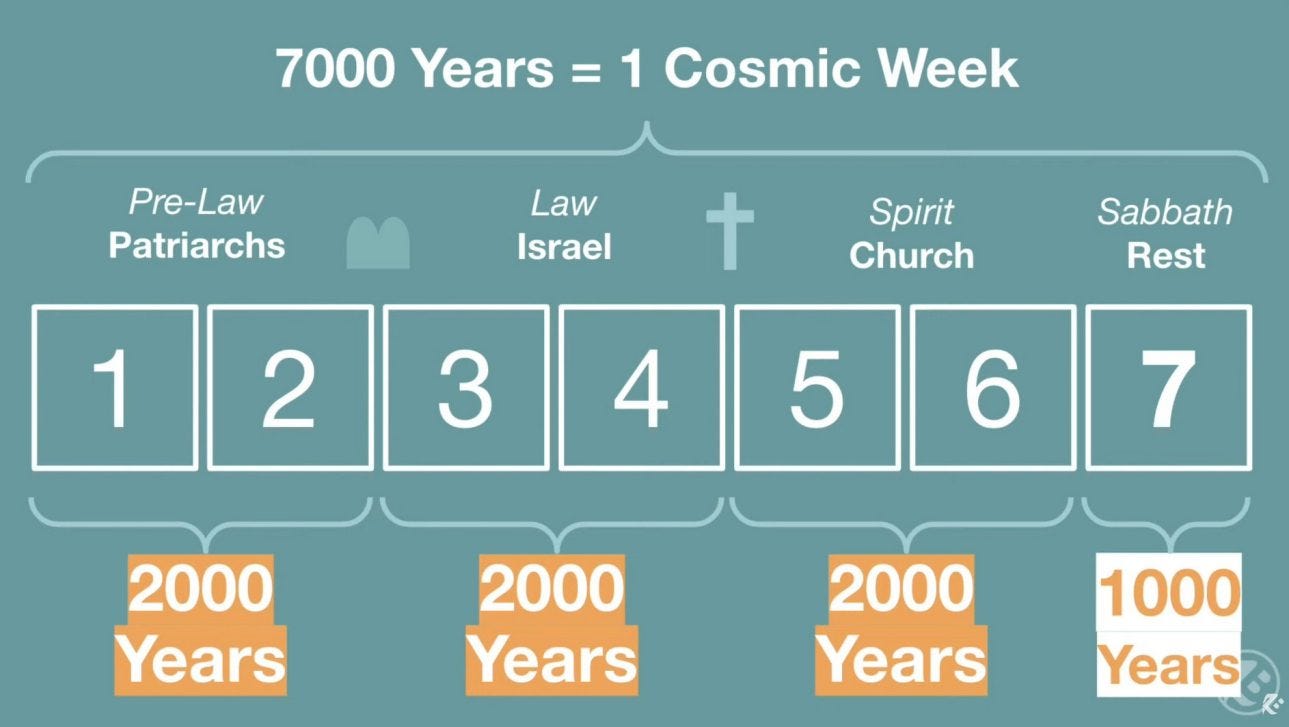
The idea is straightforward: if one day with the Lord is as a thousand years (Psalm 90:4, 2 Peter 3:8), then six days of creation represent six thousand years of human labour under sin, followed by a seventh “day” — a thousand-year Sabbath rest. The millennium of Revelation 20. Seven days. Seven thousand years. The Great Cosmic Week.
This concept didn’t originate with any denomination or modern theologian. It goes back to the earliest church fathers — men who had nothing but Scripture and the apostolic tradition to guide them. It runs through the Reformation, appears in the marginal notes of the Geneva Bible and the King James Version, was held by some of the greatest scientific minds in history, and was embraced by the pioneers of the Advent movement.
And here’s the thing that struck me the most: it elevates the Sabbath commandment to a status that most Christians haven’t considered. If the weekly Sabbath is a type of the cosmic Sabbath — the millennial rest — then the fourth commandment isn’t just about remembering creation. It’s a prophecy of ultimate deliverance.
Let’s dig in.
The scriptural foundation
The whole framework rests on a handful of verses. And they’re not obscure ones.
Psalm 90:4 — “For a thousand years in thy sight are but as yesterday when it is past, and as a watch in the night.”
2 Peter 3:8 — “But, beloved, be not ignorant of this one thing, that one day is with the Lord as a thousand years, and a thousand years as one day.”
These two verses establish the principle: God operates on a different timescale. A day in His sight corresponds to a thousand years. Peter even tells us not to be ignorant of it — as if he’s saying, pay attention to this one.
Now consider the creation week. Six days of work. One day of rest. If a day equals a thousand years, then human history under sin would span six thousand years, followed by a thousand-year period of rest. That’s 7,000 years total. And that seventh millennium? It matches Revelation 20 precisely.
The book of Revelation mentions the thousand-year period six times in chapter 20 alone. The saints reign with Christ. Satan is bound. It is, by every biblical measure, a period of rest.
But there’s more.
Genesis 2:17 — Adam died within the first “day”
God told Adam: “in the day that thou eatest thereof thou shalt surely die” (Genesis 2:17). Adam ate. But he didn’t drop dead that afternoon. He lived to be 930 years old (Genesis 5:5). Skeptics have pointed to this as a contradiction for centuries.
But if a day with the Lord is a thousand years, Adam died well within the first cosmic day. In fact, every single antediluvian patriarch died before reaching a thousand years. Methuselah came closest at 969 — still short. Not one of them survived a full cosmic day. The early church fathers and Reformation pioneers noticed this and saw it as confirmation of the day-for-a-thousand-years principle operating from the very beginning.
Hosea 6:1-2 — After two days, the third day
“Come, and let us return unto the Lord: for he hath torn, and he will heal us; he hath smitten, and he will bind us up. After two days will he revive us: in the third day he will raise us up, and we shall live in his sight.”
Many read this as a reference to Christ’s resurrection. And it can be. But the pioneers read it cosmically too. If Christ came at the four-thousand-year mark and two cosmic days (two thousand years) pass from His time, that brings us to the return — and then the “third day” is the millennial rest, where “we shall live in his sight.” It’s a beautiful dual application.
Job 5:19 — Six troubles, then rest
“He shall deliver thee in six troubles: yea, in seven there shall no evil touch thee.”
Read this in cosmic terms and it takes on a whole new dimension. Through six thousand years of trouble, God sustains His people. But in the seventh — the millennium — no evil touches them. Satan is bound. The saints are with Christ. No evil touches thee. The pioneers found this verse to be one of the most compelling cosmic week texts in the entire Bible.
Read it again. Job is amazing.
Hebrews 4 — There remaineth a rest
Paul writes extensively in Hebrews 4 about a rest that still awaits the people of God:
“For he spake in a certain place of the seventh day on this wise, And God did rest the seventh day from all his works... There remaineth therefore a rest to the people of God.” (Hebrews 4:4, 9)
Now, many theologians have used this passage to argue that the Sabbath is no longer relevant — that we “rest in Jesus” and the literal day doesn’t matter anymore. But the cosmic week framework flips that reading entirely. Paul is pointing forward to the millennial Sabbath — the cosmic seventh day — and using the weekly Sabbath as its type. He’s not abolishing the Sabbath. He’s magnifying it. He’s saying that the Sabbath points to something even bigger than creation — it points to the final rest from sin, death, and the devil himself.
The early Advent pioneers understood this connection clearly. As the first report of the General Conference of Christians expecting the Advent put it: God’s rest on the seventh day was “typically prophetic” — not a specific time prophecy, but a type pointing forward to a future rest for His believing people.
Revelation 20 — The thousand years
The millennium is described six times in Revelation 20. The righteous dead are raised. They live and reign with Christ for a thousand years away from earth. Satan is bound in the bottomless pit and cannot deceive the nations. At the end of the thousand years, the wicked are raised, Satan is loosed for “a little season,” and then fire from God consumes them.
This is the cosmic Sabbath. Six thousand years of sin and struggle — then rest. Real rest. A thousand years where Satan has no power and the saints are safe in the presence of God.
Revelation 20:2 “And he laid hold on the dragon, that old serpent, which is the Devil, and Satan, and bound him a thousand years,”
Revelation 20:3 “And cast him into the bottomless pit, and shut him up, and set a seal upon him, that he should deceive the nations no more, till the thousand years should be fulfilled: and after that he must be loosed a little season.”
Revelation 20:4 “And I saw thrones, and they sat upon them, and judgment was given unto them: and I saw the souls of them that were beheaded for the witness of Jesus, and for the word of God, and which had not worshipped the beast, neither his image, neither had received his mark upon their foreheads, or in their hands; and they lived and reigned with Christ a thousand years.”
Revelation 20:5 “But the rest of the dead lived not again until the thousand years were finished. This is the first resurrection.”
Revelation 20:6 “Blessed and holy is he that hath part in the first resurrection: on such the second death hath no power, but they shall be priests of God and of Christ, and shall reign with him a thousand years.”
Revelation 20:7 “And when the thousand years are expired, Satan shall be loosed out of his prison,”
The church fathers believed it
This isn’t some modern invention. The cosmic week was a widely held view in the earliest centuries of Christianity.
The Epistle of Barnabas (c. 100 AD)
This is one of the earliest post-apostolic Christian writings. This was written a few years after Jesus. In chapter 15, the author lays it out explicitly:
“Give heed, children, what this meaneth; He ended in six days. He meaneth this, that in six thousand years the Lord shall bring all things to an end; for the day with Him signifyeth a thousand years... Therefore, children, in six days, that is in six thousand years, everything shall come to an end. And He rested on the seventh day. This He meaneth: when His Son shall come, and shall abolish the time of the Lawless One, and shall judge the ungodly, and shall change the sun and the moon and the stars, then shall he truly rest on the seventh day.”
That’s about as explicit as it gets. Written within decades of the apostles, this text links the six days of creation to six thousand years, the seventh day to the millennial rest, and ties it directly to the second coming of Christ.
Wikipedia’s article on early premillennialism lists the scholars who held this position. It’s not a short list:
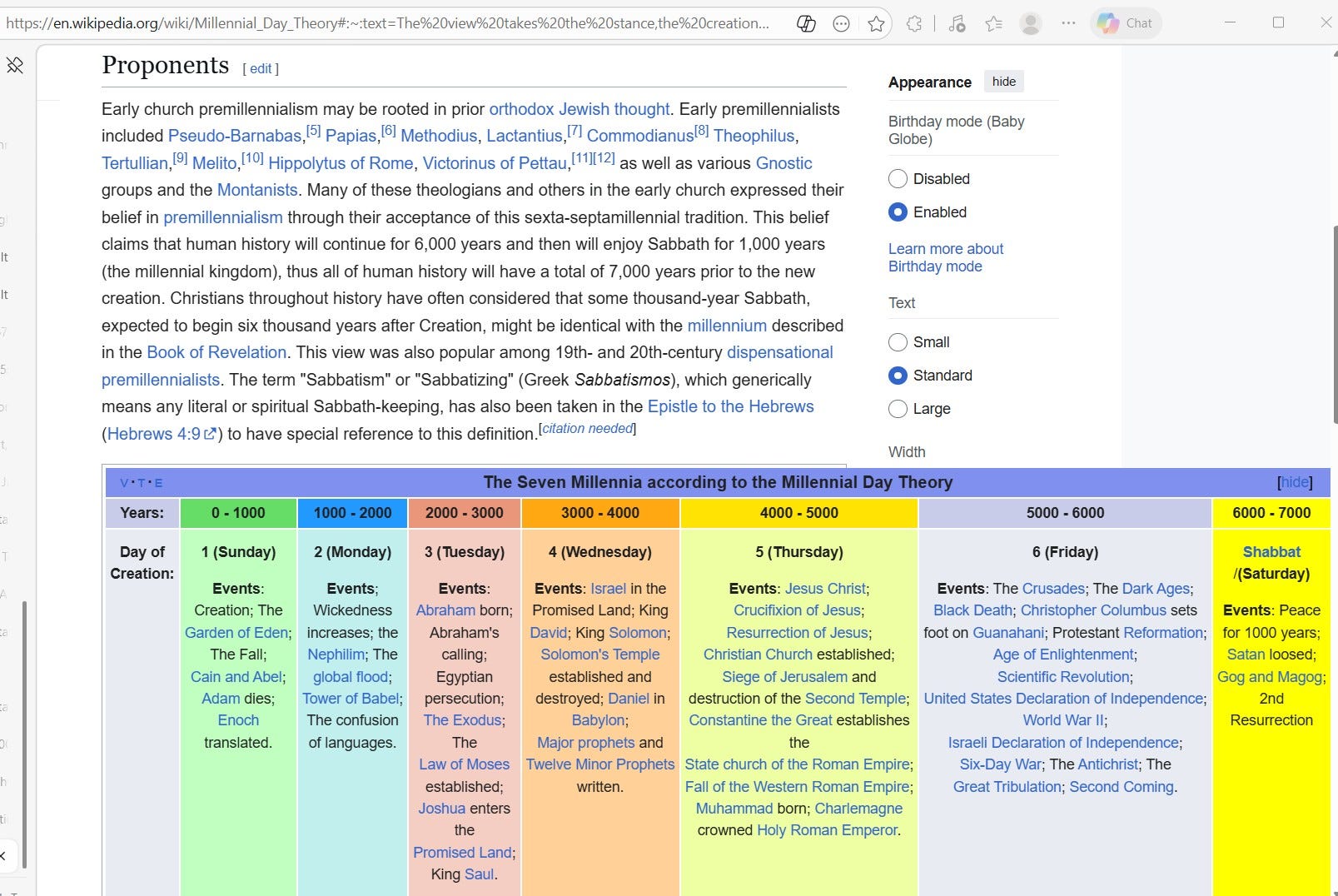
Irenaeus (120-201 AD)
Irenaeus was a student of Polycarp, who was a student of the Apostle John himself. That puts him just two links from an eyewitness of Christ. He wrote:
“For in as many days as this world was made, in so many thousand years shall it be concluded... and God brought to a conclusion upon the sixth day the work that he had made, and God rested upon the seventh day from all his work.”
He was absolutely explicit: the creation week maps onto cosmic time. Six days of creation = six thousand years. The seventh day = the millennial rest. And he saw the whole sweep of history — six thousand years of apostasy and wickedness — ending with a cataclysm and then the Sabbath of the righteous.
Hippolytus of Rome (170-236 AD)
Hippolytus wrote:
“And six thousand years must needs be accomplished, in order that the Sabbath may come, the rest, the holy day, in which God rested from all his works. For the Sabbath is the type and emblem of the future Kingdom of the Saints, when they shall reign with Christ, when He comes from heaven, as John says in his Apocalypse. For a day where the Lord is as a thousand years. Since then in six days God made all things, it follows that six thousand years must be fulfilled.”
Notice what he calls the Sabbath: a type and emblem of the future Kingdom. The weekly Sabbath isn’t just a day off. It’s a prophetic marker pointing to the final rest of the saints.
All of these men — Barnabas, Irenaeus, Hippolytus — had no influence from any modern denomination. They had the Bible and the apostolic tradition. And they all arrived at the same conclusion.
The Reformers and their Bibles
Fast forward over a thousand years. The Reformation breaks out across Europe. Scholars return to the original Hebrew and Greek manuscripts. And what do they find? The same cosmic week.
The Geneva Bible (1560)
The Geneva Bible was the first English study Bible — the Bible of the Reformation, of Shakespeare, of John Knox, of the Pilgrims on the Mayflower. It had roughly 300,000 words of marginal notes, about a third of the entire text. It was the most popular English Bible for over a century.
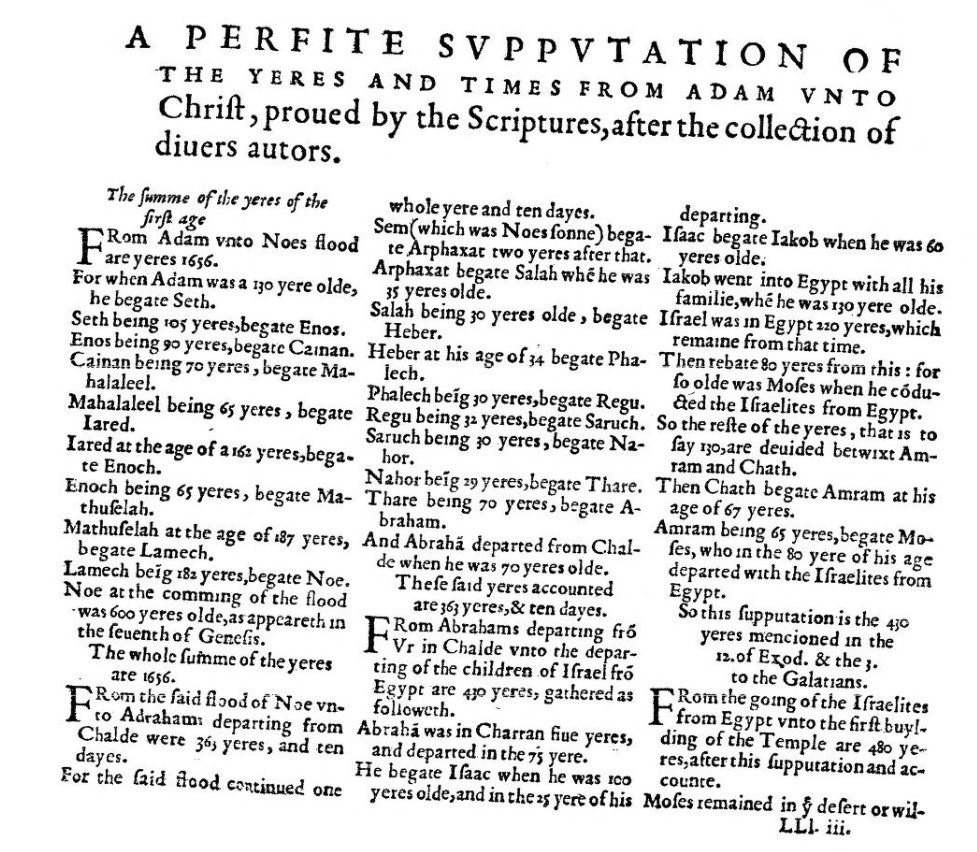
At the back, it included a detailed chronological table titled “A Perfite Supputation of the Yeres and Times from Adam unto Christ, proued by the Scriptures, after the collection of diuers autors.”
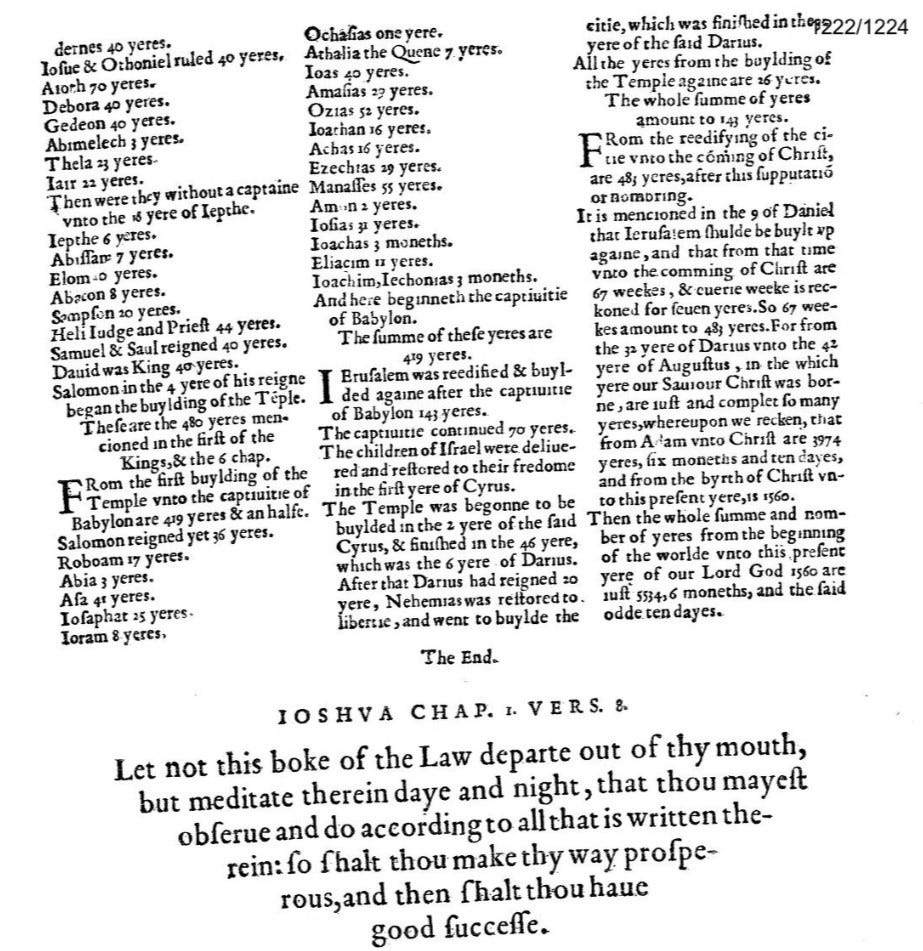
This table traces the years meticulously — from Adam to Noah (1,656 years), from the flood to Abraham’s departure from Chaldea (365 years and ten days), from Abraham to the Exodus (430 years), from the Exodus to Solomon’s Temple (480 years), and so on through the captivity, the rebuilding, and down to Christ.
The final tally? “The whole summe and number of yeres from the beginning of the worlde unto this present yere of our Lord God 1560 are iust 5534, 6 moneths, and the said odde ten dayes.”
Five thousand five hundred and thirty-four years in 1560. Fast-forward to today and you’re approaching 6,000. The Reformers who produced this Bible were well aware of what that implied.
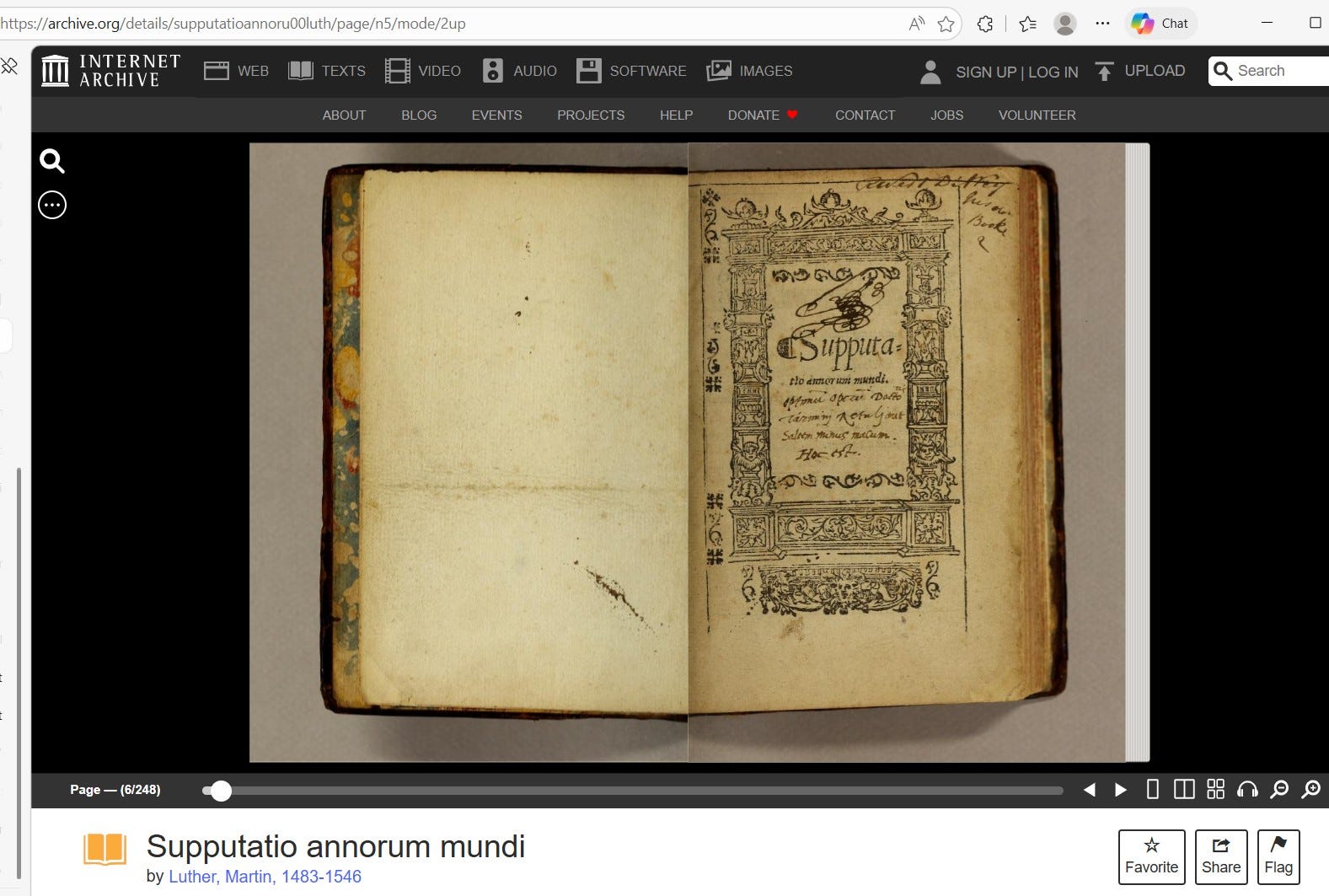
Martin Luther’s Supputatio Annorum Mundi (1541)
Martin Luther — the man who sparked the Reformation — published his own comprehensive biblical chronology in 1541 titled Supputatio Annorum Mundi (Computation of the Years of the World). It was revised and republished in 1545, just a year before his death. The work spans over two hundred pages, with each year of world history represented as a box on a running timeline. It’s meticulous.
The first page opens with “INCIPIT PRIMUS Annorum mundi millenarius” — “Here begins the FIRST millennium of the world’s years.” It starts with Adam, counting down from approximately 3,960 years before Christ.
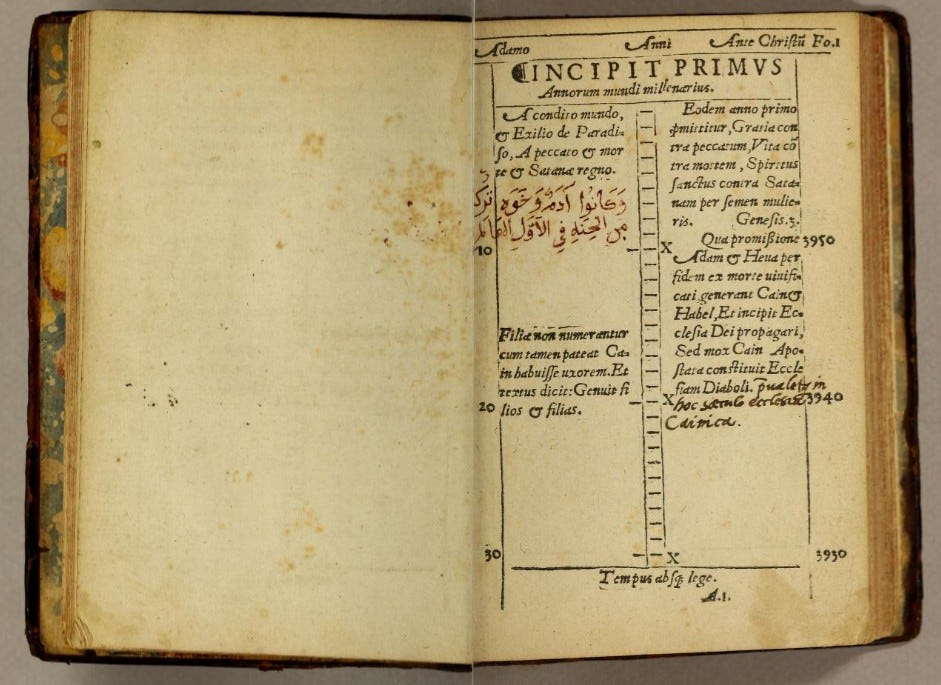
But here’s what makes it remarkable. In the final pages of the 1540 edition, Luther writes:
“Hoc anno (1540) numerus annorum Mundi praecise est 5500.” “In this year (1540) the number of years of the world is precisely 5,500.”
And then — the critical line:
“Quare sperandus est finis mundi, Nam sextus Millenarius non complebitur.” “Therefore the end of the world is to be expected, for the sixth millennium will not be completed.“
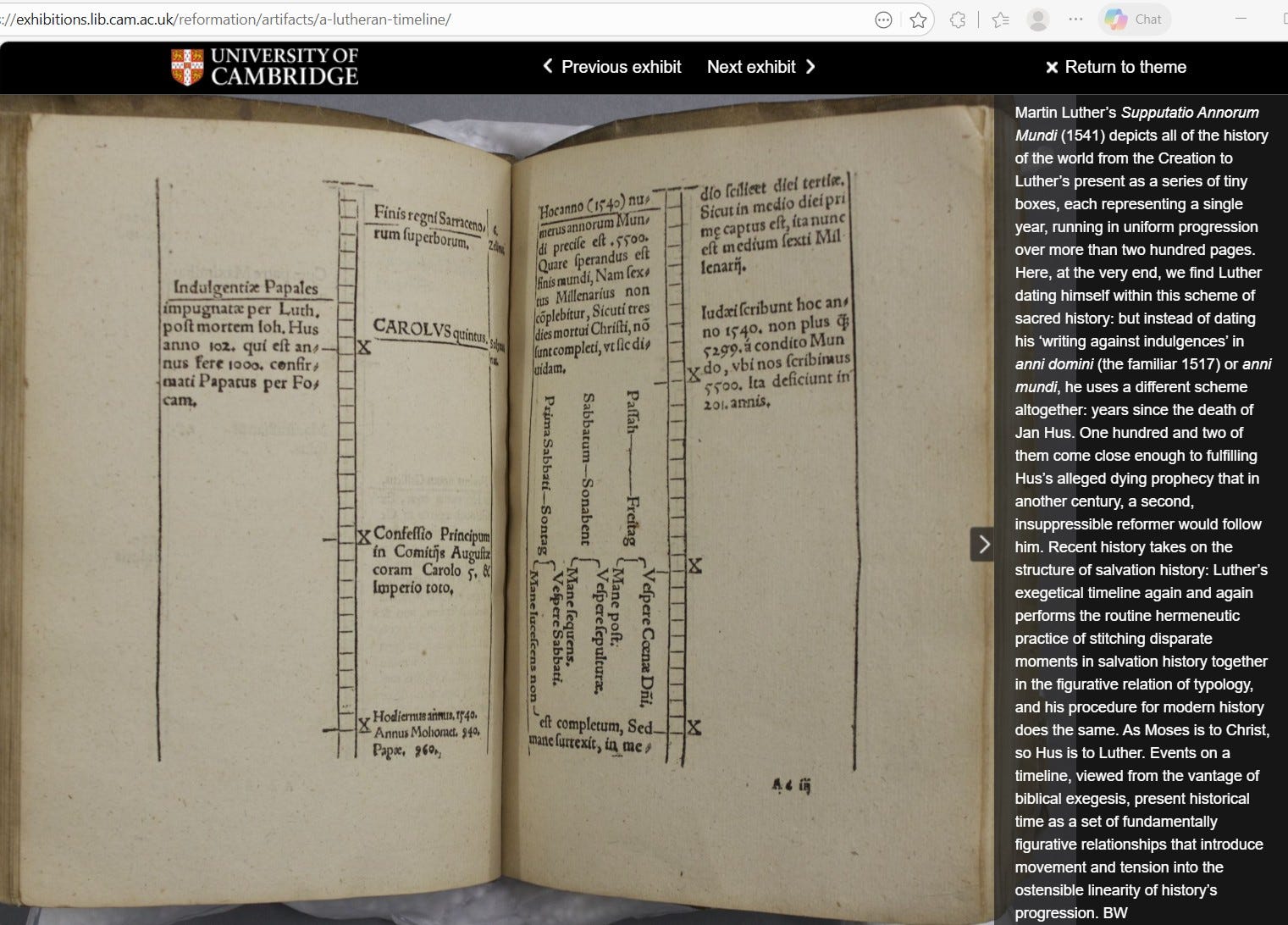
Luther expected the end before the six thousand years were up. He reasoned by analogy: just as Christ didn’t stay in the tomb a full three literal days, so the sixth cosmic day might be cut short.
But there’s another line that connects directly to the cosmic week framework:
“Sicut in medio diei primi me captus est, ita nunc est medium sexti Millenarii.” “Just as in the middle of the first day [man] was taken captive [by sin], so now it is the middle of the sixth millennium.”
Luther is explicitly mapping the days of the creation week onto millennia. He’s thinking in cosmic week terms. And he even draws a parallel between Adam’s fall (in the middle of the first day) and his own era (the middle of the sixth millennium).
The scholarly treatment of Luther’s chronological work can be found in James Barr’s “Luther and Biblical Chronology,” published in the Bulletin of the John Rylands Library, Vol. 72, No. 1 (1990), pp. 51-68. The original Supputatio is preserved in Cambridge University’s Parker Library, and the Cambridge exhibition notes that Luther’s timeline “depicts all of the history of the world from the Creation to Luther’s present as a series of tiny boxes, each representing a single year, running in uniform progression over more than two hundred pages.”
James Ussher and the KJV margins
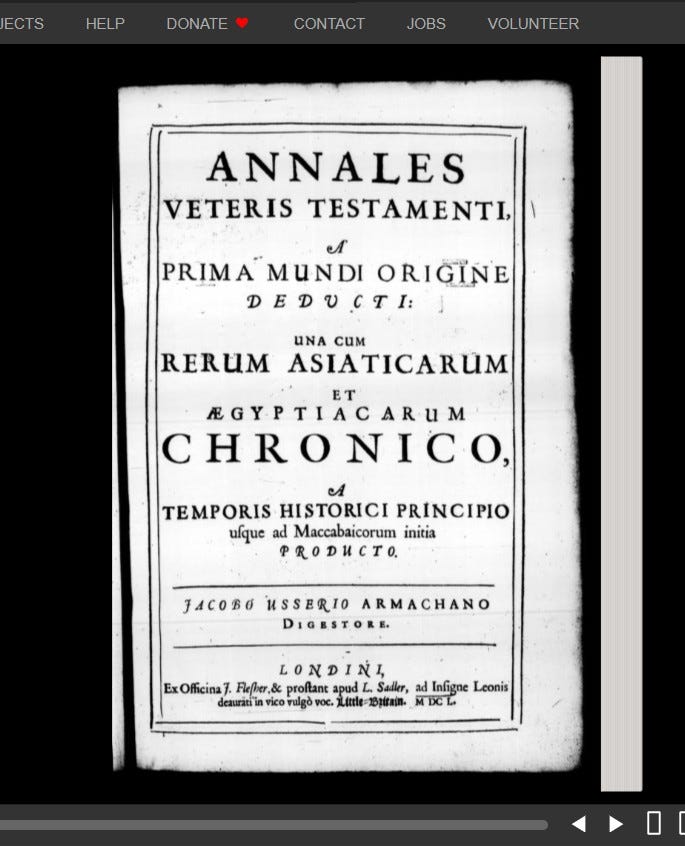
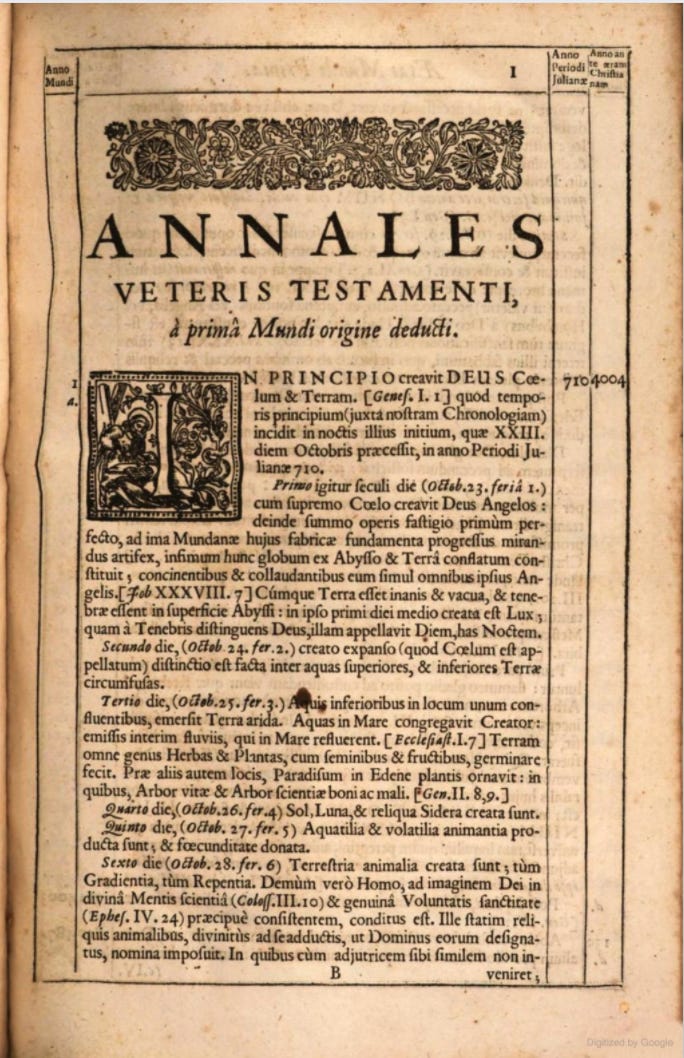
Archbishop James Ussher (1581-1656) published his monumental Annales Veteris Testamenti in 1650 — a 1,300-page chronology of the world from creation to 70 AD. He calculated the date of creation as October 23, 4004 BC. Original here or English summary here.
What gave Ussher’s work its lasting influence was its placement in the margins of the King James Bible. A London bookseller named Thomas Guy began printing Bibles with Ussher’s dates in 1675. Then from Bishop William Lloyd’s 1701 edition onwards, the KJV officially carried Ussher’s chronology in its marginal annotations. The first page of Genesis was annotated with “4004 BC.” Cambridge University Press printed these dates until 1900, and Oxford University Press until 1910. The Scofield Reference Bible (1909) carried them into the twentieth century.
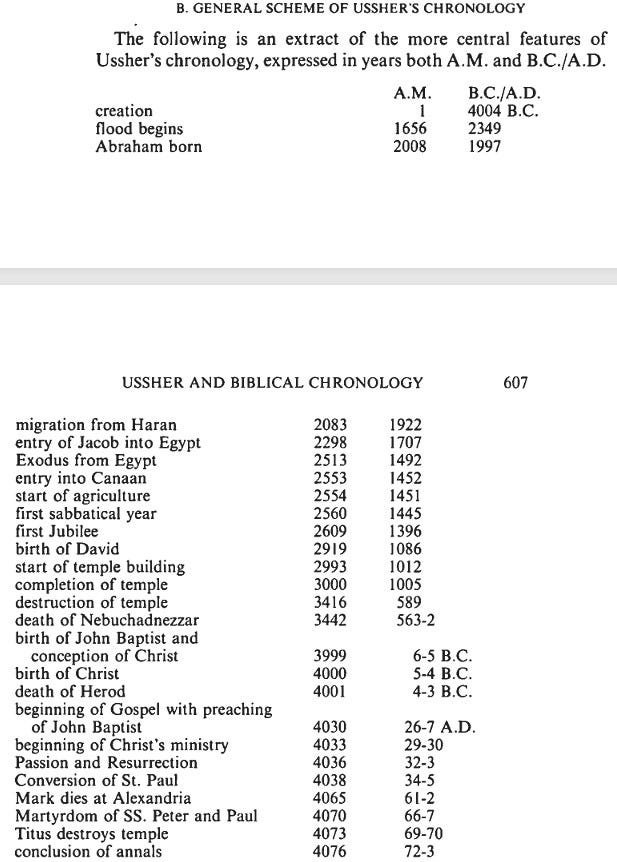
For two hundred years, if you opened a King James Bible, you saw the age of the earth right there in the margin. 4004 BC. About six thousand years.
The wider consensus
Ussher wasn’t an outlier. His date differed little from other serious biblical scholars:
Venerable Bede (AD 723) — 3952 BC
Martin Luther (1541) — approximately 3961 BC
Joseph Justus Scaliger (16th century) — 3949 BC
Johannes Kepler (1571-1630), the father of planetary motion — 3992 BC
Sir Isaac Newton (1643-1727), arguably the greatest scientist in history — approximately 4000 BC
Think about that for a moment. The man who formulated the laws of planetary motion and the man who gave us the laws of gravity both calculated biblical chronologies and arrived at roughly 4000 BC for creation. This wasn’t anti-intellectual. This was the intellectual position.
Even Shakespeare knew it. In As You Like It (c. 1599), Act IV, Scene 1, Rosalind says:
“The poor world is almost six thousand years old, and in all this time there was not any man died in his own person, videlicet, in a love-cause.”
It’s a throwaway line in a romantic comedy — which makes it even more telling. Shakespeare didn’t need to explain it. His Elizabethan audience already knew the world was about six thousand years old. It was common knowledge. The Globe and Mail captured it well: “Why mock Ussher — and excuse Kepler and Newton?”
Talmud
Knowingly treading on dangerous ground, I note the following as interesting:
Of the dozens of rabbinic passages expressing the idea of the cosmic week, perhaps the most famous is in the Babylonian Talmud: "The Tanna debe Ehyyahu teaches: The world is to exist six thousand years. In the first two thousand there was desolation [no Torah]; two thousand years the Torah flourished; and the next two thousand years is the Messianic era, but through our many iniquities all these years have been lost" (Sanhedrin 97a, b). This was a comment on what Rabbi Kattina had said "Six thousand years shall the world exist, and one [thousand, the seventh], it shall be desolate" (97a).
Why did Jesus come at the 4,000-year mark?
Here’s where it gets really interesting. If the cosmic week framework is valid, then Jesus didn’t arrive at a random point in history. He arrived precisely when you’d expect.
Paul writes in Galatians 4:4-5: “But when the fullness of the time was come, God sent forth his Son, made of a woman, made under the law, to redeem them that were under the law.”
The fullness of time. Not just any time — the time. The appointed time. But what makes it the “fullness”?
According to the Spirit of Prophecy, Christ’s baptism and wilderness temptation took place in 27 AD — exactly four thousand years after the fall of Adam. Ellen White states it repeatedly and definitively:
“Christ in the wilderness of temptation stood in Adam’s place to bear the test he failed to endure. Here Christ overcame in the sinner’s behalf, four thousand years after Adam turned his back upon the light of his home.“
There are 41 such four-thousand-year statements in her writings. And they all point to the same anchor: 27 AD, at Christ’s baptism, marks exactly 4,000 years from the fall.
Now do the math. If 4,000 years elapsed from the fall to 27 AD, then 6,000 years from the fall brings us to approximately 2027 AD. Add the thousand-year millennium and you have 7,000 years total. The cosmic week.
In cosmic week terms, Jesus came at the end of the fourth day — right at the transition point. Four cosmic days had passed. Two remained. And then the Sabbath.
Hosea 6:1-2 takes on extraordinary clarity in this light: “After two days will he revive us: in the third day he will raise us up.” Two cosmic days from Christ (2,000 years) brings us to the second coming. The third day — the millennium — is when we are raised up to live in His sight.
The millennium as the cosmic Sabbath
Consider the parallels between the weekly Sabbath and the millennial rest:
The weekly Sabbath: six days of labour, one day of rest. The cosmic week: six thousand years of sin and struggle, one thousand years of rest.
The sabbatical year: six years the land is worked, the seventh year it rests (Leviticus 25:1-7). The cosmic parallel: six thousand years the earth endures sin, the seventh millennium it lies desolate while the saints are in heaven — a Sabbath for the land.
Revelation 20 describes the millennium in terms that echo the Sabbath rest. The saints are safe. Satan is bound. The wicked are dead. There is no temptation, no persecution, no struggle. It is rest — complete rest.
And what happens during this thousand years? The saints participate in judgment (1 Corinthians 6:2-3, Revelation 20:4). They review the records. They understand why certain decisions were made. Every question is answered. Every doubt resolved. It’s not just physical rest — it’s intellectual and emotional rest. The cosmic Sabbath is thorough.
The connection to the fourth commandment is direct. Exodus 20:11 says: “For in six days the Lord made heaven and earth, the sea, and all that in them is, and rested the seventh day: wherefore the Lord blessed the sabbath day, and hallowed it.”
If those six days of creation are a type of six thousand years of human history, then the fourth commandment doesn’t just point backward to creation — it points forward to the final rest. The Sabbath is simultaneously a memorial and a prophecy.
After the rest — the final battle
The cosmic week doesn’t end with the millennium. There’s an eighth “day” — the restoration.
Revelation 20:7-10 describes what happens after the thousand years: Satan is loosed from his prison. The wicked dead are raised in the second resurrection. Satan organises them for battle against the Holy City, which has descended to earth. They surround the city. And then fire comes down from God out of heaven and consumes them.
Ellen White describes this scene vividly. Satan looks over the vast army — kings, warriors, conquerors throughout history — and tells them the company in the city is small. They construct weapons of war. They march in companies with appointed leaders. They surround the New Jerusalem.
But then Jesus and all the saints ascend the walls of the city, and the wicked behold the glory they have lost. Fire comes down. It’s over.
And here’s the key calculation from the Spirit of Prophecy: “For six thousand years, Satan had struggled to maintain possession of the earth. Now God’s original purpose in its creation is accomplished.”
Six thousand years of active struggle. Not seven thousand — because during the millennium, Satan is bound and inactive. He cannot struggle. So, the total time Satan actively warred against God’s government is exactly six thousand years. The millennium is excluded because he was imprisoned. And the “little season” after the millennium is added back to his six thousand years of active warfare, because he resumes his rebellion during that time.
This means the earth, from start to finish — from creation through the millennium and the final destruction of the wicked — spans approximately seven thousand years. The cosmic week complete.
The Advent pioneers and the Spirit of Prophecy
What I’ve shown so far comes from Scripture, the church fathers, the Reformers, and some of the greatest minds in scientific history. Now let’s look at what the Adventist pioneers and Ellen White contributed.
The pioneers believed it
Walter Veith, in his WhatsUpProf lectures (WUP 8, 9, and 229), traces the cosmic week belief through the early Adventist movement. Robert Johnston, chair of the New Testament department at the SDA Theological Seminary of Andrews University, wrote an article showing that early Advent pioneers — most notably J.N. Andrews — were firm believers in the cosmic week principle. The idea was later sidelined by some, including Uriah Smith, but it was there from the beginning.
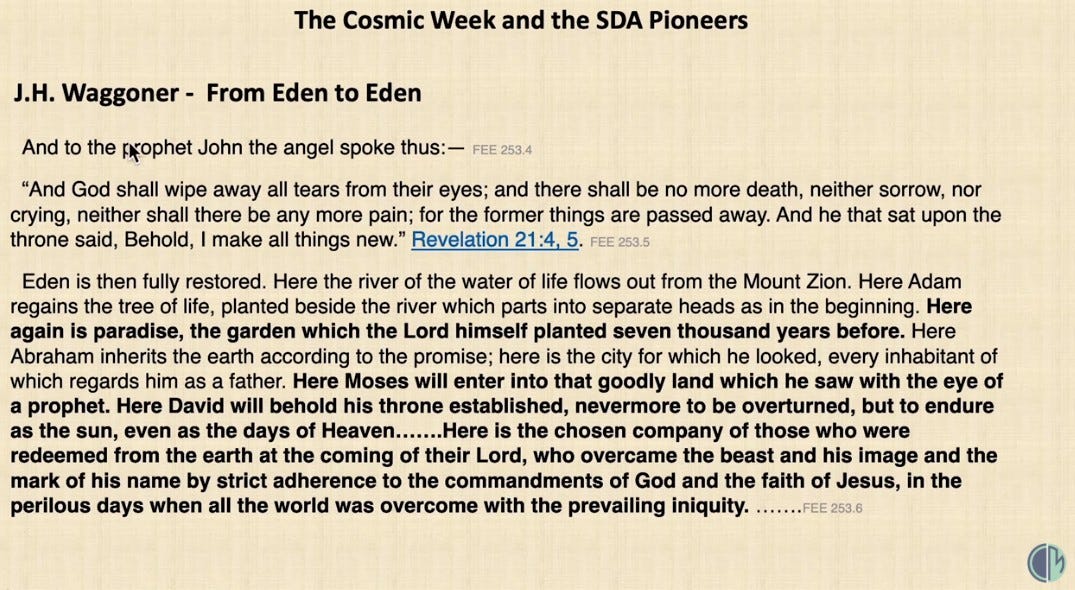
The pioneers were explicit. Waggoner wrote on page 253 here of the restored earth: “Here again is paradise, the garden which the Lord Himself planted seven thousand years before.
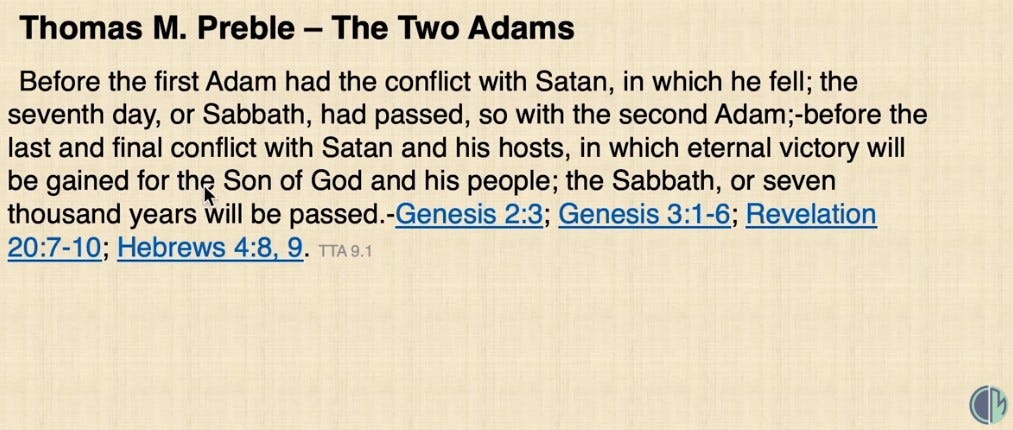
Thomas Preble connected the two Adams and the Sabbath here on page 5: before the first Adam’s final conflict with Satan ends, the “Sabbath or seven thousand years will be passed.
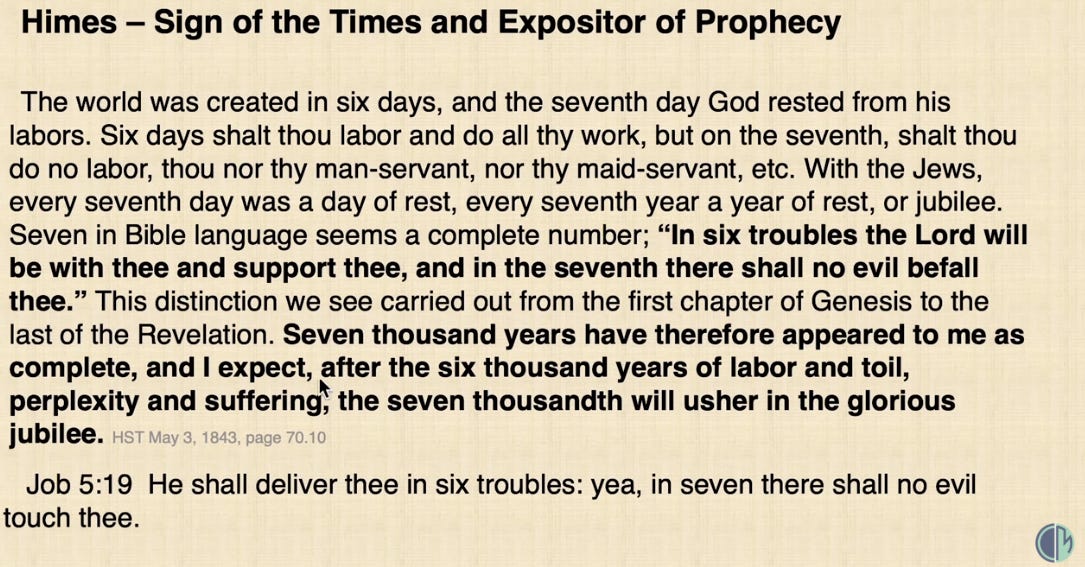
Joshua Himes wrote: “The world was created in six days and the seventh day God rested from his labors... seven thousand years have therefore appeared to me as complete, and I expect after the six thousand years of labor and toil, perplexity and suffering, the seventh thousand will usher in the glorious Jubilee.”
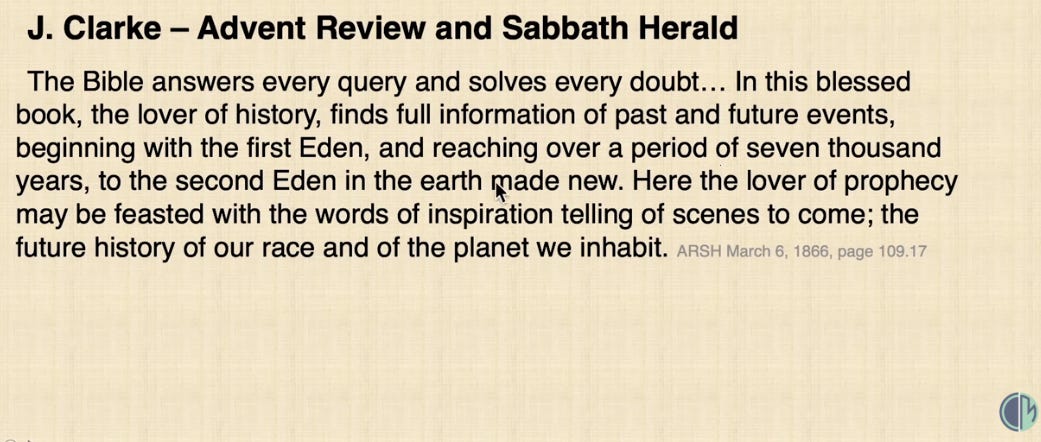
J. Clarke, writing in the Advent Review and Sabbath Herald, put it beautifully: “In this blessed book the lover of history finds full information of past and future events, beginning with the first Eden and reaching over a period of seven thousand years to the second Eden in the earth made new.”
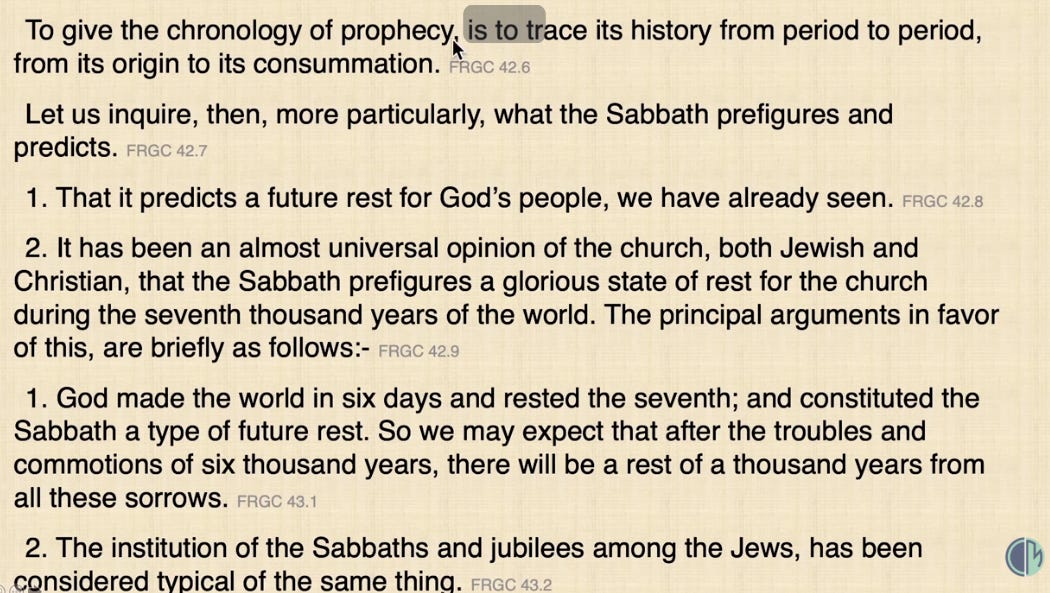
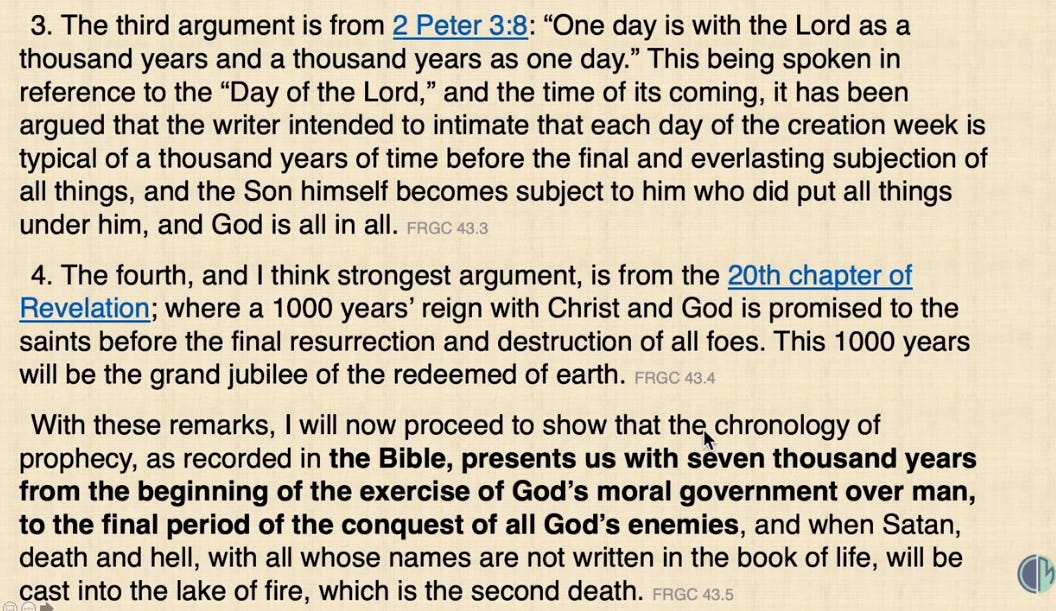
The first report of the General Conference of Christians Expecting the Advent stated it as a group position — they all believed it.
James White
The sabbath in type
Here’s a significant find. From the Ryan McCoy article on sealingtime.com, there’s a reference to O.R.L. Crozier writing in The Day-Star Extra, February 7, 1846: “The Sabbaths under the Law typify the great Sabbath, the seventh millennium; Hebrews 4:3.” Sealingtime And critically, Ellen White fully endorsed this view, writing: “The Lord shew me in vision, more than one year ago, that Brother Crosier had the true light, on the cleansing of the Sanctuary, and that it was His will, that Brother C. should write out the view which he gave us in the Day-Star, Extra, February 7, 1846.” Sealingtime
As for James White specifically — Johnston’s article mentions him indirectly through the Review and Herald articles. James White was the editor of the Review and Herald and published the cosmic week articles by Molt, Cook, and Andrews. He wouldn’t have published them if he disagreed.
Second advent
James White wrote The Second Advent where he strongly promotes a pre-millennial view of the Second Coming — Christ returns before the millennium to resurrect the righteous, rapture living believers, destroy the wicked, and desolate the earth temporarily. It rejects post-millennial ideas (a golden age of peace before Christ’s return), spiritualized interpretations (e.g., the coming as conversion, death, or the Holy Spirit’s work), and false claims by groups like Shakers or Mormons.
His main points are:
Certainty of the Second Advent: Christ’s return is an assured promise, not speculation. It is the “blessed hope” and the consummation of salvation.
Key texts: Hebrews 9:28 (”unto them that look for him shall he appear the second time without sin unto salvation”), Titus 2:13, 1 John 3:2, John 14:1-3.Personal and Visible Coming: The return is literal, bodily, and visible to all — not invisible, spiritual, or secret. Jesus will come “in like manner” as He ascended.
Key texts: Acts 1:11, Matthew 24:30 (”they shall see the Son of man coming in the clouds... with power and great glory”), Revelation 1:7 (”every eye shall see him”).Resurrection and Rapture of the Righteous: At Christ’s descent, the dead in Christ rise first (immortal), then living believers are transformed and caught up to meet Him in the air. This brings victory over death and eternal union with Christ.
Key texts: 1 Thessalonians 4:16-17, 1 Corinthians 15:51-55 (”Death is swallowed up in victory”).Destruction of the Wicked at Christ’s Return: The wicked (including the “man of sin”/papacy and all unrepentant) are destroyed by the brightness of His coming and flaming fire — no sinners remain alive on earth. The earth is left desolate.
Key texts: 2 Thessalonians 2:8, 2 Thessalonians 1:7-10, Matthew 13:38-42 (tares burned), Isaiah 13:9, Zephaniah 1:2-3.Nearness and Signs of the Event: The Advent is imminent and near, based on fulfilled signs (e.g., 1780 darkening of the sun, 1833 falling stars) and prophetic timelines from Daniel/Revelation. The generation seeing these signs will witness the end. Key texts: Matthew 24:29-34 (”this generation shall not pass, till all these things be fulfilled”), Joel 2:1, Zephaniah 1:14-18.
Call to Watchfulness, Holy Living, and Rejection of False Views: The doctrine urges repentance, readiness, and separation from worldliness/scoffers. It condemns spiritualizing the coming or expecting a temporal millennium first.
Key texts: Titus 2:12-13, James 5:8 (”the coming of the Lord draweth nigh”), 2 Peter 3:11-12, Matthew 24:23 (warnings against false christs).
Trump’s golden age
You must have heard this over and over again. The Golden age of America! I highlighted this in the previous paragraph where James White rejected it. This notion is not new and many have written about it.
The below images justify a post of its own but consider the remarkable parallels between 1888 where the US pushed for Sunday laws and today.
Similar to the 67AD when Rome was about to invade Jerusalem to setup Daniel’s “abomination of desolation”, Rome retreated but then in 70AD Jerusalem fell and the temple was torn stone from stone.



Ellen White’s statements
Ellen White made 42 (or 74, if you count compilations) six-thousand-year statements and 41 four-thousand-year statements in her writings. A few key ones:
“The world is now only about 6,000 years old.” — Spiritual Gifts, vol. 9, p. 92
“After 6,000 years of sin the earth was renewed. The great plan of redemption results in fully bringing back the world into God’s favor. All that was lost by sin is restored. Not only man but the earth is redeemed, to be the eternal abode of the obedient. For six thousand years Satan has struggled to maintain possession of the earth. Now God’s original purpose in its creation is accomplished.” — Adventist Home
She uses “about 6,000 years” thirteen times, “almost 6,000 years” once, and “nearly 6,000 years” twelve times. There are three statements that say “more than 6,000” or “over 6,000” — and all three have been explained. One refers to how long Satan has been in the deception business (which started in heaven, before earth). One refers to the new earth at the 7,000-year mark. And one was confirmed by the White Estate as a copying error — the original source didn’t contain the word “over.”
Warren H. Johns, the seminary librarian at Andrews University, researched the issue and concluded that Ellen White believed there were exactly four thousand years between the creation of man and the birth of Christ, and that her consistent position was that the world was less than six thousand years old.
“But of that day and hour knoweth no man”
Before we go further, we need to address the elephant in the room. Because any time you discuss where we are in the stream of time, someone will quote Matthew 24:36:
“But of that day and hour knoweth no man, no, not the angels of heaven, but my Father only.”
End of discussion, right? Nobody can know. Stop looking at timelines. Stop studying the chronology.
Except — that’s not quite what the verse says. And some very serious scholars have pointed this out.
James White tackled this head-on. He noted that an old English version of the passage reads: “But that day and hour no man maketh known, neither the angels which are in heaven, neither the Son, but the Father.” Not “no man knows” — but “no man maketh known.” That’s a completely different meaning.
And he wasn’t making this up. He pointed to 1 Corinthians 2:2 where Paul writes: “For I determined not to know anything among you, save Jesus Christ, and him crucified.” Did Paul really not know anything else? Of course he did. The word “know” here means “make known” — Paul determined to preach nothing else. The same word, the same usage.
White’s conclusion was direct: “Men will not make known the day and hour, angels will not make it known, neither will the Son; but the Father will make it known.”
He wasn’t alone in this reading. Albert Barnes, in his widely respected Notes on the Gospels, wrote: “Others have said that the verb rendered knoweth means sometimes to make known, or to reveal, and that the passage means, ‘that day and hour none maketh known, neither the angels, nor the Son, but the Father.’ It is true the word has sometimes that meaning, as 1 Corinthians 2:2.”
Campbell McKnight argued that the term “know” is used here in a causative sense — meaning “to make known.” Christ’s answer, he said, is equivalent to saying the Father will make it known when it pleases Him, but He has not authorised man, angel, nor the Son to reveal it.
Here’s the theological problem with the common reading: How could Jesus — who is very God, who had no beginning, to whom all power in heaven and earth is given — not know the hour of His own coming? As White put it, if this text proves that men can never know the time, it also proves that the Son of God Himself can never know it. But can anyone seriously believe that the omniscient Christ will remain ignorant until the very moment He comes to judge the world?
The alternative translation resolves this cleanly. It’s not that Christ doesn’t know. It’s that He is not the one authorised to reveal it. The Father reserves that right for Himself. And according to Ellen White, He exercises it — the voice of God from heaven declares the day and hour of Jesus’ coming to His waiting people.
And then there’s Paul in 1 Thessalonians 5:1-4:
“But of the times and the seasons, brethren, ye have no need that I write unto you. For yourselves know perfectly that the day of the Lord so cometh as a thief in the night... But ye, brethren, are not in darkness, that that day should overtake you as a thief.“
Paul is saying God’s people should not be surprised. They should be studying the Scriptures. They should know the time — not the day and hour, but the period. The season. Where we are in the stream of time.
So, does studying the cosmic week constitute “time setting”? No. It’s studying what Scripture says, what the church fathers believed, what the Reformers calculated, what the pioneers taught, and what the Spirit of Prophecy confirms. It’s not setting a date. It’s reading the signs. And Jesus Himself told us to do exactly that: “Now learn a parable of the fig tree; When his branch is yet tender, and putteth forth leaves, ye know that summer is nigh” (Matthew 24:32).
We’re not naming the day. We’re saying the branch is tender and the leaves are out.
Being entirely analytical, the verse refers to the day and the hour. This could be literal or it could be prophetic. If the latter, it implies the year and the fortnight. Either is perfectly acceptable because given all we know of the timeline, we know we are in the end times as I noted here. So, we have a feel for the period but not the exact dates. Knowing this perfectly aligns with Paul who noted that those that watch will not be caught offside.
Why this elevates the Sabbath
This is the punchline. And I think it’s the most important insight in this entire study.
If the creation week is a type of the cosmic week — if each day of creation maps onto a millennium of human history — then the seventh-day Sabbath isn’t just a memorial of creation. It’s a prophecy of the final rest.
Every Friday evening when the sun goes down and the Sabbath begins, it’s a weekly reminder that the cosmic Sabbath is coming. Six days of labour. Then rest. Six thousand years of sin. Then the millennium. The pattern is embedded in the rhythm of every week.
This is why the church fathers linked it to the creation week. This is why the pioneers were so passionate about it. As Veith explains in WUP 9: “If the Sabbath is the fourth commandment that prefigures a final rest in a cosmic day of a thousand years, then the Sabbath gains in absolute status. And we can understand with more clarity why the Sabbath will be the issue at the end of time.”
Think about it. Any god can write nine of the ten commandments. But only the Creator God can claim the fourth — because only He made heaven and earth in six days and rested the seventh. And if that creation week is also the blueprint for all of history, then the Sabbath becomes the hinge on which the entire plan of salvation turns.
Creation. Redemption. Restoration. The Sabbath ties all three together.
No wonder Rome changed it. And no wonder it will be the final test.
whydoneit?
Because the pattern is there. From Genesis to Revelation. From the church fathers to the Reformers. From the Geneva Bible to the King James margins. From Kepler and Newton to the Adventist pioneers.
God didn’t hide this. He put it on the first page of the Bible and told Peter to make sure we didn’t miss it: “Be not ignorant of this one thing.”
Six days. Six thousand years. And then — rest.
The question isn’t whether the cosmic week is real. The question is: where are we in it?
John 13:19 — “Now I tell you before it come, that, when it is come to pass, ye may believe that I am he.”