

Religious 20: The State of the Dead
Eph 5:11: “…have no fellowship with the unfruitful works of darkness, but rather reprove them.”
Amos 3:7 “…God will do nothing, but he revealeth his secret unto his servants the prophets.”
Why this post?
Think about this:
What word did Jesus use for death?
Why would several verses note about raising the dead, if they’re not?
Where did Jesus go for the few hours he was in the tomb?
Martha knew Jesus so why dis she refer to the “last day”?
If Michael contend the devil for Moses, was that to get him back from Heavan?
Below I aggregate Biblical evidence that:
There is no consciousness once we die until we are resurrected;
No “familiar spirits” (dead ancestors) communicate with the living;
The lie of inherent immortality is the most dangerous doctrine in Christendom—because it guts the Gospel, destroys God’s character, and opens the door to the final deception; and
We’ll unpack verses and terms from the original Greek and Hebrew.
The lie that started it all
Before we talk about death, we need to talk about the first lie ever spoken. Because everything—and I mean everything—flows from it.
God said to Adam: “In the day that thou eatest thereof thou shalt surely die.” (Genesis 2:17)
The serpent said to Eve
“Ye shall not surely die.” (Genesis 3:4)
Two statements. Directly contradictory. One of them is true. The other is the foundation of the greatest deception in human history.
Here’s what’s staggering. Most of Christianity—Catholicism, mainstream Protestantism, the Orthodox churches—sides with the serpent on this. They teach that when you die, some part of you lives on. Your “immortal soul” floats off to heaven or hell or purgatory. You don’t really die. You just... relocate.
That’s the serpent’s sermon. Word for word. Ye shall not surely die.
And it’s not just a theological footnote. This single lie dismantles the entire plan of salvation. Think about it:
If you don’t actually die, what did Jesus die for? The wages of sin is death—real, final, complete death (Romans 6:23). Christ died that death in our place. He didn’t experience a temporary inconvenience. He tasted death for every man (Hebrews 2:9). If death isn’t real, His sacrifice addresses nothing.
If the soul is immortal, God was wrong and Satan was right. Every funeral sermon that says “she’s in a better place now” is—perhaps unknowingly—affirming the serpent’s version over God’s.
If the soul can’t die, the wicked must live forever too. And if they live forever, they must live somewhere. And that somewhere becomes an eternal torture chamber—which makes God into a being more monstrous than any human dictator who ever lived. Hitler’s atrocities lasted years. An eternally tormenting God outdoes him by infinite orders of magnitude.
If the dead are alive, they can communicate. And if they can communicate, then séances, mediums, apparitions of Mary, near-death experiences—all of it becomes legitimate. This is Satan’s endgame. A direct channel where he can impersonate the dead and introduce doctrines that contradict Scripture. This is the trump card. And it only works if you believe the dead aren’t really dead.
God barred access to the tree of life after the fall (Genesis 3:22-24). Why? Because if sinful man ate from it, he would live forever in sin. Immortality in a fallen state would be the ultimate curse, not a blessing. Death is actually God’s mercy—it prevents eternal suffering in sin.
The immortal soul doctrine reverses this mercy and turns it into the very nightmare God was trying to prevent.
So let’s dig into what the Bible actually teaches. Not what tradition says. Not what Greek philosophy smuggled into the church. Not what feels comfortable at funerals. What does the Word say?

I unpack the end of days spiritual deception here.
What actually happens when you die?
Let’s start with how God made us.
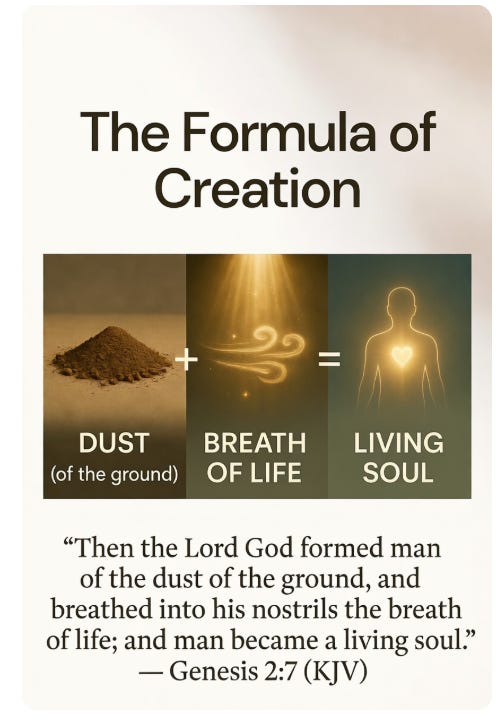
Genesis 2:7: “And the Lord God formed man of the dust of the ground, and breathed into his nostrils the breath of life; and man became a living soul.”
Notice: Adam did not receive a soul. He became one. Two components—dust plus breath—combine to form a living soul. It’s a formula:
Dust of the ground + Breath of life = Living Soul
So what happens when you reverse that formula? When the breath leaves? Ecclesiastes 12:7 tells us: “Then shall the dust return to the earth as it was: and the spirit shall return unto God who gave it.” The breath (ruach, the same word as spirit) goes back to God. The dust returns to the earth. And the soul? It ceases to exist. Just like a wooden crate ceases to exist when you pull all the nails out—the boards fall to the floor and there’s no crate anymore.
The simplicity of this model is brilliant. Every other approach and angle to this that religion have derived is ridiculously complex and not scriptural. I really can stop there. Those two verses cover it, but let’s continue.
The Bible is brutally clear about what the dead experience. Or rather, what they don’t experience:
Psalm 146:4 — “His breath goeth forth, he returneth to his earth; in that very day his thoughts perish.”
Ecclesiastes 9:5-6 — “The dead know not any thing, neither have they any more a reward; for the memory of them is forgotten. Also their love, and their hatred, and their envy, is now perished.”
Ecclesiastes 9:10 — “There is no work, nor device, nor knowledge, nor wisdom, in the grave, whither thou goest.”
Psalm 6:5 — “In death there is no remembrance of thee: in the grave who shall give thee thanks?”
Psalm 115:17 — “The dead praise not the LORD, neither any that go down into silence.”
Isaiah 38:18-19 — “The grave cannot praise thee, death cannot celebrate thee: they that go down into the pit cannot hope for thy truth.”
Job 14:10-12 — “Man dieth, and wasteth away: yea, man giveth up the ghost, and where is he?... so man lieth down, and riseth not: till the heavens be no more, they shall not awake, nor be raised out of their sleep.”
Job 14:21 — “His sons come to honour, and he knoweth it not.”
Psalm 88:10-12 — “Shall the dead arise and praise thee?... Shall thy lovingkindness be declared in the grave?”
Psalm 30:9 — “Shall the dust praise thee? shall it declare thy truth?”
Psalm 31:17 — “Let the wicked be silent in the grave.”
Psalm 49:12 — “Man... is like the beasts that perish.”
And Ecclesiastes 3:19 drives a painful nail:
“For that which befalleth the sons of men befalleth beasts; even one thing befalleth them: as the one dieth, so dieth the other; yea, they have all one breath; so that a man hath no preeminence above a beast.”
An animal dies and its breath stops. Nobody imagines the animal’s “soul” floating off to animal heaven. The same thing happens to humans. Same breath. Same process. Same result. From Revelation we know there will be animals after the third advent.
The Bible calls death “sleep” — and that changes everything
Jesus had a specific word He preferred for death. Not “transition.” Not “passing over.” Sleep.
When Lazarus died, Jesus told His disciples: “Our friend Lazarus sleepeth; but I go, that I may awake him out of sleep.” The disciples misunderstood—they thought He meant literal sleep. So Jesus said plainly: “Lazarus is dead.” (John 11:11-14)
If Lazarus was in heaven, it meant that Jesus yanked it him back to earth. This does not make sense and it does not tie up with the detail of the second and third advent.
When Jairus’ daughter died, Jesus said: “The maid is not dead, but sleepeth” (Matthew 9:24). They laughed at Him. But He wasn’t joking—He was teaching theology. Death, for those in Christ, is asleep from which they will be awakened.
This isn’t a one-off metaphor. It’s everywhere. David “slept with his fathers” (1 Kings 2:10). Solomon “slept with his fathers” (1 Kings 11:43). If you go through First and Second Kings, there are over 36 verses using this exact language. Stephen, the first martyr, “fell asleep” (Acts 7:60). Paul speaks of those who “are fallen asleep in Christ” (1 Corinthians 15:6, 18). Daniel was told he would “rest” and “arise” at the end of days (Daniel 12:13).
And here’s the critical point: the dead experience no passage of time. For them, the next conscious moment after closing their eyes is the resurrection. Paul understood this—which is why he could say that departing and being with Christ was “far better” (Philippians 1:23). Not because he’d immediately be in heaven, but because his next conscious moment would be Christ’s face. The sleep of death has no dreams, no awareness, no duration from the sleeper’s perspective.
Here’s an independent documentary that covers the topic:
Counting the verses — who really has the numbers?
Alex Jones recently claimed that the Old Testament says “over 300 times” and the New Testament “over 300 times” that we have a soul that lives after death. Scott Ritsema, who used to write for Jones, responded with a challenge: show us those 300 texts.
Here’s what I’ve found. The “dead are dead” side has overwhelming Biblical support. I’ve counted 38 clear, unambiguous texts that explicitly state the dead know nothing, sleep, have no thoughts, cannot praise God, and await resurrection:
Genesis 2:17, 3:19; Job 3:11-19, 7:9-10, 14:10-12, 14:21, 17:13; Psalm 6:5, 13:3, 30:9, 31:17, 49:12-15, 88:10-12, 104:29, 115:17, 146:4; Ecclesiastes 3:19-20, 9:5-6, 9:10, 12:7; Isaiah 26:19, 38:18-19; Daniel 12:2, 12:13; Matthew 9:24; John 5:28-29, 6:39-40, 11:11-14; Acts 2:29-34, 7:60, 13:36; 1 Corinthians 15:6, 15:16-18, 15:51-55; 1 Thessalonians 4:13-16; 1 Timothy 6:15-16; 2 Timothy 4:8; Hebrews 11:13, 39-40.
The “alive while dead” side typically relies on about 5 to 8 texts—the thief on the cross, the parable of the rich man and Lazarus, “absent from the body present with the Lord,” souls under the altar in Revelation, Philippians 1:23, and “God of the living not the dead.” Every single one of these has a straightforward contextual explanation that harmonises with the other 38. (We’ll address each one below.)
The asymmetry is staggering. 38 vs 5. And the 5 require interpretive gymnastics while the 38 are plain statements.
So who really has the numbers, Alex?
The way to read the Bible is to understand the simple verses first, then move to the complex ones because the Bible does not contradict itself.
Only God has immortality
This one verse demolishes the entire doctrine of the immortal soul in a single stroke.
1 Timothy 6:15-16: “Which in his times he shall shew, who is the blessed and only Potentate, the King of kings, and Lord of lords; who ONLY hath immortality.”
God alone possesses immortality. If humans inherently had it, this verse would be false. But it’s not false. It’s Scripture. And it means exactly what it says.
Romans 2:7 confirms it: “To them who by patient continuance in well doing seek for glory and honour and immortality, eternal life.”
We are told to seek immortality. You don’t seek what you already have.
And when do we receive it? At the resurrection.
1 Corinthians 15:51-54: “Behold, I shew you a mystery; We shall not all sleep, but we shall all be changed, in a moment, in the twinkling of an eye, at the last trump: for the trumpet shall sound, and the dead shall be raised incorruptible... and this mortal shall have put on immortality.”
Immortality is a gift. Given at the resurrection. Not a factory setting.
Ezekiel 18:4, 20: “The soul that sinneth, it shall die.”
Seven words. The soul dies. Not just the body. The soul—the entire entity, the dust-plus-breath combination that IS the person—it dies. If the soul were immortal, Ezekiel is lying.
Where did this lie come from?
We’ve already seen the serpent introduce it in Eden. But how did it infect Christianity?
The doctrine of the immortal soul was not taught by the Hebrew prophets, by Jesus, or by Paul. It was “first borrowed from the pagan philosophy” of Greece—specifically from Plato’s Phaedo, where he argues for the soul’s independent existence and survival after bodily death. Early church fathers like Tertullian, Origen, and Augustine—brilliant men, many of them martyrs—had been educated in Platonic schools before their conversion. They brought Greek dualism with them: the idea that humans have a fleshly component and a spiritual component, and the spiritual part is inherently immortal.
This was foreign to the Hebraic worldview. In Hebrew thought, a person is a unified whole—body and breath together. But as the church drifted from its Jewish roots during the great apostasy, Greek philosophy progressively replaced Biblical anthropology.
By the Dark Ages, the immortal soul was church dogma. And from it sprang purgatory, indulgences, prayers for the dead, communion of saints, Marian apparitions, and the entire apparatus of medieval control through fear. If your soul lives on and might be suffering, you’d pay anything to get it out. The institutional church knew this. And they cashed in.
This is one of the most significant false teachings of the Catholic Church.
What the Reformers believed
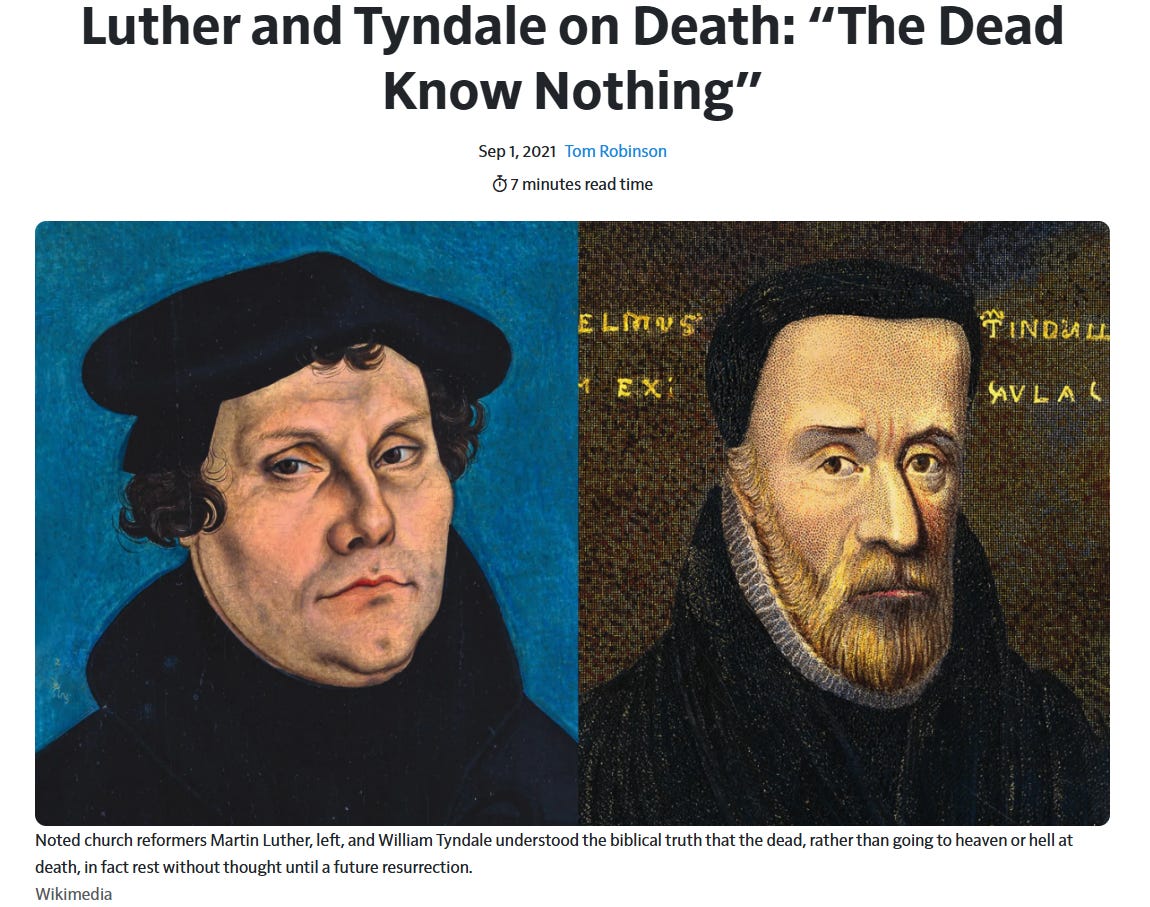
Here’s something most Protestants don’t know: the great Reformers—the men who risked their lives to break from Rome—believed in soul sleep.
Martin Luther classified the immortality of the soul as one of the “numberless prodigies of the Romish dunghill of decretals.” Not exactly diplomatic. But he was clear about what Scripture taught. Here’s what he wrote:
“We should learn to view our death in the right light, so that we need not become alarmed on account of it, as unbelief does; because in Christ it is indeed not death, but a fine sweet and brief sleep, which brings us release from this veil of tears, from sin, and from fear and extremity of the real death and from all the misfortunes of this life, and we shall be secure and without care, rest sweetly and gently for a brief moment, as on a sofa, until the time when He shall awaken us together with all his dear children to the eternal glory and joy.”
And again: “For since we call it a sleep, we know that we shall not remain in it, but be again awakened and live, and that the time during which we sleep shall seem no longer than if we had just fallen asleep.”
And: “Scripture everywhere affords such consolation which speaks of the death of the Saints as if they fell asleep and were gathered to their fathers, that is, had overcome death through his faith and comfort in Christ, and awaited the resurrection together with the Saints who preceded them in death.”
Luther understood it. Perfectly.
William Tyndale—the man who gave us the English Bible—understood it too. When the papal champion Thomas More mocked the reformers for teaching that “all souls lie and sleep till doomsday,” Tyndale responded with devastating sarcasm. In 1530, he wrote:
“And ye, in putting them [the departed souls] in heaven, hell and purgatory, destroy the arguments wherewith Christ and Paul prove the resurrection.”
Think about that for a second. If souls are already in heaven, Paul’s entire argument for the resurrection in 1 Corinthians 15 becomes pointless.
Tyndale pressed further: “If the souls be in heaven, tell me why they be not in as good case as the angels be, and then what causes there of the resurrection?”
If they’re already in glory like the angels, why bother resurrecting them? What’s the point?
And then, dripping with sarcasm directed at Thomas More’s position: “Nay, Paul, thou art unlearned! Go to Master More and learn a new way. We be not most miserable though we rise not again, for our souls go to heaven as soon as we be dead... I marvel that Paul had not comforted the Thessalonians with that doctrine, if he had wist it.”
If Paul knew the dead go straight to heaven, why didn’t he say so? Why did he comfort the Thessalonians with the resurrection instead? Because the dead DON’T go straight to heaven. Paul knew it. Luther knew it. Tyndale knew it.
It wasn’t just Luther and Tyndale
Most Protestants assume soul sleep is a uniquely Seventh-day Adventist idea. Some fringe belief cooked up in the 19th century. Nothing could be further from the truth. The conditional immortality of man—the teaching that the dead sleep until the resurrection—was the dominant view of the earliest Christians, was widely held among the first Reformers, and was only suppressed through papal decrees and Calvin’s aggressive counter-campaign.
Let’s trace the thread.
The earliest Church Fathers
The very first post-apostolic Christians—the men closest in time to the apostles themselves—never taught the immortality of the soul. Not once.
Clement of Rome (died ~100 AD). Ignatius (died ~107). The Didache (~120). Barnabas (died ~140). The Shepherd of Hermas (~154). Polycarp (died ~155). Justin Martyr (died ~165). Tatian (~172). Irenaeus (died ~202).
None of them speak of the immortality of the soul. None teach eternal, unending punishment. They present death as the cessation of life—thanatos, in the Greek—and immortality as something coming ONLY to the righteous at the resurrection. Conditional immortality.
So when did the change happen? With the neo-Platonists. Clement of Alexandria (~220 AD) and his pupil Origen (~254 AD)—both from Alexandria, which was the great centre of Greek philosophy. These men imported Plato’s concept of the immortal, pre-existing soul directly into Christian theology. And from there, Augustine picked it up and built the entire medieval Catholic framework on it.
The doctrine didn’t come from Moses. It didn’t come from Jesus. It didn’t come from Paul. It came from Plato, via Alexandria, through Augustine, into Rome.
John Wycliffe (1320s–1384) — the Morning Star of the Reformation
Wycliffe—the man who first translated the Bible into English, a full century before Luther—challenged Rome on many fronts. While he still believed in the soul’s separate existence, he taught that it was unconscious in death. He is the earliest English proto-reformer to question Rome’s teaching on the intermediate state.
John Frith (1503–1533) — martyred for teaching soul sleep
This one should stop every reader in their tracks. John Frith was an English Protestant scholar—a colleague of Tyndale’s—who was burned at the stake in 1533. One of the specific charges against him was this:
“Thou false heretic has preached openly saying, that the soul of man sleep to the latter day of judgment, and shall not obtain life immortal until that day.”
They killed him for teaching what the Bible says. Let that sink in.
The Anabaptists
The Anabaptist movement—the radical wing of the Reformation—broadly held to soul sleep. These are the spiritual ancestors of the Mennonites, the Amish, and the Baptists. They were persecuted by both Catholics AND mainstream Protestants for their views, and conditional immortality was among the doctrines they refused to surrender.
Michael Servetus (1511–1553)
Servetus held to soul sleep and was burned at the stake—not by Rome, but by John Calvin in Geneva. Which brings us to perhaps the most revealing part of this story.
Calvin’s first book — a furious attack on soul sleep
Here’s what most Protestants don’t know. John Calvin’s very first publication—before the Institutes, before his commentaries, before everything—was a book called Psychopannychia (1534). The title means “the sleep of the soul.” And it was a furious, aggressive attack specifically targeting Luther’s teaching that the dead sleep.
Archdeacon Francis Blackburne, an 18th-century historian of the Reformation, described Calvin’s treatise as “hot, furious, and abusive.” Calvin called believers in soul sleep “babblers, madmen, dreamers, drunkards.” He accused them of paying “no regard to the Scriptures”—which is rich, given that his own position came from Plato, not from Paul.
But here’s the irony that should make every thinking person pause. Calvin admitted that “some thousands” held the soul sleep view. You don’t write a furious 100-page rebuttal of a fringe position. You write it because the position is threatening to go mainstream. Soul sleep was widespread among early Protestants, and Calvin felt compelled to crush it before it took over.
And here’s the delicious contradiction: in Calvin’s own last will and testament, he wrote: “I wish that, after my departure out of this life, my body be committed to the earth, till the day of resurrection arrive.”
Till the day of resurrection arrive. Even Calvin’s own language, when he was being honest rather than polemical, betrayed the truth he spent his career attacking.
Other notable defenders of conditional immortality
Camillo Renato (1540) — Italian Reformer
Mátyás Dévai Bíró (1500–1545) — the “Hungarian Luther”
Dirk Philips (1504–1568) — Anabaptist leader
The Socinians (1570–1800) — held broadly to conditional immortality
Johann von Mosheim — chancellor of the University of Göttingen, wrote that the soul between death and resurrection “has neither pleasure nor pain, but is in a state of insensibility”
Henry Layton (1670–1706) — Anglican, wrote 12 books on conditionalism: “During life, we live and move in Christ; and when we die we rest and sleep in Him, in expectation of being raised at His second coming”
Dr. Joseph Priestley (1733–1804) — the discoverer of oxygen, also a minister. Observed that many early reformers held soul sleep and wrote: “The state of the soul in death is one of utter insensibility, as much dead as the body itself”
David R. Davies — rector at St. Mary Magdalen, Britain: “The soul of man is not necessarily automatically immortal. It is capable of being destroyed. The Bible offers no ground whatsoever for believing that the soul is immune from death. The immortality of the soul is not a Biblical doctrine, but Greek philosophy. The Biblical doctrine about the soul is the resurrection from the dead.”
And in the modern era, the list of respected scholars who have moved toward conditionalism continues to grow. Even within mainstream evangelicalism, figures like John Stott, Clark Pinnock, and Edward Fudge have challenged eternal torment and argued for the biblical case for annihilationism.
The point is this: soul sleep and conditional immortality are NOT an SDA invention. They represent the recovery of a truth that was held by the earliest Christians, championed by the first Reformers, suppressed by papal decree and Calvin’s polemics, and is now being rediscovered by honest students of Scripture across denominational lines.
When you believe what the Bible says about death, you stand in the company of the apostolic fathers, of Luther, of Tyndale, of the Anabaptist martyrs, and of John Frith who was burned alive for saying what Ecclesiastes 9:5 says plainly. That’s not bad company to be in.
What the Catholic Church actually admits
Here’s where it gets really interesting. The Roman Catholic Church knows the Bible doesn’t teach the immortality of the soul. Their own scholars admit it.
The New Catholic Encyclopedia states: “The soul in the Old Testament means not a part of man, but the whole man—a living being.” And further: “The New Testament does not teach the immortality of the soul in the Hellenistic sense of survival of an immortal principle after death.”
Read that again. Rome’s own encyclopedia says the New Testament does NOT teach the Greek concept of the immortal soul. They know it. And they teach it anyway.
But when the Reformers started recovering this truth, Rome moved to crush it. On Monday, December 19, 1513, Pope Leo X issued a papal bull declaring:
“We do condemn and reprobate all who assert that the intelligent soul is mortal.”
The bull was directed specifically at the growing “heresy” of those who denied natural immortality and affirmed conditional immortality—immortality on condition of obedience and faith. You were a heretic if you believed what the Bible actually says. The Reformers—Luther among them—fell directly under this condemnation.
Catholic Answers (a modern apologetics organisation) openly names the Seventh-day Adventists, Jehovah’s Witnesses, Christadelphians, and others as groups who have “rejected or modified the doctrine of hell so radically that it is no longer a serious threat.” They acknowledge that even mainstream evangelicals are now moving toward annihilationism. And they don’t like it.
The medieval Catholic view of hell was—and this is actual Catholic teaching—that watching the torment of the damned would be entertaining for the saved. Samuel Hopkins wrote: “The smoke of their torment shall ascend up forever in the sight of the blessed... this display of divine character and glory will be in favour of the redeemed, and most entertaining, and give the highest pleasure to those who love God.”
Most entertaining? Highest pleasure? From watching eternal torture? What kind of theology produces that?
Cyril of Jerusalem wrote that the wicked would “receive an eternal body fitted to endure the penalties of sin, that he may burn eternally in fire, nor ever be consumed.” So God gives you a super-body specifically designed to endure infinite pain without dying. This is the character of God according to Catholic theology. A celestial torturer who engineers bodies for maximum suffering.
And then there’s the Jesuit take. Ignatius Loyola’s Spiritual Exercises include a meditation on hell where you are instructed to use all five senses to imagine the torment—see the fires, hear the wailing, smell the sulphur, taste the bitter tears, feel the flames on your soul. The entire exercise is designed to produce fear. Not love. Not repentance. Fear.
Refer to my post on Secret Societies.
God explicitly says in His Word: “Perfect love casteth out fear” (1 John 4:18). Satan’s method? Fear and coercion. You can tell whose theology is whose by the fruit it produces.
The difficult texts — answered
Now let’s deal honestly with the texts that seem to teach the opposite. Because ignoring them would be intellectually dishonest. And because every one of them has a clear, contextual answer.
The thief on the cross (Luke 23:43)
“And Jesus said unto him, Verily I say unto thee, To day shalt thou be with me in paradise.”
The problem: If Jesus promised the thief they’d be in paradise that day, doesn’t that mean the dead go straight to heaven? Jesus to?
Three things demolish this reading:
First, the thief himself didn’t expect to go to heaven that day. His request was: “Lord, remember me when thou comest into thy kingdom” (v.42). He’s talking about the future Second Coming, not that afternoon.
Second, Jesus Himself didn’t go to paradise that Friday. Two days later, on Sunday, He told Mary: “Touch me not; for I am not yet ascended to my Father” (John 20:17). If Jesus wasn’t in paradise on Sunday, He certainly wasn’t there on Friday. If you read Luke 23:43 as a promise of paradise that day, you make Jesus a liar—and God cannot lie.
Third, there were no commas in the original Greek. The punctuation was added by translators over a thousand years later. Move the comma one word and the meaning changes completely: “Verily I say unto thee today, thou shalt be with me in paradise.” Jesus is saying: today—on this dark Friday when everything looks hopeless and I’m hanging on a cross like a criminal—I am telling you right now, you WILL be with me in paradise. When? When He comes into His kingdom. The thief asked for the future. Jesus answered for the future.
The rich man and Lazarus (Luke 16:19-31)
This is the heavyweight that gets thrown at you every single time. So let’s give it the attention it deserves.
First — context. Look at where this story sits in Luke’s Gospel. Chapters 15 and 16 are a series of parables. The lost sheep. The lost coin. The prodigal son. The unjust steward. And then the rich man and Lazarus. Every story in this sequence is a parable. Nobody disputes that the lost sheep is a parable. Nobody thinks the prodigal son is a literal biography. But suddenly, when we get to the rich man and Lazarus, people want to switch gears and declare it literal? On what basis? The literary form hasn’t changed. The audience hasn’t changed. Jesus is still teaching in parables.
Second — Jesus didn’t invent this story. Scholars have traced the rich man/poor man afterlife reversal to pre-existing Jewish and Egyptian folklore. The “Egyptian Tale of Setme” contains a nearly identical plot—a rich man and a poor man die, their fates are reversed in the afterlife. This story was circulating in Jewish rabbinic literature well before Jesus told His version. He was borrowing a familiar cultural narrative—just as a preacher today might reference a well-known movie to make a spiritual point. Using the story doesn’t endorse the worldview behind it.
Third — look at the internal absurdities if you take it literally:
The saved sit on Abraham’s chest (”bosom”). Literally? Abraham must be enormous. And is that heaven? Sitting on an old man’s chest for eternity?
The rich man has a tongue. He wants water. These are physical features. But according to the traditional view, the body is in the grave and only the “soul” survives. So which is it? Does the disembodied soul have a tongue?
People in “heaven” and “hell” can see each other. They hold conversations. You can watch your loved ones burn while you sit on Abraham. And that’s paradise?
A single drop of water would provide relief from the flames of hell. Really? The physics of this are absurd—unless it’s a parable.
Abraham tells the rich man his brothers should listen to “Moses and the prophets.” But wait—what do Moses and the prophets teach about death? That the dead know nothing (Ecclesiastes 9:5). That the dead don’t praise God (Psalm 115:17). That thoughts perish at death (Psalm 146:4). The parable ITSELF directs people to the very Scriptures that contradict a literal reading of the parable. It’s self-defeating if you take it literally.
Fourth — the actual lesson. The punchline is in the last verse: “If they hear not Moses and the prophets, neither will they be persuaded, though one rose from the dead” (Luke 16:31).
Think about the prophetic weight of that statement. Jesus is standing there, weeks or months away from His OWN resurrection from the dead—and He’s predicting that even THAT won’t persuade the religious leaders. They had Moses. They had the prophets. They refused to listen. And when one DID rise from the dead—Lazarus of Bethany, and then Jesus Himself—they still didn’t believe. In fact, John 12:10 tells us the chief priests conspired to put Lazarus to death AGAIN, because his resurrection was converting too many people.
That’s the point of the parable. Not the geography of the afterlife. Not the mechanics of disembodied existence. The point is: Scripture is sufficient. If you won’t believe Moses and the prophets, no miracle will save you.
And by the way—in Judges 9:8-15, the trees go forth to anoint a king over them. The olive tree refuses. The fig tree refuses. The vine refuses. The bramble accepts and threatens to burn down the cedars of Lebanon with fire. Nobody builds a doctrine of sentient, politically active forests from this passage. Everyone recognizes it as a parable—a story using fictional elements to teach a real lesson. The rich man and Lazarus is the same literary form. Different props, same technique.
One more thing. If this story IS literal—if the dead really do go immediately to Abraham’s bosom or to flames—then it contradicts every plain statement we’ve already examined. The dead know nothing? But the rich man knows everything. Their thoughts perish? But he’s having a theological debate. The dead don’t praise God? But Lazarus is apparently in bliss. You’d have to throw out Ecclesiastes, the Psalms, Job, Daniel, Paul’s entire argument in 1 Corinthians 15, and Jesus’ own words about Lazarus sleeping—all to preserve one parable as literal.
That’s not how you study the Bible. You don’t build doctrine on a parable and then dismiss 38 plain texts. You build doctrine on the plain texts and then interpret the parable in their light.
“Absent from the body, present with the Lord” (2 Corinthians 5:8)
This is probably the verse that gets quoted at funerals more than any other. And I understand why—it sounds comforting. But it doesn’t say what most people think it says. And the only way to see that is to read the full context. Not just verse 8. The whole passage.
Let’s walk through 2 Corinthians 5:1-9 carefully. Because Paul is building an argument here, and pulling out verse 8 without the structure around it is like reading the last line of a contract without reading the terms.
Verse 1: “For we know that if our earthly house of this tabernacle were dissolved, we have a building of God, an house not made with hands, eternal in the heavens.”
Paul is comparing two “houses”—this current mortal body (the earthly tabernacle) and the resurrection body (the building of God, eternal in the heavens). He’s not talking about a disembodied state. He’s talking about getting a NEW body.
Verse 2: “For in this we groan, earnestly desiring to be clothed upon with our house which is from heaven.”
Clothed UPON. He wants to PUT ON something. Not take something off. Not strip away the body and float around as a spirit. He wants to be clothed with the new, heavenly body. This is resurrection language—identical to 1 Corinthians 15:53-54 where “this mortal must put on immortality.”
Verse 3: “If so be that being clothed we shall not be found naked.”
Here’s the critical verse everyone skips. Paul explicitly does NOT want to be “naked”—that is, without a body. The Greek word gymnos means stripped, bare, without covering. Paul’s fear is NOT death itself—it’s the idea of existing without a body. He doesn’t want disembodiment. He wants RE-embodiment. If Paul believed in a conscious, blissful disembodied existence after death, why would he call it being “naked” and express dread about it?
Verse 4: “For we that are in this tabernacle do groan, being burdened: not for that we would be unclothed, but clothed upon, that mortality might be swallowed up of life.”
Paul repeats it. He does NOT want to be unclothed (disembodied). He wants to be clothed upon—to receive the resurrection body. And look at that last phrase: “that mortality might be swallowed up of life.” Where have we heard that before? 1 Corinthians 15:54: “When this corruptible shall have put on incorruption, and this mortal shall have put on immortality, then shall be brought to pass the saying that is written, Death is swallowed up in victory.” Same language. Same event. The resurrection.
Verse 5: “Now he that hath wrought us for the selfsame thing is God, who also hath given unto us the earnest of the Spirit.”
God has given us the Holy Spirit as a guarantee—a down payment—of what’s coming. The full payment is the resurrection body.
Verses 6-8: “Therefore we are always confident, knowing that, whilst we are at home in the body, we are absent from the Lord... We are confident, I say, and willing rather to be absent from the body, and to be present with the Lord.”
NOW we get to the famous verse. But see what Paul has done. He’s set up a contrast between THIS body (mortal, groaning, burdened) and THAT body (the resurrection body, eternal, from heaven). He’s expressing a preference—he’d RATHER be done with this mortal existence and be with Christ in the glorified state. This is a DESIRE, not a description of the mechanics of death. He’s saying: I prefer the destination to the journey.
And when does Paul believe he’ll arrive at that destination? He’s already told us: when mortality is “swallowed up of life.” At the resurrection. At the last trump.
Verse 9: “Wherefore we labour, that, whether present or absent, we may be accepted of him.”
Paul’s focus isn’t on the timing of when he’ll be with Christ—it’s on being faithful NOW so that he’ll be accepted THEN.
Here’s the thing that seals it. Paul interprets his OWN words in other letters. In Philippians 3:20-21, he says our citizenship is in heaven, “from whence also we look for the Saviour, the Lord Jesus Christ, who shall change our vile body, that it may be fashioned like unto his glorious body.” When does the body change? At the Saviour’s COMING. Not at death.
And in 2 Timothy 4:8, writing at the end of his life: “Henceforth there is laid up for me a crown of righteousness, which the Lord, the righteous judge, shall give me at that day: and not to me only, but unto all them also that love his appearing.” At THAT DAY. Not today. Not at death. At the day of Christ’s appearing.
If Paul believed he’d be consciously with Christ the instant he died, why would his crown be reserved for “that day”? Why not say “which the Lord shall give me when I close my eyes in death”? Because Paul didn’t believe in immediate conscious presence with Christ at death. He believed in resurrection.
But here’s what makes this work beautifully. For Paul, dying and being with Christ ARE effectively simultaneous—from his subjective experience. The dead experience no passage of time. Paul closes his eyes in death. His next conscious moment is the face of Christ. Whether 2,000 years pass in between is irrelevant to Paul—he won’t experience any of it. From his perspective, death IS being with Christ, because nothing comes between. No waiting room. No intermediate state. No gap. Just sleep—and then glory.
Daniel was told the same thing: “Go thy way till the end be: for thou shalt rest, and stand in thy lot at the end of the days” (Daniel 12:13). Rest. Then arise. For Daniel, the gap between death and resurrection will feel like nothing. Same for Paul. Same for your loved ones.
That’s far more comforting than the traditional view. Your grandmother isn’t watching you struggle from heaven. She’s not aware of wars and cancer and heartbreak. She closed her eyes—and the very next thing she’ll experience is Christ’s face and your face, together, in glory. No suffering in between. Not even awareness of time passing.
Ellen White puts it perfectly: “Death cannot convey us to the presence of God; but the resurrection shall show us the path of life, and ‘so shall we ever be with the Lord.’”
“To depart and be with Christ” (Philippians 1:23)
Same principle. Paul’s next conscious moment after death IS Christ. There’s no passage of time for the dead. So departing IS being with Christ—not because it happens instantly in real time, but because from Paul’s perspective, the gap between death and resurrection doesn’t exist. He also clarifies in Philippians 3:20-21 that our citizenship is in heaven, “from whence also we look for the Saviour”—who will “change our vile body” at His coming.

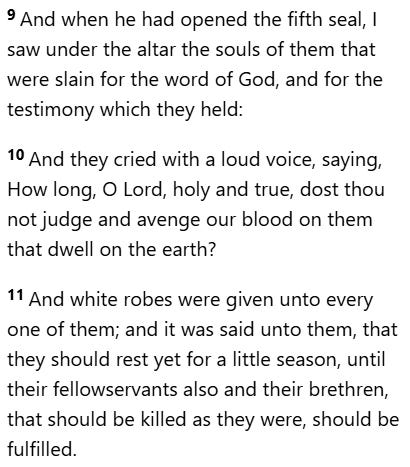
Souls under the altar (Revelation 6:9-11)
Revelation is a symbolic book. These souls are no more literally under an altar than Abel’s blood was literally crying out from the ground (Genesis 4:10). Both represent the cry for justice—the demand that God vindicate the righteous dead. It’s symbolic language. Building a doctrine of conscious death from an apocalyptic vision is like building a doctrine of talking animals from Balaam’s donkey.
“God of the living, not the dead” (Matthew 22:32)
Context is everything. Jesus is arguing with the Sadducees who denied the resurrection. His argument is FOR resurrection, not for conscious death. God calls Himself the God of Abraham, Isaac, and Jacob—because He WILL raise them. They are “living” in the sense that God has decreed their resurrection and His promise cannot fail. Romans 4:17 says God “calleth those things which be not as though they were.” They are as good as alive because their resurrection is certain.

The witch of Endor / Samuel (1 Samuel 28)
Was it really Samuel? God had already departed from Saul and refused to answer him (1 Sam 28:6). Would God then honour a forbidden necromantic ritual by sending the real Samuel? The “Samuel” that appeared told Saul “tomorrow thou and thy sons shall be with me”—but Saul died in rebellion against God. Saul would NOT be “with Samuel” in any righteous sense. This was a demonic impersonation. Exactly why God forbade these practices.
“Spirits in prison” (1 Peter 3:19)
The context (v.20) clarifies: the “spirits in prison” were “disobedient, when once the longsuffering of God waited in the days of Noah.” The Spirit of Christ preached through Noah to the antediluvian world—people imprisoned by sin. This is not Jesus touring hell between His death and resurrection. It’s about Noah’s contemporaries.
Pulled back from paradise? The resurrection problem
Here’s an argument that stops people in their tracks.
The Bible records at least 9 instances of individuals being raised from the dead before the final resurrection: 1 - the widow of Zarephath’s son (1 Kings 17), 2 - the Shunammite’s son (2 Kings 4), 3 - the man who touched Elisha’s bones (2 Kings 13), 4 - Jairus’ daughter (Matthew 9), 5 - the widow of Nain’s son (Luke 7), 6 - Lazarus (John 11), 7 - the saints raised at Christ’s resurrection (Matthew 27:52-53), 8 - Tabitha/Dorcas (Acts 9), 9 - and Eutychus (Acts 20).
Not a single one of them—NOT ONE—came back describing what heaven was like.
Think about Lazarus. He was dead four days. If the traditional view is correct, he was in paradise for four days in the conscious, blissful presence of God. And then Jesus called him back. To this world. This broken, sinful, disease-ridden world. To eventually die again.
If Lazarus had been in paradise, calling him back would be the cruelest thing Jesus ever did.
But nobody asked Lazarus what heaven was like. Nobody said “tell us about paradise!” Because everyone understood he’d been asleep. Martha’s own response confirms this. When Jesus said “thy brother shall rise again,” Martha replied: “I know that he shall rise again in the resurrection at the last day” (John 11:24). She didn’t say “I know he’s in heaven right now.” She said he’ll rise in the LAST DAY. Martha understood the doctrine of the resurrection better than most modern Christians.
And notice Jesus’ words: “Lazarus, come FORTH”—not “Lazarus, come DOWN.” He came out of the tomb, not down from heaven.
Moses is the special case. Jude 1:9 tells us Michael contended with the devil over Moses’ body. Moses was resurrected—a special, early resurrection by promise of Christ’s future resurrection. He represents the resurrected dead at Christ’s coming. Elijah, who was translated without seeing death, represents the living translated. That’s why both appear with Jesus on the Mount of Transfiguration—they typify the two groups who will meet Christ at the Second Coming.
But these are exceptions. Special resurrections given as types, as previews. They don’t prove the dead are normally conscious—they prove God has the power to resurrect.
The horror of the watching dead
Now consider what the traditional view actually implies if you follow it to its logical conclusion.
If the dead are conscious and can observe the living—as many Christians claim—then heaven is not bliss. It’s surveillance. And it’s horrifying.
Walter Veith, who came out of deep involvement in spiritualism before his conversion, puts it bluntly. He says he used to live with this constant notion that his mother—who died when he was twelve—was “up there in heaven, chewing her fingernails, watching what you do... seeing every sin that you are committing.” He calls it “silly and stupid and ridiculous and dangerous.”
And he’s right. Think about it:
A mother in heaven watches her children struggle through foster homes, poverty, abuse—powerless to help.
A parent watches their child slowly die of cancer.
A spouse watches their partner grieve, then remarry.
Your dead grandmother sees every private moment of your life. Every argument. Every failure. Every sin.
If that’s heaven, it’s indistinguishable from hell. How is that bliss? How is that “fullness of joy” and “pleasures forevermore” (Psalm 16:11)?
And here’s the kicker—as the Strange Normal host points out: if your dead brother is watching over you, he’s literally following you everywhere. To the bathroom. To your worst moments. Either he knows about your entire private life (which is a nightmare) or he only sees the good parts (in which case he’s being deceived by God about reality). Neither option works.
The biblical answer is so much better. The dead know NOTHING. They are asleep. They are unaware of earthly events. They are waiting—without any awareness of waiting—for the resurrection. God knows. God watches. God cares. But your loved ones are mercifully, peacefully unconscious. And their next moment of awareness will be the face of Jesus.
As Walter says: “When I discovered what the Scripture says, it was the greatest relief. Thank heaven that it’s like that.”
What is hell, really?
Today, hell is portrayed as a place of continuous punishment—a subterranean torture chamber where the wicked burn forever. But when you examine the original words and their usage, something very different emerges.
In the Old Testament
The first occurrence of this term is in “Deuteronomy 32:22 – “For a fire is kindled in mine anger, and shall burn unto the lowest hell, and shall consume the earth with her increase, and set on fire the foundations of the mountains.”
The verse with Hebrew reference:

The Hebrew word translated “hell” is Sheol. It appears 65 times. And here’s the problem for the traditional view: Sheol is where righteous Job expected to go. Where righteous David expected to go. Where animals go when they die. It’s where the dead have their bed, where the soul decays, where worms cover the dead.
Sheol is simply the grave. The resting place of all the dead. Not a torture chamber.

It then seems a more accurate translation would be lowest or deepest part of the pit or grave, OR maybe in the womb/middle of that state of where the dead are which is in death. Given the rational above, the dead is in that state where there is no return, or where they do not have the ability to praise, or where the wicked is sent for punishment which is complete death, the complete and final state.
In this case, it does not make sense to write: the lowest part of hell if hell is a place. Are there levels? Really?
The next occurrence is in 2 Samuel 22:6 – “The sorrows of hell compassed me about; the snares of death prevented me.” where it’s the same Hebrew word and the third in Job 11:8.
This pattern continues.
If we take Psalm 16:10 - “For thou wilt not leave my soul in hell; neither wilt thou suffer thine Holy One to see corruption.” and we compare it to what was used in the original Geneva Bible:

The word GRAVE.
In the New Testament
Three Greek words are translated as “hell”:
Hades — the Greek equivalent of Sheol. The grave. The place of the dead.
Gehenna — the Valley of Hinnom south of Jerusalem, where refuse and dead animals were burned. A fit symbol of final destruction—not ongoing torture. The fires of Gehenna consumed what was thrown in. They didn’t preserve it.
Tartarus — used once (2 Peter 2:4), referring to fallen angels in chains of darkness.
When the King James translators rendered all three words as “hell,” they created enormous confusion. Three different concepts collapsed into one misleading English word. If you study each occurrence in context, the “ever-burning hell” disappears entirely.
Matthew 5:22 – “But I say unto you, That whosoever is angry with his brother without a cause shall be in danger of the judgment: and whosoever shall say to his brother, Raca, shall be in danger of the council: but whosoever shall say, Thou fool, shall be in danger of hell fire.”
Here is what is meant with “fire”:

We know that the Bible noted in Revelation 20:14-15 (KJV): “And death and hell were cast into the lake of fire. This is the second death. And whosoever was not found written in the book of life was cast into the lake of fire.” where the wicked are finally done away with through the final fire.
Then the word “hell” or Gehenna:

Here it refers to the final state, which aligns with Revelation 20:15 where the final state through fire is complete death.
If you consider ChatGPT’s interpretation, it again refers to a state rather than a place. The final condition of the punished is in the realm of the dead, which is death itself and not a place of eternal continuous punishment but rather the outcome of final punishment which is complete termination of life.

Eternal fire that went out — the type/antitype proof
This is the argument that breaks the back of the eternal torment doctrine. And it comes straight from Scripture interpreting itself.
The types
Sodom and Gomorrah — Jude 1:7 says they are “set forth as an example, suffering the vengeance of eternal fire.” Eternal fire. But then 2 Peter 2:6 says God “turning the cities of Sodom and Gomorrha into ashes condemned them with an overthrow, making them an ensample unto those that after should live ungodly.”
So Sodom suffered “eternal fire” AND was “turned to ashes.” Go to the Dead Sea region today. Is there fire burning? No. There is nothing. Just desolation. The fire did its work and went out.
The consequences are eternal. The process is not.
Jerusalem — Jeremiah 17:27 prophesied: “I will kindle a fire in the gates thereof, and it shall devour the palaces of Jerusalem, and it shall not be quenched.” An unquenchable fire. But Jeremiah 52:12-13 records the fulfillment—Nebuchadnezzar’s forces burned the house of the Lord, the king’s house, and all the houses of Jerusalem. 2 Chronicles 36:19 confirms it: they burned the house of God, broke down the wall, burned all the palaces.
Is Jerusalem still burning? Obviously not. The “unquenchable fire” completed its work and went out. And notice the fascinating Sabbath connection: the fire came because they refused to hallow the Sabbath (Jer 17:27). In the antitype, the same issue—God’s authority through His Sabbath versus man’s counterfeit—will be the central issue at the end of time with the mark of the beast.
2 Chronicles 36:21 even says the land “enjoyed her sabbaths... she kept sabbath” for seventy years during desolation. A type of the millennium—the earth lying desolate for a thousand years, keeping its sabbath rest.
The antitype
Malachi 4:1-3 — “For, behold, the day cometh, that shall burn as an oven; and all the proud, yea, and all that do wickedly, shall be stubble: and the day that cometh shall burn them up, saith the LORD of hosts, that it shall leave them neither root nor branch... And ye shall tread down the wicked; for they shall be ashes under the soles of your feet.”
Stubble. Burned up. Neither root nor branch. Ashes. Not “eternally burning.” Not “forever screaming.” Ashes.
Obadiah 16 — “They shall be as though they had not been.” How much clearer can Scripture get? They will not exist. Period.
Psalm 37:10, 20 — “Yet a little while, and the wicked shall not be... the wicked shall perish... into smoke shall they consume away.”
Revelation 20:9 — “Fire came down from God out of heaven, and devoured them.” Devoured. Past tense. Complete action. Done.
Ezekiel 28:18-19 — Even Satan himself: “I will bring thee to ashes upon the earth... and never shalt thou be any more.”
What about Revelation 14:11?
“And the smoke of their torment ascendeth up for ever and ever: and they have no rest day nor night.”
This verse is the go-to for eternal torment advocates. But read it in context of everything above. The “forever” (aionios) we’ve already seen used 56 times in the Bible for things that have already ended. Jonah was in the whale “forever”—three days. A Hebrew slave serves his master “forever”—until death.
And the “no rest day nor night”? This refers to their life—they did not find rest in God’s completed work. They did not enter God’s Sabbath rest. They rejected the gospel. The smoke ascending forever represents the permanence of the result, not the duration of the process.
Isaiah 34:9-10 uses identical language about Edom: “The smoke thereof shall go up forever.” Edom is not burning today.
The Bible does not contradict itself. The plain statements—perish, destroy, ashes, consumed, devoured, shall not be—must govern our interpretation of the figurative ones. Not the other way around.


The timeline that breaks everything
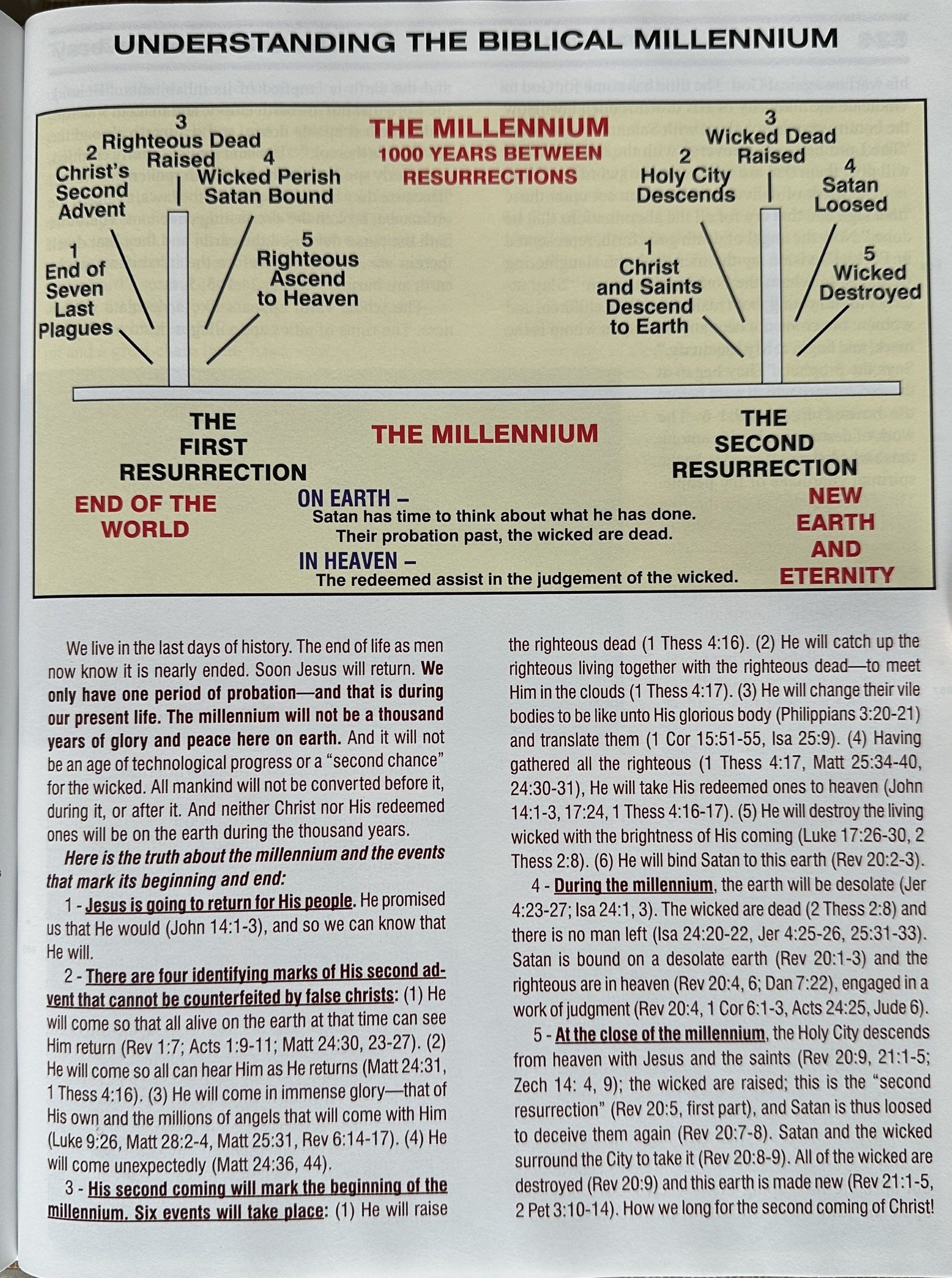
If you accept the traditional view—righteous go straight to heaven, wicked go straight to hell—the entire prophetic sequence of end-time events collapses into absurdity. Watch what happens:
The Second Coming: Jesus returns. The dead in Christ rise first (1 Thess 4:16). But wait—they’re already in heaven? So what’s being raised? Empty graves for no reason? And the living righteous are “caught up together with them in the clouds to meet the Lord in the air.” But the dead are already WITH the Lord. Why would they need to meet Him in the air if they’ve been with Him for centuries?
The Judgement: Christ brings His reward with Him (Rev 22:12). But the reward has already been distributed? The investigative judgment (Daniel 7:22, 8:14) that determines who is saved—it’s already been pre-empted by everyone going directly to their destination at death?
The Millennium: The righteous spend 1,000 years in heaven judging—verifying God’s judgments (1 Cor 6:2-3, Rev 20:4). They examine the books. They understand why certain people are not there. But if the verdicts were already executed at death, what’s left to verify?
The Third Coming: After the millennium, Christ returns to earth. The New Jerusalem descends (Rev 21:2). The wicked dead are resurrected (Rev 20:5). But they’ve been burning in hell for millennia already. So they’re pulled OUT of hell, resurrected, judged AGAIN at the Great White Throne (Rev 20:12), and THEN thrown back into the lake of fire (Rev 20:14-15)?
Double jeopardy. Pulled from torment, given a trial, sentenced to the same torment. What kind of justice is that?
The timeline only makes sense if the dead are asleep. Then: the investigative judgment examines the books, Christ comes, the righteous dead are resurrected, the righteous living are translated, both groups go to heaven, they spend 1,000 years verifying, Christ returns to earth, the wicked are resurrected for the final judgment, they acknowledge God’s justice, fire destroys them, and God creates a new heaven and new earth.
Clean. Logical. Biblical. No contradictions.
When the Quran sides with Rome
The Quran’s description of hell is virtually identical to the medieval Catholic view—and both contradict Scripture.
Sura 2:81 — “Indeed those who earn sins and become surrounded by their evil work will be dwellers of hell; they abide in it forever.”
Sura 4:56 — “Indeed those who disbelieve in our verses, we will drive them into a fire. Every time their skins are roasted through, we will replace them with other skins so they may taste the punishment.”
God gives you new skin every day so you can feel the same pain again? What kind of deity does that?
Sura 18:29 — “For the wrongdoers we have prepared a fire whose smoke and flames, like the walls and roof of a tent, will hem them in. If they implore relief, they will be granted water like melted brass that will scald their faces.”
Sura 14:49-50 — “And they will see the sinners that day bound together in fetters, their garments liquid pitch and their faces covered with fire.”
Now compare this with the Catechism of the Catholic Church, Article 1035: “The teachings of the church affirm the existence of hell and its eternity. Immediately after death the souls of those who die in a state of mortal sin descend into hell, where they suffer the punishments of hell, eternal fire.”
And compare both with Cyril of Jerusalem: the sinner receives “an eternal body fitted to endure the penalties of sin, that he may burn eternally in fire, nor ever be consumed.”
The Quran and Rome teach the same thing. New skin to feel more pain. Eternal bodies designed for maximum suffering. A god who delights in torture. Neither position comes from the Bible. Both come from the same source—the pagan doctrine of the immortal soul, filtered through different traditions but arriving at the same horrifying destination.
The God who weeps
Let’s come back to God’s character. Because this is ultimately what’s at stake.
Ezekiel 33:11 — “As I live, saith the Lord GOD, I have no pleasure in the death of the wicked; but that the wicked turn from his way and live: turn ye, turn ye from your evil ways; for why will ye die?”
Ezekiel 18:32 — “I have no pleasure in the death of him that dieth.”
Isaiah 55:7 — “Let the wicked forsake his way, and the unrighteous man his thoughts: and let him return unto the LORD, and he will have mercy upon him; and to our God, for he will abundantly pardon.”
2 Peter 3:9 — “The Lord is... not willing that any should perish, but that all should come to repentance.”
John 11:35 — “Jesus wept.” At the tomb of Lazarus. The Son of God wept over death. Does this sound like a God who would maintain an eternal torture facility?
And here’s a point that Scott Ritsema makes that should shake every believer: if the wages of sin is eternal conscious torment, then Jesus didn’t pay the full price for our sins. He died and was raised after three days. He didn’t burn for eternity. If eternal torment is the real penalty, Jesus didn’t actually take our punishment—which means the Gospel is incomplete. But the wages of sin is DEATH—not eternal torment. And Jesus died that death. Fully. Completely. And rose again, offering us the gift of eternal life.
Romans 6:23 isn’t complicated: “The wages of sin is death; but the gift of God is eternal life through Jesus Christ our Lord.”
Two options. Death or life. Not three options. Not death, life, or eternal conscious torment. Two.
John 3:16 says it the same way: “That whosoever believeth in him should not perish, but have everlasting life.” Perish or live. Those are the choices. The Bible never offers a third door called “suffer forever.”

The 2. Familiar spirits — don’t talk to the dead
The second purpose of this post is equally critical: no “familiar spirits” communicate with the living. The dead cannot talk to you. Period.
If the dead know nothing (Ecclesiastes 9:5), if their thoughts have perished (Psalm 146:4), if they do not return to their house (Job 7:10), then who is it that appears at séances, in hauntings, and in “visits” from dead loved ones?
The Bible is explicit: these are demonic entities impersonating the dead.
God forbade these practices in the strongest possible terms:
Deuteronomy 18:10-12 — Consulting mediums and necromancers is an “abomination unto the LORD.”
Isaiah 8:19-20 — “When they shall say unto you, Seek unto them that have familiar spirits, and unto wizards that peep, and that mutter: should not a people seek unto their God? for the living to the dead? To the law and to the testimony: if they speak not according to this word, it is because there is no light in them.”
2 Kings 23:24 — King Josiah removed the workers with familiar spirits and wizards from the land.
Scott Ritsema shares a remarkable observation: a recent Gallup poll found that nearly one in three Americans believes they’ve already been in contact with someone who has died. One in three. The deception is already deeply embedded.
And it will intensify. Revelation 16:14 speaks of “spirits of devils, working miracles” that go out to deceive the world. 2 Corinthians 11:14 warns that Satan himself “is transformed into an angel of light.” If he can appear as an angel of light, can he impersonate your dead grandmother? Your dead child? The Virgin Mary?
Walter Veith, who participated in séances before his conversion, describes how he spoke to entities through a Ouija board, trying to contact his dead mother. The glass went berserk, spelled out “go to hell,” and flew off the table. He was speaking to demons. He says this will be Satan’s trump card at the end of time—appearing as dead loved ones to deceive billions who don’t know that the dead are asleep.
Near-death experiences are part of this same deception. Science has identified the angular gyrus—a portion of the brain that can misfire under extreme stress, producing sensations of floating, out-of-body awareness, and tunnel-vision experiences. This isn’t to dismiss everyone’s experience as imagination. But supernatural doesn’t mean divine. Satan can produce very real experiences. The test is always: does it align with Scripture?
What is the true hope?
The hope of the Christian is not disembodied existence on a cloud. It’s not “going to a better place” as a ghost. The hope is resurrection.
1 Thessalonians 4:16-18 — “For the Lord himself shall descend from heaven with a shout, with the voice of the archangel, and with the trump of God: and the dead in Christ shall rise first: Then we which are alive and remain shall be caught up together with them in the clouds, to meet the Lord in the air: and so shall we ever be with the Lord. Wherefore comfort one another with these words.”
That’s the comfort Paul offers. Not “she’s in a better place.” The RESURRECTION. The dead rising. Immortality given. Bodies restored—not as ghosts, but as physical, glorified, incorruptible beings. Every ailment gone. Every pain erased. Every sorrow finished. Meeting Christ in the air. Together forever.
John 14:1-3 — “Let not your heart be troubled... In my Father’s house are many mansions... I go to prepare a place for you. And if I go and prepare a place for you, I will come again, and receive you unto myself; that where I am, there ye may be also.”
When does He receive you? When He comes again. Not at death. At His coming.
2 Timothy 4:7-8 — “I have fought a good fight, I have finished my course, I have kept the faith: Henceforth there is laid up for me a crown of righteousness, which the Lord, the righteous judge, shall give me at that day: and not to me only, but unto all them also that love his appearing.”
At THAT DAY. The day of His appearing. Not the day of Paul’s death. The crown is future. The reward is future. The glory is future. And it is certain—because God’s promises cannot fail.
What the Spirit of Prophecy says
For those familiar with Ellen White’s writings, her statements on this topic are some of the clearest and most direct in all her works. She doesn’t hedge. She doesn’t equivocate. She traces the lie to its source and shows exactly where it leads.
On the origin of the deception:
“The declaration of the serpent to Eve in Eden—’Ye shall not surely die’—was the first sermon ever preached upon the immortality of the soul. Yet this declaration, resting solely upon the authority of Satan, is echoed from the pulpits of Christendom and is received by the majority of mankind as readily as it was received by our first parents.” — The Great Controversy, p. 531
Think about the weight of that statement. The first sermon on the immortality of the soul was preached by Satan. And it’s been echoed from pulpits ever since.
On how the deception progressed:
“Satan told his angels to make a special effort to spread the deception and lie first repeated to Eve in Eden, ‘Thou shalt not surely die.’ And as the error was received by the people, and they believed that man was immortal, Satan led them still further to believe that the sinner would live in eternal misery. Then the way was prepared for Satan to work through his representatives, and hold up God before the people as a revengeful tyrant; that those who do not please him, he will plunge into hell, and cause them ever to feel his wrath.” — Early Writings, p. 218
Notice the sequence. Step one: convince people the soul is immortal. Step two: introduce eternal torment. Step three: make God look like a tyrant. Each error builds on the previous one. Remove step one and the whole structure collapses.
“It was a marvel to me that Satan could succeed so well in making men believe that the words of God, ‘The soul that sinneth it shall die,’ mean that the soul that sinneth it shall not die, but live eternally in misery.” — Early Writings, p. 218
That’s the whole deception in one sentence. God says “die.” Satan says “not die.” And most of Christianity sides with Satan’s reading.
On the damage this doctrine does to the Bible and the Gospel:
“The doctrine of man’s consciousness in death, especially the belief that spirits of the dead return to minister to the living, has prepared the way for modern spiritualism.” — The Great Controversy, p. 551
“The doctrine of natural immortality, first borrowed from the pagan philosophy, and in the darkness of the great apostasy incorporated into the Christian faith, has supplanted the truth, so plainly taught in Scripture, that ‘the dead know not anything.’” — The Great Controversy, p. 551
And the powerful logical argument from Man’s Nature and Destiny that demolishes the traditional view using Paul’s own reasoning:
“If the souls of the dead live right on, are they perished? What! Perished? And yet living in a larger sphere? Perished? And yet enjoying the attendant blessings of everlasting life in heaven? Perished? And yet at God’s right hand where there is fullness of joy, and pleasures forevermore?” — Man’s Nature and Destiny, p. 211
This is referencing 1 Corinthians 15:18 where Paul says that without the resurrection, “they also which are fallen asleep in Christ ARE PERISHED.” If the dead are already in heaven, how can Paul say they’ve perished? The word “perished” becomes meaningless if souls are consciously alive in glory. But if the dead are sleeping and the resurrection is the ONLY hope—then Paul’s statement makes perfect sense. Without a resurrection, the dead have nothing. They are, as Paul says, perished.
On the two great errors that form the endgame:
“Through the two great errors, the immortality of the soul and Sunday sacredness, Satan will bring the people under his deceptions. While the former lays the foundation of spiritualism, the latter creates a bond of sympathy with Rome. The Protestants of the United States will be foremost in stretching their hands across the gulf to grasp the hand of spiritualism; they will reach over the abyss to clasp hands with the Roman power.” — The Great Controversy, p. 588
Two pillars. The immortal soul lays the foundation for spiritualism—communication with the dead, apparitions, near-death experiences, alien contact (as we explored in Religious 28). Sunday sacredness creates the bond with Rome. Together, these two errors form the bridge that unites apostate Protestantism, Roman Catholicism, and spiritualism into the three-fold union of Revelation 16.
On the deception that is coming:
“The saints must get a thorough understanding of present truth, which they will be obliged to maintain from the Scriptures. They must understand the state of the dead, for the spirits of devils will yet appear to them, professing to be beloved friends and relatives, who will declare to them that the Sabbath has been changed, also other unscriptural doctrines.” — Early Writings, p. 87
Read that carefully. The spirits won’t just appear as dead loved ones for emotional manipulation. They will teach doctrine. Specifically, they’ll declare that the Sabbath has been changed. The state of the dead and the Sabbath are connected in the end-time deception—exactly as the Great Controversy quote above states.
“Many will be confronted by the spirits of devils personating beloved relatives or friends and declaring the most dangerous heresies. These visitants will appeal to our tenderest sympathies and will work miracles to sustain their pretensions.” — The Great Controversy, p. 560
“The forms of the dead will appear, through the cunning device of Satan, and many will link up with the one who loveth and maketh a lie.” — Last Day Events
And on the only safeguard:
“So closely will the counterfeit resemble the true that it will be impossible to distinguish between them except by the Holy Scriptures. By their testimony every statement and every miracle must be tested.” — The Great Controversy, p. 593
The ONLY protection is Scripture. Not feelings. Not experiences. Not what you saw or what appeared to you. The Bible. That’s why understanding the state of the dead isn’t optional theology—it’s survival equipment for the last days.
On God’s character and the true hope:
“Death cannot convey us to the presence of God; but the resurrection shall show us the path of life, and ‘so shall we ever be with the Lord.’” — Departing and Being with Christ
“Without a resurrection from the dead, there is no future life.” — Man’s Nature and Destiny
“He bore the sins of the world, and endured the penalty, which rolled like a mountain upon His divine soul. He yielded up His life a sacrifice, that man should not eternally die. He died, not through being compelled to die, but by His own free will.” — SDA Bible Commentary, vol. 5, p. 1127
Christ died a REAL death so that we might have REAL life. Not a transition. Not a relocation. Death—and then resurrection. That’s the Gospel. And the immortal soul doctrine guts it.
whydoneit?
Because these two false doctrines—the immortality of the soul and eternal torment—are designed to deceive the nations. That’s it. That’s the purpose.
If we don’t really die, there’s no real consequence to sin. If there’s no real death, Christ didn’t really die for us—or if He did, He didn’t pay the full price. If the soul is inherently immortal, God lied in Genesis and the serpent told the truth. If the wicked burn forever, God is worse than every human dictator combined. If the dead can communicate, Satan has a direct line into every grieving heart on earth.
Pull out the lie of the immortal soul and the entire edifice of deception crumbles. Eternal torment disappears. Purgatory disappears. Indulgences disappear. Communication with the dead disappears. Marian apparitions lose their power. Near-death experiences lose their authority. The alien deception loses its foundation. The three-fold union of Revelation 16—spiritualism, Catholicism, and apostate Protestantism—loses the glue that holds it together.
That’s why they fought so hard to preserve it. That’s why they burned John Frith. That’s why Pope Leo X issued a papal bull. That’s why Calvin wrote his very first book attacking it. Because if people discover that the dead are dead—really, truly, biblically dead—then the whole system of control through fear and deception falls apart.
And that’s exactly what we want. Because the truth about death reveals the truth about God. He’s not a torturer. He’s not a tyrant. He’s a Father who weeps at the grave of His friend, who promises to come again, who prepares mansions for His children, and who will one day wipe every tear from every eye.
The dead are asleep. The resurrection is coming. And Christ is faithful.
“Comfort one another with these words.” — 1 Thessalonians 4:18
Recommended viewing
These video studies go deeper into the arguments presented above:
What’s Up Prof Episode 97 — History’s Coming Climax: The Return of Jesus Christ (Luther/Tyndale quotes, state of the dead, séance testimony)
What’s Up Prof Episode 98 — Battle of Armageddon & Gog and Magog (Quran parallels, type/antitype fire, Catholic quotes, millennium sequence)