

Eph 5:11:"…have no fellowship with the unfruitful works of darkness, but rather reprove them.”.
Amos 3:7 “…God will do nothing, but he revealeth his secret unto his servants the prophets.”
Why this post?
To show how the 7 churches are the final phases in time.
Introduction
It took me two decades to obtain, process and organise the information written about across these posts. One of the major revelations was to learn that the 7 churches that John was ordered to write to in Revelation 1 to 3, was also a typology.
Those 7 churches were both physical but also 7 time periods.
This interpretation is not widely accepted but several have written about it and below I shall provide the evidence as best I can.
Location
The churches were scattered on the western side of Turkey:
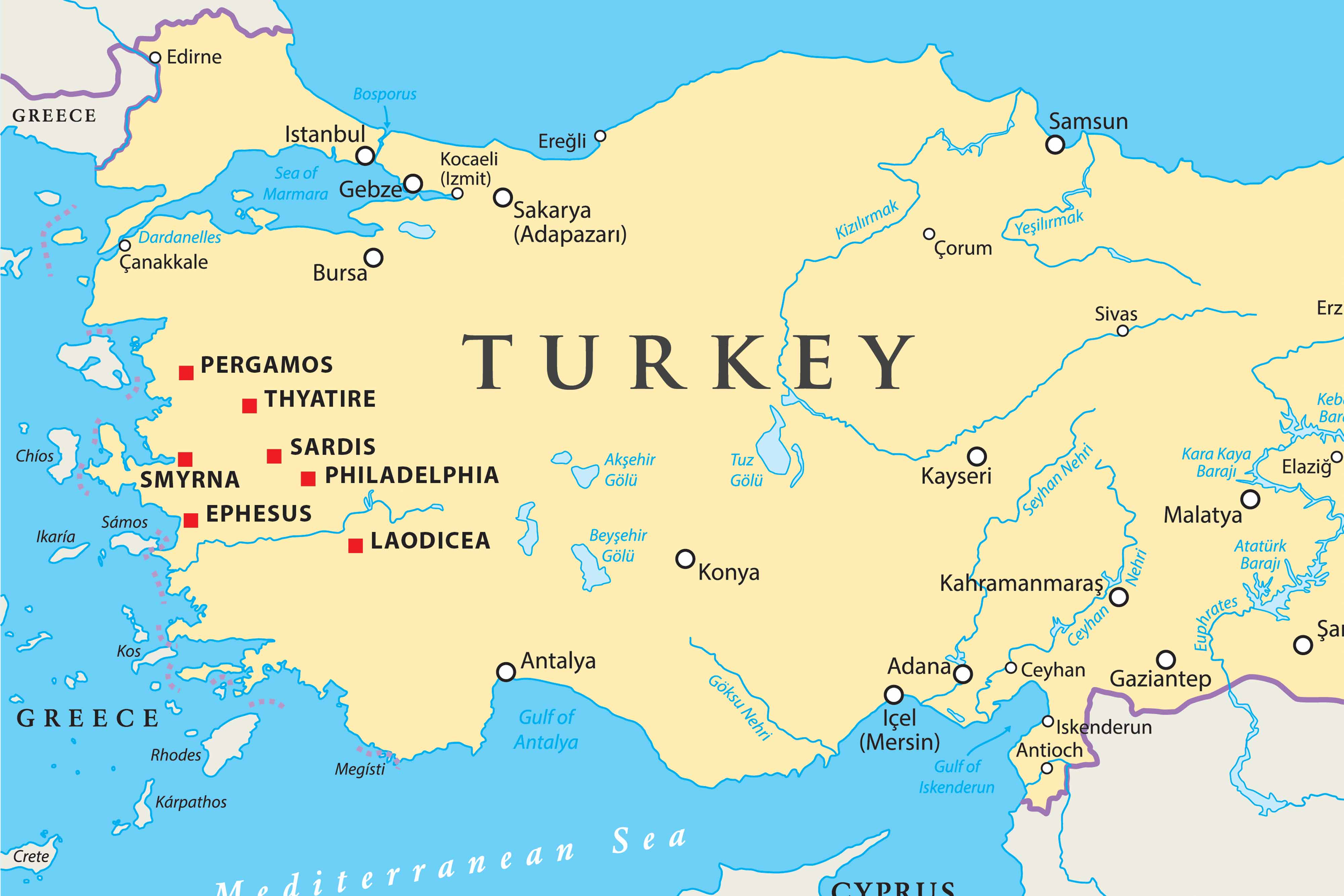
The map shows seven cities clustered along the western coast and inland river valleys of Asia Minor — modern western Turkey. Note the route. Ephesus on the coast, then north along the postal road to Smyrna and Pergamos, east to Thyatira, south through Sardis to Philadelphia, and finally Laodicea. That order — Ephesus, Smyrna, Pergamos, Thyatira, Sardis, Philadelphia, Laodicea — is the exact sequence of the ancient Roman postal route through Asia Minor. A courier carrying the letters would deliver them in this order, in this geography. Revelation 1-3 names them in the same order.
The sequence is not arbitrary. It traces the courier’s path. And the same sequence, read across centuries instead of cities, traces the path of the Christian church through history.
Characteristics
The seven periods can be summarised up as follows:
The Apostolic Church ≈ 30 - 300 A.D.
The Martyr Church ≈ 100 - 313 A.D.
The Compromising Church ≈ 314 - 590 A.D.
The Roman Catholic Church ≈ 590 - 1517 A.D.
The Reformation Church ≈ 1517-1700
The Revival Church ≈ 1700 -1900
The Worldly Church ≈ 1900 - Rapture
Herewith, tabular representation of the characteristics of these churches:
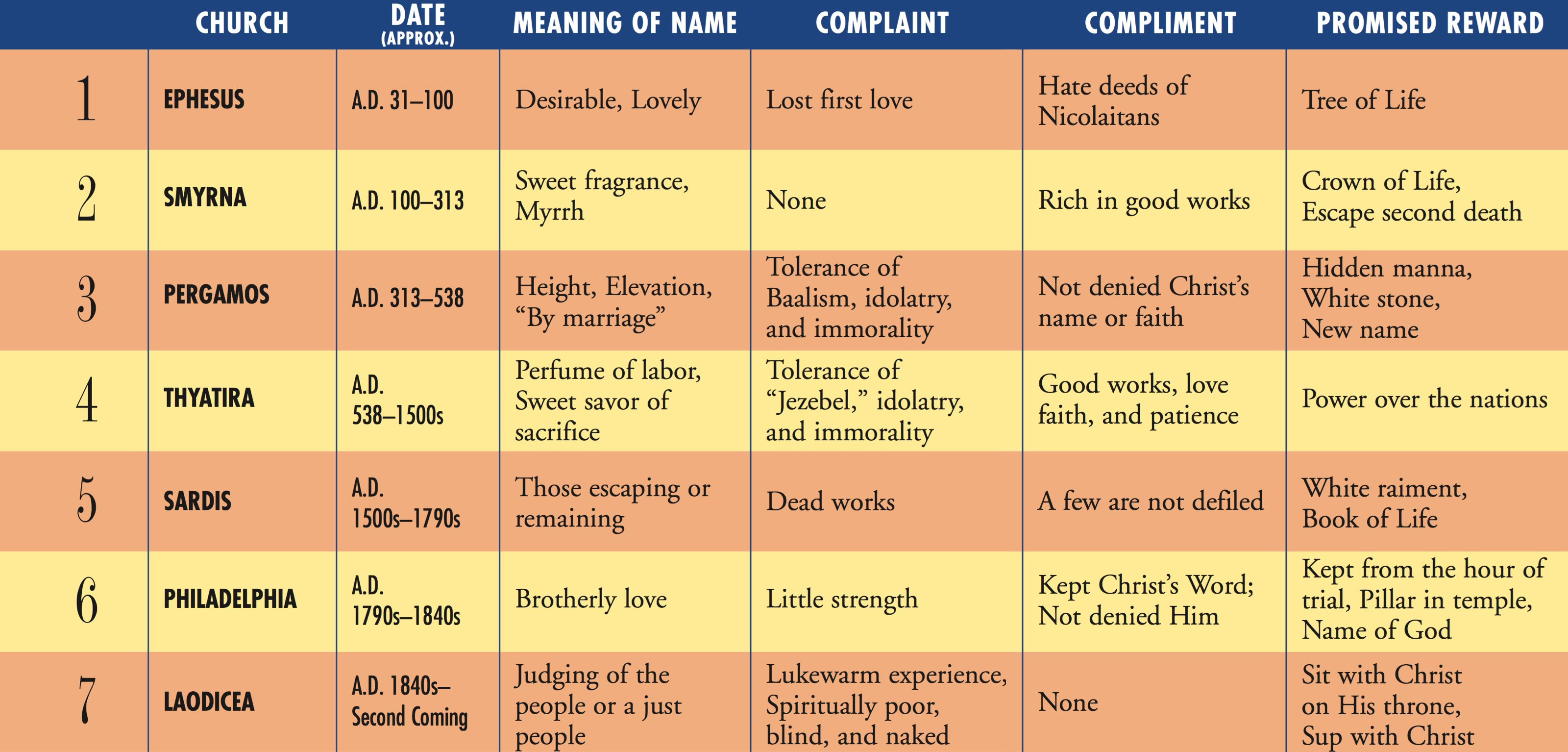
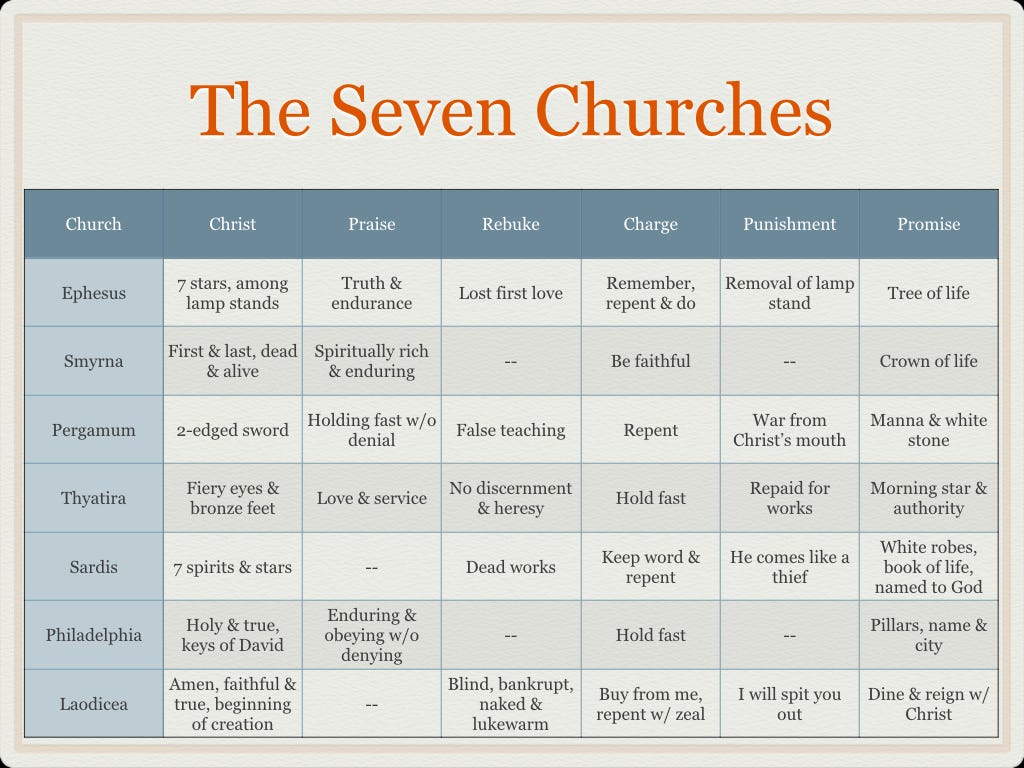
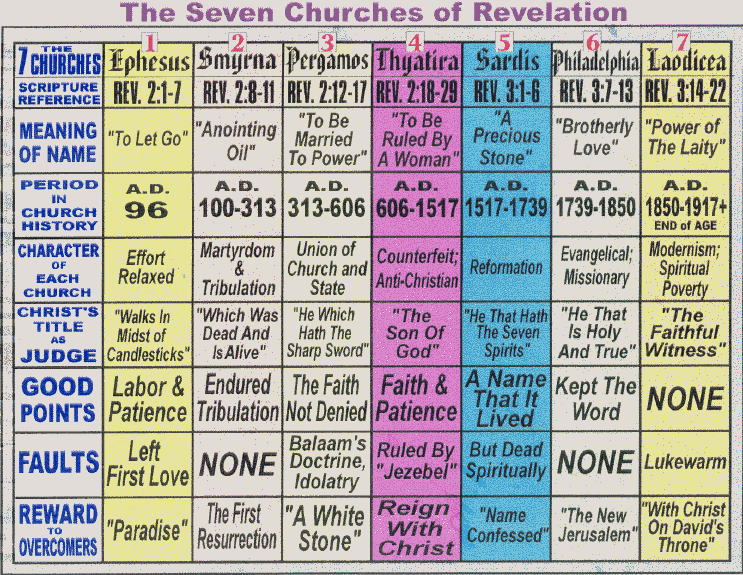
Era 1 — Ephesus (Apostolic Church, A.D. 31-100)
Ephesus means desirable. Christ’s first letter (Rev 2:1-7) describes Himself as the one who holds the seven stars and walks among the seven golden candlesticks — gathered authority over the early-church communities. The era’s commendation: truth and endurance, especially the church’s discernment in hating the deeds of the Nicolaitans (verse 6). The era’s rebuke: “thou hast left thy first love” (verse 4). The era’s charge: remember from whence thou art fallen, and repent. The era’s reward: the tree of life.
The geographical city deepens the spiritual reading. Ephesus was the seat of Diana — Diana of the Ephesians, the mother of the gods — with her temple built around 480 BC. (Acts 19 records Paul’s near-riot in this very city when the silversmiths felt their Diana-statue trade threatened.) And in AD 431, the Council of Ephesus, held in this same city, gave Mary the title Theotokos — Mother of God. The city of the mother of the gods gave the Christian church the Mother of God. Same city. Two titles. Eight centuries apart. Make of that geographical coincidence what you will.
The Nicolaitans are commonly identified as a Gnostic sect that taught the law of God did not bind the flesh. But the name has a second resonance worth noticing. Nicolas in Greek transliterates to a name that became, by linguistic descent, Saint Nicholas — the figure who in modern Western culture rides a sky-chariot, distributes gifts on the very night Christians ostensibly celebrate Christ’s birth, and quietly displaces Him in the imagination of every child who learns to ask Father Christmas instead of Christ. The early church hated the deeds of the Nicolaitans. The modern church largely doesn’t notice them.
Era 2 — Smyrna (Martyr Church, A.D. 100-313)
Smyrna means myrrh — the spice burned in sacrifice and used to anoint the dead. Fitting for the era of martyrdom. Christ’s letter (Rev 2:8-11) describes Himself as the first and the last, which was dead, and is alive — resurrection authority spoken to a church about to die. The era has no rebuke. None. Only commendation: “I know thy works, and tribulation, and poverty, (but thou art rich)” (verse 9). The era’s charge: be thou faithful unto death. The era’s reward: a crown of life and escape from the second death.
The letter promises “ye shall have tribulation ten days” (verse 10). Apply the day-year principle (the same principle the post on prophetic timelines uses for Daniel’s 1260 and 2300). Ten prophetic days = ten literal years. The Diocletian persecution — the most systematic Roman attempt to extinguish Christianity — ran from AD 303 to AD 313. Exactly ten years. The first Smyrnaean martyr was Polycarp, disciple of John, burned alive around AD 155. The era ended when Constantine’s Edict of Milan (AD 313) gave Christianity legal status and the official persecution stopped. Of all seven eras, Smyrna and Philadelphia are the only two with no rebuke. When the church suffers under fire, no fault is found.
Era 3 — Pergamos (Compromising Church, A.D. 313-538)
Pergamos means elevation — the lifting up of self over God. Christ’s letter (Rev 2:12-17) describes Himself as he which hath the sharp two-edged sword — the Word that cuts in judgment. The era’s commendation: thou holdest fast my name, and hast not denied my faith. The era’s rebuke: tolerance of Balaamism (compromise — getting God’s people to mix with paganism, the Numbers 22-25 type) and the doctrine of the Nicolaitans (which the Ephesian church hated, Pergamos now holds). The era’s charge: repent. The era’s punishment if not: I will fight against them with the sword of my mouth. The era’s reward: hidden manna, a white stone, a new name.
The geographical city explains the era’s compromise. Pergamos in the second century BC was the institutional seat of the Babylonian priesthood. When Babylon fell to Medo-Persia, the Babylonian priest-class was driven out; they relocated, with their relics and offices, to Pergamos. The priests held the Palladium Stone. They wore the vestments of Dagon — fish robes and fish miters with open mouths at the front. They bore the title Pontifex Maximus — “the bridge between heaven and earth.” They carried two keys, the key of heaven and the key of hell. They were called the pontiff kings of Pergamum. The last of them was Attalus III, who, when Rome moved to absorb the kingdom by force, bequeathed the title to the Roman Emperor in 133 BC. The Caesars from Augustus forward bore the letters PM. The Roman Emperor was, in his own self-titling, the bridge between heaven and earth.
Then in AD 378, the Christian Emperor Gratian refused the title — the first Roman Emperor to do so — and the Pontifex Maximus office stood vacant. Until the Bishop of Rome, Damasus I, claimed it. From that point, the Bishop of Rome — the Pope — has carried the letters PM behind his name. He has carried the two keys, now called the keys of Peter. He has worn the same vestments — the miter representing Dagon, the fish-mouth at the front. He has claimed the same office: the bridge between heaven and earth. The institutional priesthood that started in Babylon, relocated to Pergamos, transferred to Rome, and re-emerged in the Christian church has never gone anywhere. It just changed the lettering on the door.
This is what “Satan’s seat” in Revelation 2:13 — said to Pergamos — refers to. Not a metaphor. A specific geographical and institutional address.
The era’s compromise was completed by Constantine. He minted a medallion with Christ on one side and his pagan deities on the other — explicit syncretism. He commissioned his court priest Eusebius to produce fifty copies of the Bible for distribution across the empire — but produced in such a way that Jesus Christ would read as less than what He was, so that He could stand alongside Zoroaster, Zeus, and Apollo without obvious contradiction. (See the post on which Bible for the textual-transmission detail.) Both moves — the medallion and the rewritten Bibles — fit Pergamos’s doctrine of Balaam: get God’s people to compromise. The compromise was institutional, textual, and liturgical. By 538 — when Justinian’s decree formally appointed the Bishop of Rome the corrector of heretics — the compromise was law.
Era 4 — Thyatira (Roman Catholic Church / Counterfeit, A.D. 538-1517)
Thyatira’s name has multiple readings: perfume of labor, sweet savor of sacrifice — and, in some traditions, Satan’s teachings. The transposed image-table reads it more sharply: to be ruled by a woman. Christ’s letter (Rev 2:18-29) describes Himself with eyes like unto a flame of fire, and his feet like fine brass — the judging Christ. The era’s commendation: charity, service, faith, patience, and works. The era’s rebuke: thou sufferest that woman Jezebel, which calleth herself a prophetess, to teach and to seduce my servants to commit fornication, and to eat things sacrificed unto idols (verse 20). The era’s charge: hold fast till I come. The era’s reward: power over the nations, the morning star.
The geographical city had a temple of Apollo (sun-god) and an altar to a female deity — male sun-god and female deity worshipped side by side. The Church of the Middle Ages had exactly the same dual structure: a male deity and a deified female. Jezebel — the Phoenician princess who married Ahab and led Israel into the worship of Baal alongside Asherah — is the Old Testament type. Israel’s apostasy under Ahab ran with priests of Baal and priests of Asherah, side by side. Thyatira’s apostasy ran the same way: priests of Christ and priests of Mary, side by side. Same shape, two epochs.
Thyatira was also famous for its purple-and-crimson textile dyes, made from madder root. Purple is the colour of royalty. Crimson is the colour of sacrifice. The Church of the Middle Ages adopted exactly those colours for its vestments — the cardinal’s red, the bishop’s purple — and assumed the positions of royalty and sacrifice that should accrue only to Christ. The geography of the era’s named city anticipated its institutional appropriation by a millennium and a half.
H. Sierra Houser, a Roman Catholic theologian, summarises Thyatira-as-Roman-Church plainly: “It is the Church of the Middle Ages.” (Outside-witness from inside Catholicism.) The pagan deities Belus, Zeus, and Osiris were worshipped with round wafers symbolising their bodies. The Catholic Eucharist’s round wafer is in the same iconographic family. None of this is a coincidence; all of it is documented.
Era 5 — Sardis (Reformation Church, A.D. 1517-1798)
Sardis means that which remains, the renewal — and in some readings, Reformation itself. Christ’s letter (Rev 3:1-6) describes Himself as he that hath the seven Spirits of God, and the seven stars — the source of fresh life to a dying body. The era has no commendation in Christ’s preamble — the only era of the seven where Christ moves straight to rebuke. The rebuke: “thou hast a name that thou livest, and art dead” (verse 1). “I have not found thy works perfect before God.” The era’s charge: be watchful, strengthen the things which remain, that are ready to die. The era’s reward: white raiment, a name kept in the book of life.
The Reformation breathed new life into Christ’s doctrine — Tyndale, Wycliffe, Hus, Luther, Calvin, Knox. Sola scriptura. Sola fide. Sola gratia. The five Reformer principles. But the work was not completed.
At the Council of Trent (1545-1563), Rome made a tactical move that the Reformers had no clean answer to. Rome turned the sola scriptura principle back on the Reformers and asked: “You say Bible alone — so why do you keep Sunday? The Bible says the seventh day. We taught Sunday. You inherited Sunday from us. So either drop Sunday and keep your principle, or keep Sunday and admit you follow tradition. Pick one.” The Reformers had inherited the Sunday-for-Sabbath swap from Roman tradition without re-examining it. Trent called them on it. The principle of sola scriptura, applied consistently, would have required ending Sunday-keeping. The Reformers kept Sunday. The principle therefore had a leak. “I have not found thy works perfect before God” names exactly that.
And the leak got bigger across the next three centuries. Lutherans, then Calvinists, then Baptists, then Methodists — each new movement noticed something the previous one had stopped short of, and each new movement stopped short of going all the way themselves. Sardis is the fragmentation era as well as the renewal era. The work was real. The work was incomplete. “Strengthen the things which remain, that are ready to die” (verse 2) is the era’s charge in the era’s own voice.
The geographical city is fitting. Sardis was impregnable by reputation — and was taken twice without resistance, once by Cyrus and once by Antiochus the Great. A church with a name that it lived and was dead, in a city that thought itself impregnable and was not. The geography matches the spiritual condition.
Era 6 — Philadelphia (Revival / Missionary Church, A.D. 1798-1844)
Philadelphia means brotherly love — the city was named for King Attalus II’s love for his brother Eumenes. Christ’s letter (Rev 3:7-13) describes Himself as he that is holy, he that is true, he that hath the key of David, he that openeth, and no man shutteth; and shutteth, and no man openeth. The era has no rebuke — like Smyrna, only commendation. “Thou hast a little strength, and hast kept my word, and hast not denied my name” (verse 8). The era’s charge: hold fast that which thou hast. The era’s reward: a pillar in the temple of God, the name of God, the name of the New Jerusalem.
Philadelphia was the era of world mission. The 1260 years of Daniel ended in 1798 (see the post on prophetic timelines), and almost immediately the Word of God broke out worldwide. William Carey to India in 1793. Robert Morrison to China in 1807. Robert Moffat to Africa in 1817. The British and Foreign Bible Society in 1804. The American Bible Society in 1816. The Word, suppressed for the dark ages, rose. And the era closed at 1844 — the cleansing of the heavenly sanctuary, the Daniel 8:14 terminus. In 1611 the KJV saw the light.
The Christ-attribute is striking. He that hath the key of David, he that openeth and no man shutteth. Philadelphia’s era is when the door to the Most Holy Place opened — the next-stage shift in Christ’s heavenly ministry the post on the judgment unpacks. The chapter’s geographical city was an open gateway through the mountains. And the chapter’s prophetic city is the era when the gateway in heaven opened.
Era 7 — Laodicea (Worldly Church, A.D. 1844 to Christ’s return)
Laodicea has two readings: judging of the people and, in the transposed image-table, power of the laity. Christ’s letter (Rev 3:14-22) describes Himself as the Amen, the faithful and true witness, the beginning of the creation of God — eternal authority over the lukewarm. The era has no commendation. None. The only era of the seven without a single word of praise from Christ. The rebuke: “thou art neither cold nor hot” (verse 16). “I will spue thee out of my mouth.” The era’s charge: buy of me gold tried in the fire, that thou mayest be rich; and white raiment, that thou mayest be clothed; and anoint thine eyes with eyesalve, that thou mayest see (verse 18). The era’s reward: to him that overcometh will I grant to sit with me in my throne (verse 21).
The geographical city’s archaeology gives the lukewarm metaphor a literal grounding. Laodicea had no hot springs of its own; the nearest were six miles away at Hierapolis. The city’s engineers built insulated aqueducts to pipe the water in — but the engineering wasn’t quite good enough. By the time the water arrived in Laodicea, it was lukewarm. Drinking lukewarm water induces nausea. Hot water is medicinal. Cold water is refreshing. Lukewarm water makes you throw up. The Rev 3:16 “I will spue thee out” is a literal description of what your body would do if you drank Laodicea’s tap water.
The city was wealthy — destroyed by an earthquake in AD 60 and rebuilt with its own funds, refusing imperial subsidy. “Rich, and increased with goods, and have need of nothing” (verse 17). It was famous for a local eye-salve called kerion — “anoint thine eyes with eyesalve, that thou mayest see” (verse 18) is a direct local-product allusion. It had a textile industry making fine black wool — “I counsel thee to buy of me… white raiment, that thou mayest be clothed” (verse 18) is the antithesis. The Christ of the Laodicean letter is selling the buyer the opposite of what Laodicea’s own merchants stocked.
The era is now. We are in it. The seventh church. The lukewarm one. The rich one. The one with no commendation. The one with the local eye-salve and the local black wool that Christ is offering an opposite to. “As many as I love, I rebuke and chasten: be zealous therefore, and repent. Behold, I stand at the door, and knock” (verses 19-20). If you are looking for a perfect end-time church, you will not find one. You have to look for one that knows it is wretched, and miserable, and poor, and blind, and naked. That is the only kind of church the seventh era can produce.
Christ’s self-description across the seven letters (place near the third era table)
Notice the pattern. Christ describes Himself differently to each church, and the description fits the era. To the early church (Ephesus), the one who holds the seven stars and walks among the candlesticks — gathered authority, present everywhere. To the persecuted church (Smyrna), the first and the last, which was dead and is alive — resurrection power for those about to die for Him. To the compromising church (Pergamos), the sharp two-edged sword — the Word that judges the false teaching the era is tolerating. To the medieval church (Thyatira), eyes like a flame of fire, feet like fine brass — the judging Christ stripped of the soft imagery the era preferred. To the Reformation church (Sardis), he that hath the seven Spirits of God and the seven stars — the source of fresh life to a body that has a name to live but is dying. To the missionary church (Philadelphia), he that is holy, he that is true, he that hath the key of David — open-door authority, the one who can shut what no man can open. To Laodicea, the Amen, the faithful and true witness, the beginning of the creation of God — eternal authority over a church that thinks itself adequate.
The era determines which face of Christ is visible. The lukewarm get the unanswerable witness. The persecuted get the resurrection. The compromising get the sword. The reader of Revelation 2-3 is being told: the Christ you most need is the Christ your era was given.
Analysis
Please take your time to consume the characteristics. Here’s a few specific points worthy of mention:
Given the time period, it is appropriate to have the first church compared to light since that’s the source of the modern church being the light to the world;
NO faults are mentioned for the second and sixth churches, which, in history, does reflect the urgency and accuracy with which the Word was spread. And hence no punishment;
Given the previous posts, it seems accurate to note the character of the 4 church to be counterfeit given that Papal Rome ruled;
The 7th church has no praise; and
If these are periods, the reward of the last seems remarkably accurate.
Evidence from Daniel and Revelation
Herewith a few general data points from Daniel and Revelation:
Both Daniel and Revelation employ symbolic language and imagery to convey prophetic messages. Interpreting the seven churches as representative of historical periods is consistent with this style of prophetic communication.
The Bible often reveals God's plan progressively, with earlier events or symbols foreshadowing or representing later realities. In this view, the seven churches could be seen as a prophetic outline of the progress of church history.
Some scholars see parallels between the seven churches and other prophetic passages, such as the seven seals, trumpets, and bowls in Revelation. This could suggest a broader prophetic significance to the churches.
Many of the commendations, rebukes, and challenges given to the seven churches can be seen as relevant to different stages of church history, as the church has faced various trials, temptations, and opportunities throughout the centuries.
Revelation is meant to provide symbolic and prophetic information to His Church across the earth and given that it expounds all the events that are to play out, it makes sense that it would be aimed at all and not only to those local Churches.
Daniel and Revelation is littered with typology and an ocean of evidence that the words are prophetic, why would the start of Revelation be any different? Why would a prophetic book spend three chapters on literal churches only?
Evidence from the Revelation 1 to 3
Herewith my arguments from the content:
In biblical symbolism, the number seven often represents completeness or perfection and could imply a complete message for the entire church throughout history post Christ.
In each letter, Christ is described using different titles that relate to His attributes and roles and could be seen as relevant to the needs and challenges of the church in different eras.
The repetition of the phrase "He who has an ear, let him hear what the Spirit says to the churches": This refrain at the end of each letter suggests that the messages have a universal and timeless relevance for all churches, not just those specifically addressed.
Each letter concludes with a promise to those who overcome, which could be interpreted as having both immediate and future implications for believers throughout history.
Rev 3:17 notes that “Because thou sayest, I am rich, and increased with goods, and have need of nothing“, mirrors our current age. Since so few lack physical needs, faith is cast aside. Character only develops under dire circumstances.
Rev 3:20 state that “To him that overcometh will I grant to sit with me in my throne“ and from the other chapters in Daniel and Revelation, the final events will be those where Michael stand up (Dan 12:1).
Rev 1:13 notes “midst of the seven candlesticks” and then in verse 20 “The seven stars are the angels of the seven churches: and the seven candlesticks which thou sawest are the seven churches” so we know that these seven Churches is that light from when He left until He returns. In my mind this point is a mic drop…
whydoneit?
He said it in both Amos and Isaiah that He would always send his prophets and, in this case, He specifically tells us where in time we are and what it is we need to watch out for and what His promise is.