Update 30 July 2025 at the bottom.
Eph 5:11:"…have no fellowship with the unfruitful works of darkness, but rather reprove them.”.
Amos 3:7 “…God will do nothing, but he revealeth his secret unto his servants the prophets.”
Why this post?
To show the remarkable integrity of chiastic writing.
Introduction
Before I continue unpacking the symbolism in Revelation I wanted to point out a specific literary style named “Chiasm”. I’ll explain it briefly, then provide a few examples and then elaborate those in Revelation.
What is it?
I got this straight from Claude 3:
Biblical chiasms, also known as chiastic structures or chiastic patterns, are a literary device found in ancient Hebrew literature, particularly in the Bible. The term "chiasm" comes from the Greek letter "chi" (χ), which is shaped like an "X" and represents the inverted parallel structure of this literary technique.
A chiasm is a rhetorical or literary pattern in which words, phrases, or concepts are arranged in a concentric, symmetrical manner, with the second part of the pattern mirroring the first part in reverse order.
The core of the message is in the middle.
Only in the Bible?
Straight from Claude 3:
No, chiasms are not found exclusively in the Bible. While they are prevalent in ancient Hebrew literature, including the Old and New Testaments, chiastic structures have been identified in various other literary works and across different cultures and languages.
Here are some examples of chiasms found outside of the Bible:
Ancient Greek and Latin Literature: Chiasms were used by ancient Greek and Latin writers, such as Homer, Herodotus, Cicero, and Virgil. For instance, in Homer's Iliad, there is a famous chiastic line: "The very same, their voice, their air" (αὐτῶν γὰρ σφετέρην φρένα τέρπει).
Ancient Indian Literature: Chiastic patterns can be found in ancient Indian texts, such as the Vedas and the Upanishads. For example, in the Brihadaranyaka Upanishad, there is a chiastic structure: "You are woman, you are man; you are the youth, you are the maiden; you are the old man tottering along on a staff."
Ancient Chinese Literature: Chiasms have been identified in ancient Chinese literature, such as the Analects of Confucius and the Daodejing. For instance, in the Analects, there is a chiastic saying: "The Master's Way is simply this: Loyalty and Reciprocity" (夫子之道, 忠恕而已矣).
Native American Literature: Chiastic patterns can be found in the oral traditions and literary works of various Native American tribes, including the Navajo, Hopi, and Zuni.
Modern Literature: Chiasms have been used by modern writers as well, including Shakespeare, Milton, and Dickens. For example, in Shakespeare's King Lear, there is a chiastic line: "Fair day, today, too, fair for our sport."
While chiasms are particularly prominent and significant in the Bible, this literary device has been employed across various cultures and time periods, indicating its widespread use and appreciation as a rhetorical and artistic technique.
It’s about the centre
The message is structured so that the most important message is located at the centre. The part leading up to it is a setup of the problem or how things were, the part that follows is the aftermath or solution to the initial problem.
JFK
I thought this one was interesting where JFK wrote about what man can do for country and Mark about man and the Sabbath:


Examples from the Old Testament
In Eden
The Eden chiasm is more layered than most — six steps in, six steps out — and it deserves a pause to ponder. The whole of Genesis 3, from the serpent’s promise that “ye shall be as gods” to God’s “Behold, the man is become as one of us”, mirrors itself across a single pivot.
And the pivot — the dead centre of the Fall narrative — is the serpent accused, then the serpent’s curse. Not the eating. Not Adam’s curse. Not Eve’s. The deceiver. We tend to read Genesis 3 as the story of how we fell. The structure tells you it is also the story of who pushed us. That distinction matters everywhere downstream.

The flood
Bernhard Anderson did the work on this one back in 1978, and it deserves a pause to ponder. The whole flood narrative — Genesis 6:9 through 9:29 — is constructed as a chiasm. Twelve elements going in, twelve back out, every step mirrored on the way back.
Now look at the centre: “And God remembered Noah” — Genesis 8:1. That is NOT the moral we get taught. We get taught the flood is about judgement. About wickedness. About the destruction, the dove, the rainbow at the end. But the literary structure — written by someone who knew exactly what they were doing — points squarely at one verse at the dead centre of the whole story. And God remembered Noah. That is what the flood narrative is actually about. Not the wrath. The remembrance.

And Babel
Genesis 11 — the Tower of Babel. Seven steps in, seven steps out. Look at the structure carefully and you will see the entire story bends around one verse at its centre.
The centre is not the languages. It is not the tower. It is not the scattering. It is “But the LORD came down to see the city and the tower” — Genesis 11:5. That is the load-bearing claim of Babel. God descended to see, before He acted. The story we tell is about human pride. The structure tells you it is also about divine descent — God coming down before judgement falls. Read it again with that pivot in mind.

Sinai and the Tabernacle
Exodus 24 sets up two parallel chiasms — one on Mount Sinai, one in the Tabernacle — and they mirror each other beat for beat. Cloud covers the mountain. Cloud covers the Tabernacle. Glory of God on the mountain. Glory of God fills the Tabernacle. Moses goes up. Moses goes in.
And both chiasms share the same centre: God called to Moses / the Tent of Meeting. The pivot of the Sinai narrative AND the pivot of the Tabernacle narrative is the meeting between God and man. Same centre, two settings. The earthly sanctuary mirrors the moment on the mountain — and both mirror something larger still in heaven itself. That is not coincidence. That is design.

Or Proverbs
Even Proverbs runs chiastic. The famous “six things which the LORD hates, yes, seven which are an abomination” looks like a list. It is not a list. It is a chiasm — three pairs wrapped around a single load-bearing claim.
The centre is “A heart that devises wicked plans.” Not the haughty eyes. Not the lying tongue. Not the hands that shed innocent blood. Not the feet that run to evil. The heart. Solomon, writing around 1000 BC, structured the verse so the heart sits at the dead centre — because the actions on either side flow from it. It is the same point Jesus made a thousand years later in Matthew 15:19. “For out of the heart proceed evil thoughts…” The structure was already there in Proverbs.

Examples from the New Testament
From John
John 13:36 through to John 14:5. Read it as one passage, not two chapters. The chapter break does not match the literary unit — chapters were added more than a thousand years after the fact.
The chiasm runs from “where are you going?” in 13:36 to “where are you going?” in 14:5, pivoting on a single verse at the dead centre: “Ye believe in God, believe also in me” (14:1). Peter’s denial sits on one side. Jesus preparing a place on the other. But at the very centre, Jesus calling for faith. We get told John 14:1-3 is a passage about heaven. The chiasm tells you it is a passage about belief. Heaven is the consequence. Faith is the centre.

John 4. The woman at the well. Two verses — 23 and 24 — and they form a tight little chiasm wrapped around one revelation.
The pivot is “God is a Spirit” (24a). Not the worshippers. Not the Father seeking. Not the spirit and truth. The nature of God. That is the centre of the whole exchange. We tend to read this passage as Jesus correcting how to worship. The structure tells you it is about who is being worshipped. The how flows from the who. Always does.

From Matthew
“No man can serve two masters.” Matthew 6:24. Six lines, three pairs, mirrored on the way back — and unusually, the centre here is a doubled pivot, not a single verse. C and C’ both: “love the other” and “he will be devoted to one.”
What the structure makes clear is what most pulpits skip: this verse is not primarily about money. It is about devotion. Whatever sits at the centre of a chiasm is what the passage is actually about. And in this one, C is love. C-prime is devotion. Not hatred for one. Not service to wealth. Devotion to one. The closing line — “Ye cannot serve God and mammon” — is the application. The structure tells you the principle came first.

Paul to the Ephesians
Paul to the Ephesians. Eight nested layers — one of the deepest chiasms in the New Testament — and every step on the way down to the centre mirrors a step on the way back out.
The centre is one phrase: “by abolishing in His flesh the enmity” (Eph 2:15a). The cross. That is the pivot of the entire reconciliation passage. We get told Ephesians 2 is about being saved by grace. About being brought near. About the wall of partition coming down. All true. But the literary architecture points to one specific moment — the cross itself, abolishing enmity in His flesh. Everything in the passage flows out from that single beat. The structure refuses to let you forget it.

Back to Daniel
Please consider this work of art:
Now Daniel. Frank B. Holbrook laid this out back in 1986 — and it deserves a pause to ponder, because what he showed is not one chiasm but TWO. The book of Daniel runs as two parallel chiasms, back to back, bracketed by two destructions of the temple. Babylonian destruction at the start (Chapter 1). Roman destruction at the end (Chapter 11:36 to 12:13). The whole story unfolds between two temples being torn down.
The first chiasm is Daniel 2 to 7 — the Chaldean half, written in Aramaic. It pivots on the humiliation of Nebuchadnezzar in Chapter 4 and the overthrow of Belshazzar in Chapter 5. God’s sovereignty over the kings of the earth. That is what the historical half of Daniel is structurally about. Not the lions. Not the furnace. The kings — humbled by Heaven.
The second chiasm is Daniel 8 to 12 — the Hebrew half. And this is where it gets remarkable. The pivot of the prophetic half of Daniel is Daniel 9:26: “And after threescore and two weeks shall Messiah be cut off, but not for himself.”
The 70 weeks prophecy that pinpoints the exact week of the Messiah’s death sits at the literary dead centre of the entire prophetic half of the book. I unpack the math in the post on prophetic timelines — but the architecture was already telling you what mattered, long before any of us tried to do it. The cross. At the centre. Of the prophetic half. Of the book of Daniel.

On to Revelation
What then is the core message of Revelation?
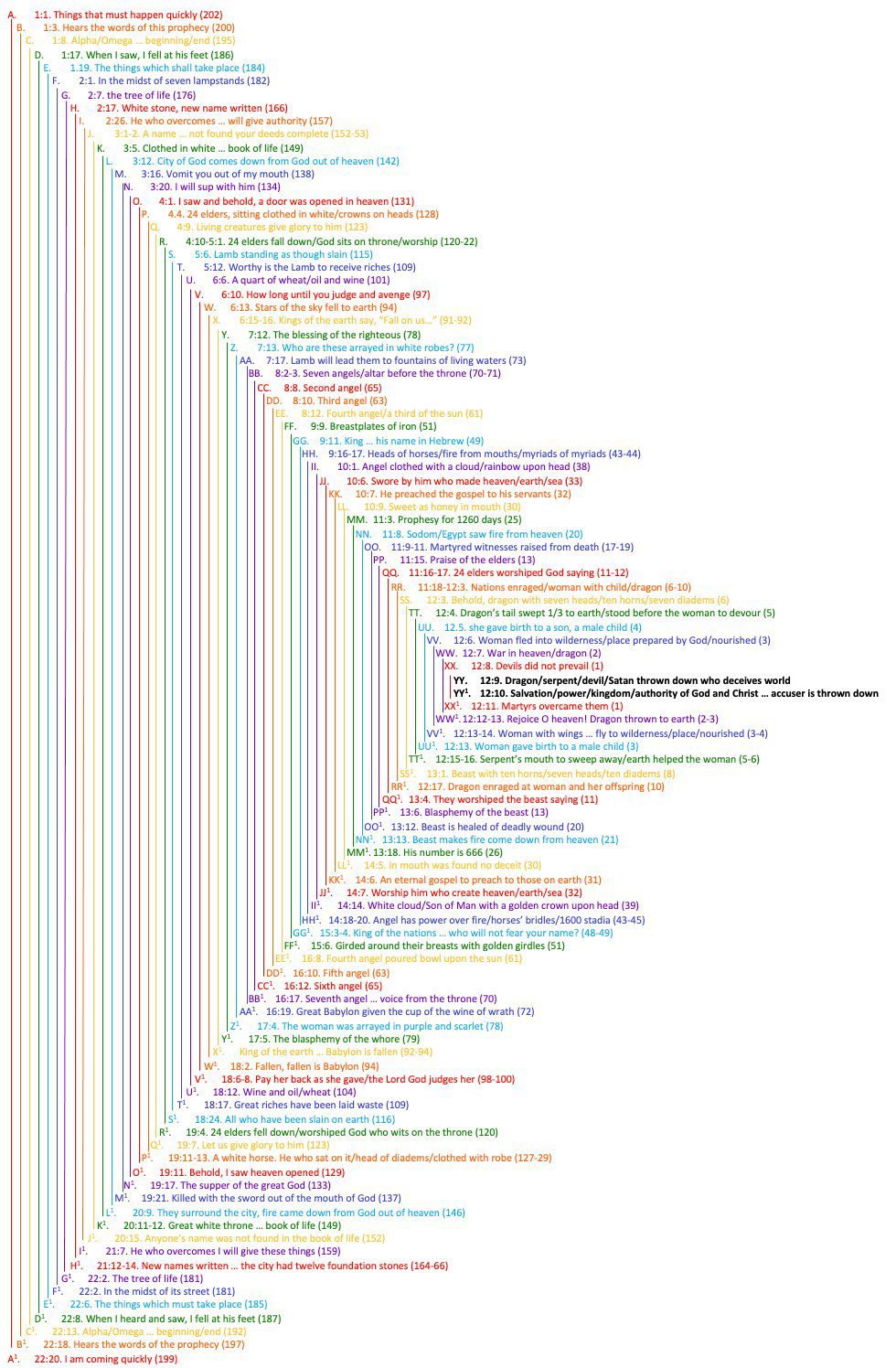
Now Revelation. The most chiastic book in the Bible, hands down — and the one that pays off the principle most heavily. Several scholars and groups have laid out the structure across the years; what follows is a cluster of variants of the same finding, each refining the case from a slightly different angle. Pause and look at each one. They converge on the same answer.
What is the core message of Revelation? The structure tells you. The pivot — the dead centre of the entire book — is Revelation 12. The Woman. The Dragon. War in heaven. Satan cast out. That is what Revelation is structurally about. Not the new earth at the end. Not the seals or the trumpets or the bowls in their sequence. The cosmic conflict in the middle. Everything else in the book flows out from there.
The chiasm in pyramid form. Centre at the top: The Final Crisis (Rev 11:19–14:20). Note that the Final Crisis sits in the middle of the book — not at the end.

The same chiasm laid across all 22 chapters. The centre is labelled A: Revelation 12, the Woman and the Dragon. The two halves are explicitly named — historical on the left, eschatological on the right. The fold-point is Revelation 12.

The same diagram with chapter-level notes — the seven churches as seven eras (see the post on the seven churches), the close of probation, the third woe, the historic dark age and the future dark age. Same centre. More detail.

Another rendering, two-column form. Satan's attacks on the left. God's victory over Satan and his forces on the right. Pairs walked across the chiasm — same structure, different visualisation.

The most detailed rendering yet. Every section paired with its mirror, point by point. 7 Churches mirror New Jerusalem. 7 Seals mirror Fall of Babylon. 7 Trumpets mirror the 7 Last Plagues. The Great Controversy (Rev 11:19–14:20) sits at the historical-to-eschatological pivot. Worth a slow read.

The outer frame of the whole chiasm. The seven promises to the seven churches in Revelation 1–3 are mapped one-for-one onto their fulfilments in the New Jerusalem of Revelation 21–22. Tree of life promised to the overcomers (2:7) → tree of life in the new city (22:2). Open door (3:8) → gates never closed (21:25). New Jerusalem comes down (3:12) → New Jerusalem comes down (21:2,10). Seven promises, seven matching fulfilments. That is not coincidence. That is design.

The outermost frame. The Prologue (Rev 1:1-10) mapped against the Epilogue (Rev 22:5-21). Seven point-for-point parallels, including "the time is near" in 1:3 and 22:10, and "I am coming quickly" echoed across both ends. The book closes the way it opens.

The same chiasm in clean outline form, with verse references at every layer. The centre is named explicitly: "Satan cast out (12:12)." That is the literary pivot of the entire book of Revelation. Read the verse for yourself: "Therefore rejoice, ye heavens, and ye that dwell in them. Woe to the inhabiters of the earth and of the sea! for the devil is come down unto you, having great wrath, because he knoweth that he hath but a short time." The whole book points there.

whydoneit?
Why write this way?
This literary structure points to the core of the message AND, as a side benefit, we can have comfort in the accuracy of the translation.
One book. Multiple renderings. One pivot. Whatever else Revelation is doing, it is structured to point you at Revelation 12 — the moment the dragon is cast out and the war in heaven plays out on earth. The cosmic conflict is not a sub-plot of the book. It is the centre of the book. Read it again with that pivot in mind.
UPDATES
30 July 2025 - Here is an excellent example for the entire book of Revelation:
The same chiasm at maximum resolution — every verse cluster paired with its mirror across Revelation 12. It is dense, but every paired element is verse-referenced. The structure refuses to be denied.